Health — Field report TQL-HEA-659
Booking a Course of Skin Treatments? Five Checks First, and What the First Visit Tells You
How to judge a private aesthetic practitioner before you commit to a package, and the signals a first appointment gives you about the next six months.
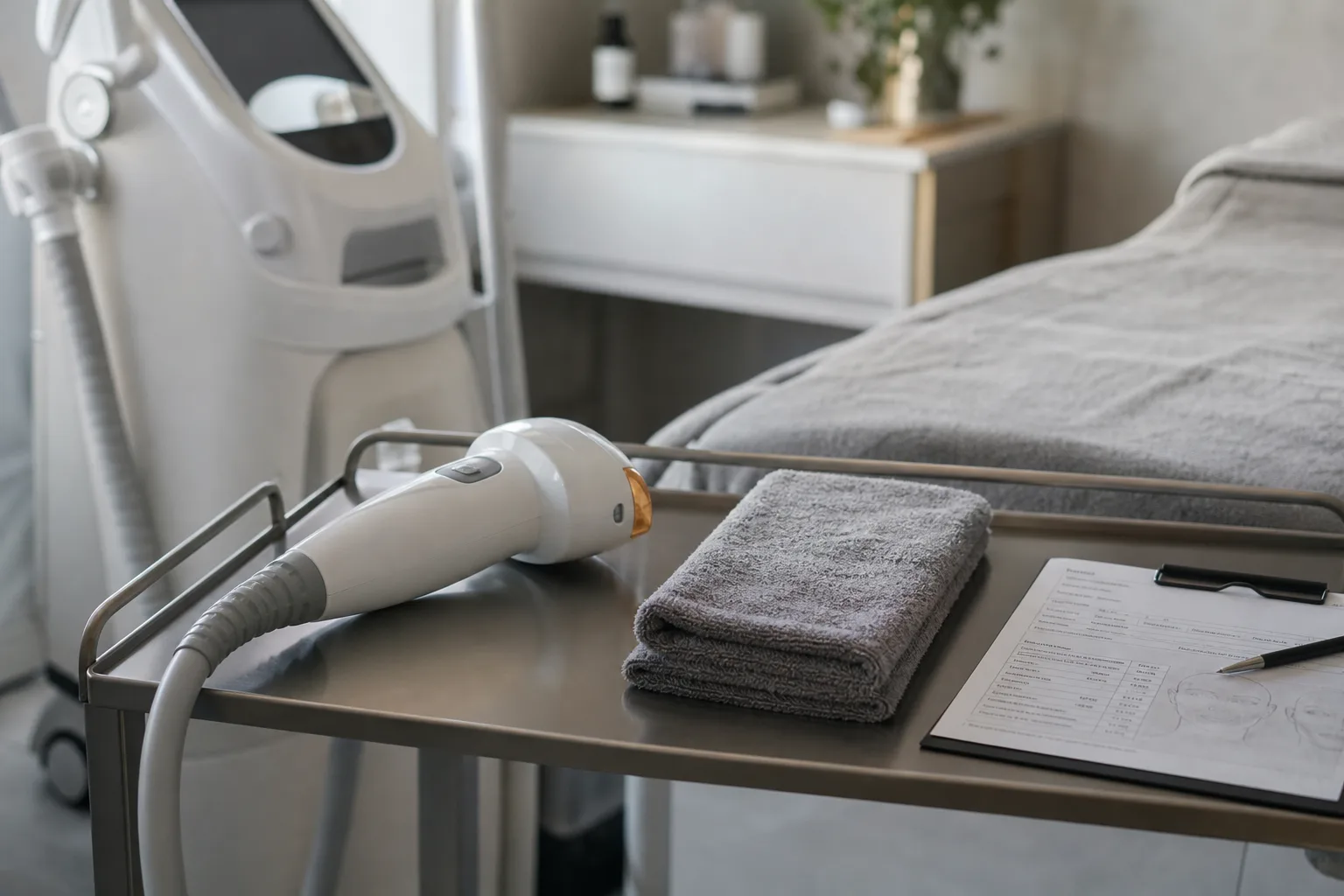
The decision that costs you money isn't the first appointment. It's the package. Somewhere around the end of a consultation, a treatment plan appears: six sessions, spaced two to three weeks apart, discounted if you pay up front. That one signature commits you to roughly four months of showing up at a specific place, handing your face to a specific pair of hands, and rearranging Thursday afternoons around it. Most people evaluate the clinic as though they're buying a single service. They're actually buying a schedule.
So the useful question isn't whether the first visit goes well. Almost all of them go well. The question is what the first visit tells you about visits three, four and five, when the novelty is gone and the clinic is running at normal speed.
1. Who is actually holding the device, and under whose license
Private aesthetic practices are staffed in layers. There may be a supervising physician whose name is on the door, a nurse practitioner or physician assistant, and licensed estheticians who perform the bulk of the hands-on work. All of that can be entirely legitimate. What varies is how much of it the clinic will tell you plainly.
Ask who will perform each session in your plan, by role, not by name. Then ask whether that person changes if your usual provider is out. The answer matters more than it sounds: a device-based protocol delivered by three different hands over four months produces three different results unless the clinic has standardized settings and documentation. Practices that take this seriously answer immediately, because they've been asked before and they've built around it.
State rules on who may operate which device and what level of supervision is required differ considerably. A clinic that can describe its own state's framework without hedging is telling you something about how it handles everything else.
2. What the equipment is, and what it's cleared to do
Energy-based skin devices are regulated as medical devices, and the Food and Drug Administration is responsible for clearing them and for the claims manufacturers may attach to them. That gives you a concrete thing to ask about rather than a vague impression of technology.
Get the make and model in writing. Then look it up yourself before you commit. If a practice uses an ultrasound facial machine as part of a multi-step protocol, you should be able to find the manufacturer's own description of what that step does and where it sits in the sequence, and compare it against what you were told in the room. Agreement between the two is reassuring. Divergence is information you got cheaply.
A second, quieter question: how old is the unit, and who services it? Devices that are used daily need maintenance. A practice with a service contract and a log will say so without defensiveness.
3. The appointment length that's actually scheduled
Here's where the week-to-week reality surfaces. Ask how long each session in your plan is blocked for on the calendar, and compare it to how long your consultation took. If the consult ran fifty unhurried minutes and sessions three through six are blocked at twenty-five, you now know the economics of the place. That's not automatically bad. Some protocols genuinely are short. But the gap is worth naming out loud, because it predicts how much room there will be to raise something on a Tuesday when your skin reacts differently than it did last time.
The follow-on question is rebooking. If you need to move a session, what's the realistic wait? A practice running three weeks deep on its schedule will stretch a six-session plan from four months to six, and the spacing of the sessions is usually part of why the plan works at all.
4. What they wrote down, and what they'll give you
After the first visit, you should walk out with a record: your skin assessment, the device settings used, the products applied, the plan and its spacing, and anything you were told to avoid. Ask for it. Not because you'll study it, but because the request reveals whether the record exists in a form a human can read.
This matters two steps later. If you change practices, move cities, or need a dermatologist to understand what's been done to your face, a legible chart is the whole difference between continuity and starting over. It also protects you if a reaction occurs and you need to establish what was used and at what intensity. Clinics that document properly tend to produce the file within a day or two, often by portal.
5. The money, before the discount is applied
Get the per-session price separately from the package price. Then ask three things: what happens to unused sessions if you stop, whether the package expires, and whether a refund is prorated at the package rate or the higher single-session rate. That last one catches people. Stopping after three of six sessions sometimes means being rebilled for three sessions at full price, which can leave almost nothing to refund.
Also ask what isn't in the package. Take-home products, numbing, add-on steps and touch-ups frequently sit outside the quoted figure. A clinic that volunteers the full picture at this stage is the kind that won't surprise you at session four.
Pay attention to how you felt being asked to decide. A plan you were given time to think about, with the per-session math visible, is a plan you can still evaluate honestly in six weeks.
Run these five before you commit and the first visit stops being an experience you react to and becomes a test you're administering. You'll know who holds the device, what the device is, how much time you'll actually get, what gets written down, and exactly what you owe. That's a reasonable basis for handing over four months of Thursdays.