House & Home — Field report TQL-HOM-082
Gutters, Chimney, Roof Edge. The Person on the Ladder Decides What You Ask
Fall and winter upkeep moves the work off the ground and near combustion, which changes who carries the risk and what you should gather before the first phone call.
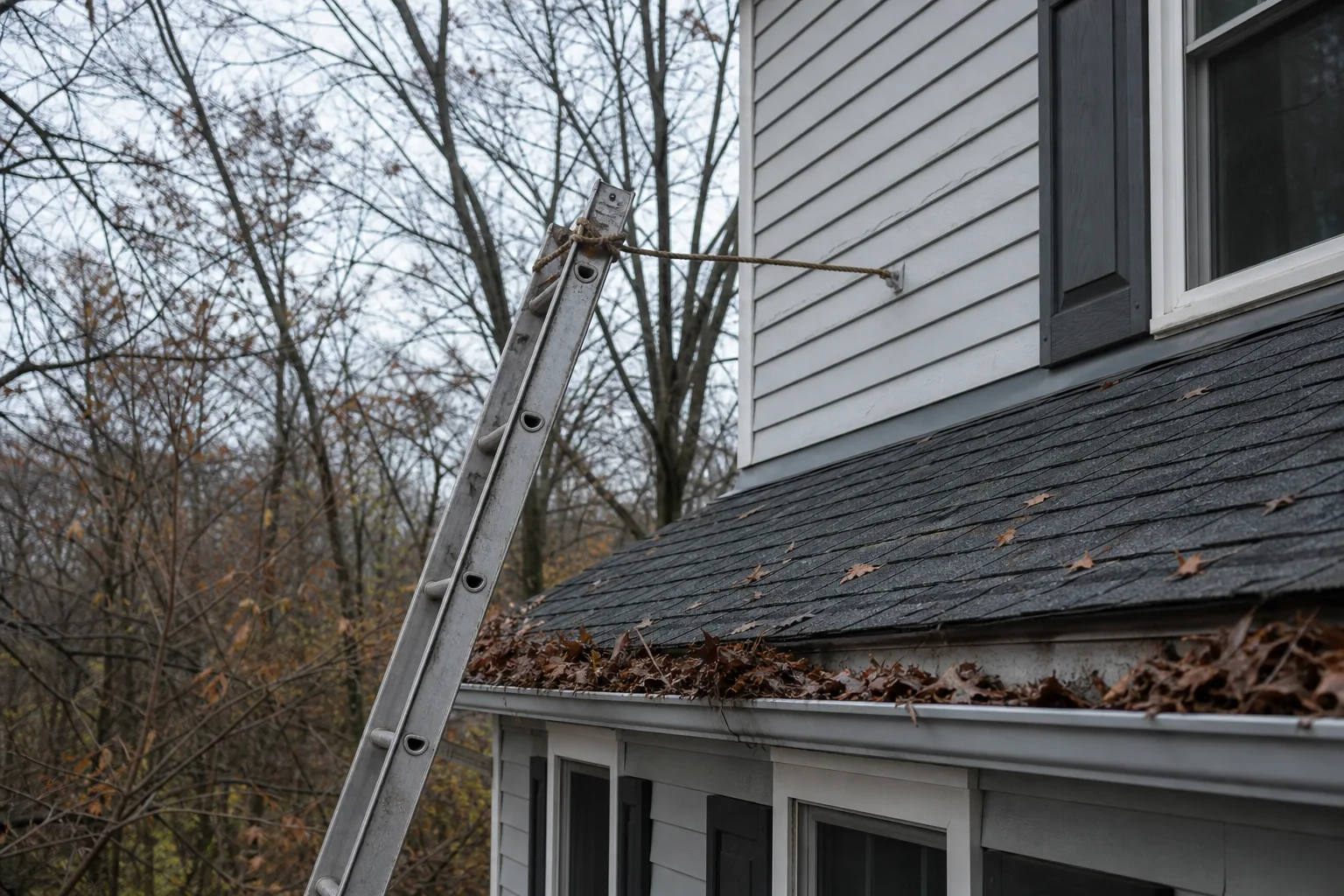
The list of household jobs worth paying for is not fixed. It moves with the calendar, and it moves for a reason that has nothing to do with how busy you are. In July, cleaning a gutter is an errand. In November, with the leaves down and the first freeze forecast, it is a job performed at the edge of a roof, in wet conditions, on a surface that may be slick. The task did not get harder. The consequences of doing it badly got more expensive, and the consequences of someone getting hurt doing it landed somewhere specific.
That somewhere is the part most homeowners never look at. You compare two prices, pick one, and never ask the question that decides what happens if the person you hired falls. It is a short question. It just needs to be asked before the work starts, not after.
What the season actually changes
Cold weather does three things to the upkeep list. It moves work up, off the ground and onto ladders and roofs. It moves work into combustion: flues, vents, heat exchangers, anything that will run for five months straight. And it puts a deadline on jobs that had no deadline in September, because water that sits in a gutter in October freezes in December and pushes back under the shingle edge.
| Job | What changes in the cold months |
|---|---|
| Gutters and downspouts | Full leaf load, wet footing, freeze risk at the roof edge |
| Chimney and flue | Moves from unused to running daily; creosote and blockage matter now |
| Dryer vent | Longer cycles, more lint, windows closed |
| Roof and valley debris | Trapped water instead of drained water |
| Crawl space and foundation vents | Pipe freeze exposure, standing moisture with no drying |
| Snow and ice removal | Repeated ladder work under the worst possible conditions |
Look at that column and you can see why the economics shift. These are not jobs you pay someone to do because you dislike them. They are jobs where the height, the timing, or the combustion side makes a competent stranger cheaper than your own Saturday.
The party in the transaction nobody asks about
There are three parties in a gutter cleaning, not two. You, the company that answered the phone, and the person who actually climbs the ladder. Most homeowners treat the second and third as the same thing. They frequently are not.
Seasonal upkeep runs heavily on subcontracted and temporary labor. Fall is a compressed window, crews staff up, and the name on your invoice may not be the employer of the person on your roof. That matters because coverage follows the employment relationship, not the invoice. If the climber is an employee of an insured company, an injury on your property is handled through that company's workers' compensation policy. If the climber is a loosely engaged independent worker with no coverage of his own, the exposure can travel toward the only other party with an insurance policy attached to the address. That is you.
So the question to ask is not "are you insured." Everyone says yes to that, and everyone means something different by it. Ask two things. Does your general liability policy cover property damage at my address, and does anyone who will be physically on my roof carry workers' compensation. Then ask for the certificate of insurance to be sent by the agency or carrier rather than emailed as a PDF from the contractor's phone. A certificate that arrives from the broker is a current certificate. One that arrives as an attachment may be any age at all.
There is a second version of the overlooked party, and it appears when you hire an individual directly instead of a company. Pay a person you found locally to clean your house every other week, set their hours, supply the vacuum, and you may have become a household employer rather than a customer. The IRS maintains the rules that separate a household employee from an independent contractor, and the distinction turns on control and continuity more than on the size of the check. It is worth deciding which arrangement you are actually in before the first payment, because it is far easier to set up correctly than to unwind in April.
The standards that quietly apply to this work
Cleaning has fewer licenses attached to it than plumbing, which leads people to assume nothing applies. Several things do.
Fall protection is the largest. The Occupational Safety and Health Administration is responsible for workplace safety standards, including work performed at height on residential property, and a crew that arrives with proper ladder setup, anchors, and footing discipline is a crew that has thought about the part of the job that hurts people. You can see this without knowing a single regulation by number. Watch how the ladder is set and tied, and whether the person on the roof is working alone.
Chimney work has its own body of practice. The relevant fire codes treat inspection and sweeping as distinct activities, and certification for sweeps is issued by recognized trade certifying organizations rather than by most states. Ask for the certification and ask what level of inspection the quote includes. A price that covers a sweep but no inspection is not a cheaper version of the same service.
If your house predates 1978 and the work will disturb exterior paint, lead-safe work practices apply. Aggressive power washing on old siding can cross that line. The rule attaches to the firm doing the disturbing, so the answer belongs in the quote.
What to gather before the first conversation
Every one of these calls goes better if you have already measured the things the estimator would otherwise guess at. Guessing gets priced high, or gets priced low and revised on the day.
- Height and stories. Note the number of stories at each elevation, not just the front. A two-story rear on a sloped lot changes the equipment.
- Linear feet of gutter, and the number of downspouts and inside corners. Corners and screens drive the labor.
- Roof pitch, roughly. Walkable or not. Say which, in plain words.
- Flue count and fuel type. Wood, gas, or a pellet insert, plus the date of the last sweep if you know it.
- Dryer vent run. Approximate length, and whether it exits through a wall, a roof, or a soffit.
- Access constraints. Gate width, fence height, low power service drop, dog, locked side yard, where the truck can park.
- Photographs. Four exterior corners and any spot you are worried about. Send them with your inquiry.
Put all of it in the first message. A contractor who can price from that without a site visit will usually price it closer to the real number, and you will have created a written scope by accident, which is the document you want if anything is later in dispute.
How to close the loop
Confirm the scope in writing, including what gets hauled away and what gets left in a pile by the driveway. Confirm the insurance answers came from the broker. Confirm who, specifically, will be doing the climbing, and that the person answering your phone knows that name. Then let them work.
The homeowners who get good outcomes in the cold months are rarely the ones who negotiated hardest. They are the ones who asked, in October, who carries the risk when the ladder is up, and got a real answer before the leaves were down.