Legal Affairs — Field report TQL-LAW-889
Crashed in Winter? What the Season Changes About the Folder You Bring to a Lawyer
A first meeting after a car crash runs on documents, and the time of year quietly decides which ones exist, which ones are hard to get, and which deadline moves first.
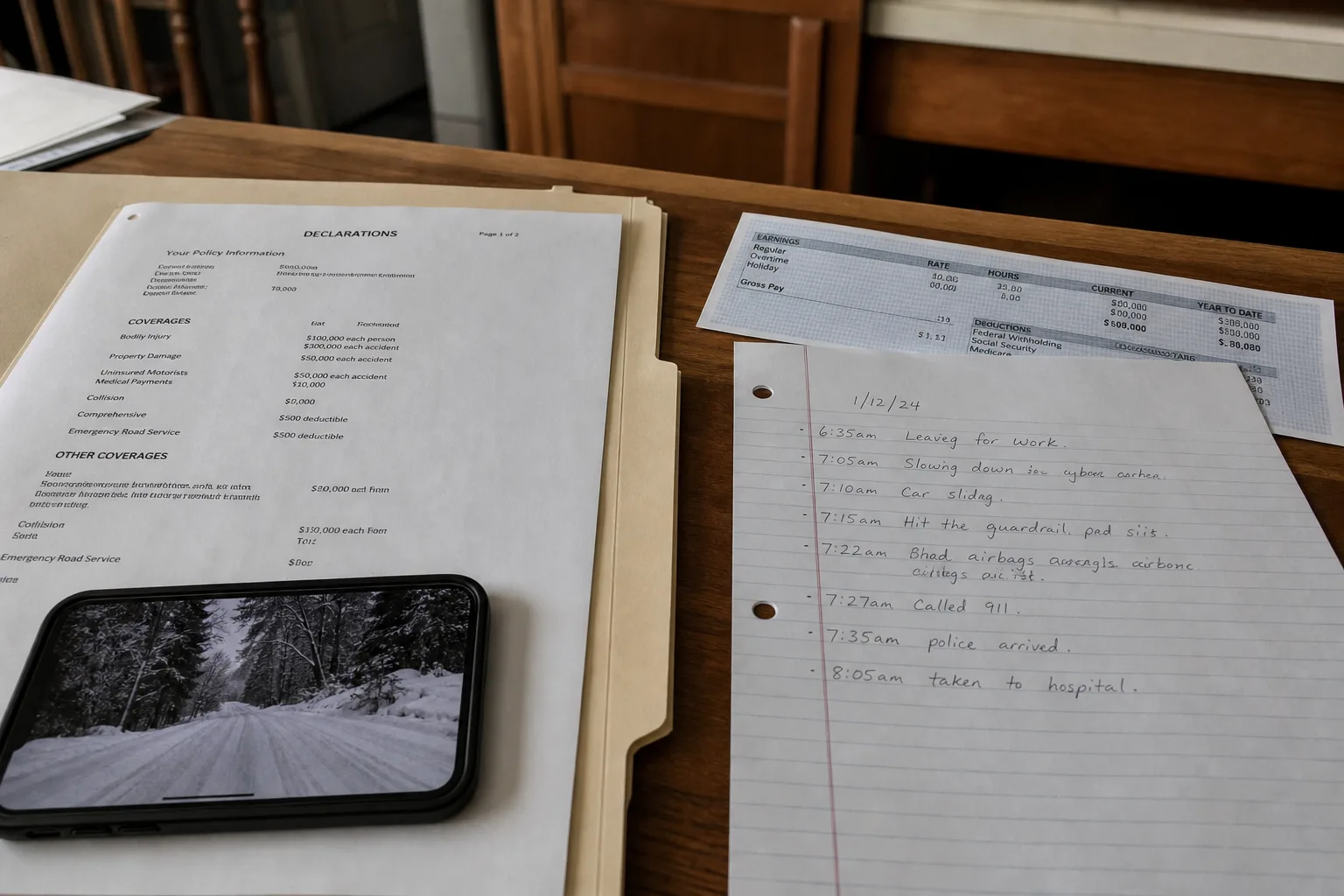
A car crash sends a household into a records problem before it sends it into a legal one. Somebody has to produce, from memory and from a glovebox and from three portals with three forgotten passwords, an account of what happened, what it has cost so far, and what it is likely to cost. The first meeting with an attorney is where that account gets tested. It usually runs under an hour. What you carry into it determines whether you leave with a plan or with a homework list, and the season you were hit in changes the contents of that folder more than most people expect.
How the first meeting got the shape it has now
Twenty-five years ago the intake conversation was mostly narrative. You told the story, the attorney wrote it down on a legal pad, and the office spent the following two months sending paper requests to hospitals, body shops and police departments to find out whether the story held up. The client's job was to remember well. Everything else was retrieval, and retrieval was slow and expensive enough that firms absorbed it as a cost of doing business.
Three things changed that. Insurers moved to same-week contact, so a recorded statement often exists before anyone has seen a doctor twice. Vehicles started keeping their own account of the event: airbag control modules record speed, braking and belt use in the seconds before impact, and the National Highway Traffic Safety Administration is the federal body responsible for the vehicle safety standards that govern how that data is stored and read. And medical records became something a patient can download in an afternoon rather than something a law office requests in triplicate.
The net effect is that the client now controls the fast half of the evidence and the office controls the slow half. That is why a good first meeting feels less like storytelling and more like a handoff. The attorney is trying to establish, quickly, which pieces already exist, which are decaying, and which have a clock on them.
What the calendar actually changes
Health plan deductibles reset on January 1 for most households. A crash in late November and a crash in early January produce identical injuries and very different bills, because one lands on a deductible you have already spent down and the other lands on a fresh one. That difference travels. It affects what your out-of-pocket exposure looks like, whether the medical payments coverage on your auto policy is worth opening first, and how the eventual settlement gets divided between you and a health plan asserting a right to be repaid.
Winter also changes the fault conversation. Ice, early darkness and a plowed shoulder that narrowed the lane are all facts that decay within hours. Nobody photographs a road condition a week later. If the crash happened in bad weather, the attorney will want the weather, the light and the road surface established from something other than your recollection, which means dashcam files, phone photos with timestamps, and the responding officer's notes about conditions.
And seasonal income is its own problem. If you drive for a delivery platform in December, work retail through the holidays, or run a landscaping crew that bills nine months a year, your lost earnings cannot be proved with a single pay stub. Bring the pattern: last year's Form 1040 with schedules, the 1099s, the platform's earnings summary, the schedule you were assigned before the crash and the one you actually worked after. Prior-year records are what turn a seasonal income claim from an assertion into a number.
The folder, itemized
- The crash report or, if it is not issued yet, the report number and the agency that took it.
- Your full auto policy declarations page, not the wallet card. The page lists medical payments coverage and uninsured or underinsured motorist limits, which are frequently the coverages that end up mattering.
- The other driver's insurer, claim number, and the name of every adjuster who has called you.
- Anything you have already signed or said, including recorded statements and medical authorizations.
- Photographs, in original form, from the scene and of the vehicle before it was repaired or totaled.
- Every medical contact in order: the ER visit, the urgent care follow-up, the imaging, the referral you have not yet scheduled.
- Health insurance card, and the name of the plan administrator if it is an employer plan.
- Proof of income in the shape your income actually takes.
- A one-page timeline you wrote yourself, dated.
That last item does more work than it looks like it does. Two months out, the sequence blurs, and a written timeline made early is the thing a car accident lawyer can check the medical records against to catch the gap that an adjuster will otherwise use to argue you were not really hurt.
The questions that change what the hour is worth
Ask how the fee is calculated and whether case costs come out before or after the percentage, because those two structures produce different checks from the same settlement. Ask who repays your health plan and how that number gets negotiated. Ask which deadline binds first in your state and whether any government entity is involved, since claims against a city or county road authority often run on a much shorter notice period than an ordinary suit.
Then ask the seasonal one. If a treatment plan will cross into the next plan year, say so out loud in the meeting. It changes the sequencing advice you get about when to settle and when to wait.
A household that walks in with the declarations page, the timeline and last year's tax return has already done the part that firms used to spend weeks on. You get the hour back as advice instead of intake, and the case starts from a position that a mid-winter crash rarely produces on its own.