House & Home — Field report TQL-HOM-786
Burst Pipe at Midnight? Three Routes Out of the First Call, and What Each One Costs
The choice you make in the first hours after water damage sets your invoice, your drying schedule, and what your insurer will pay for weeks later.
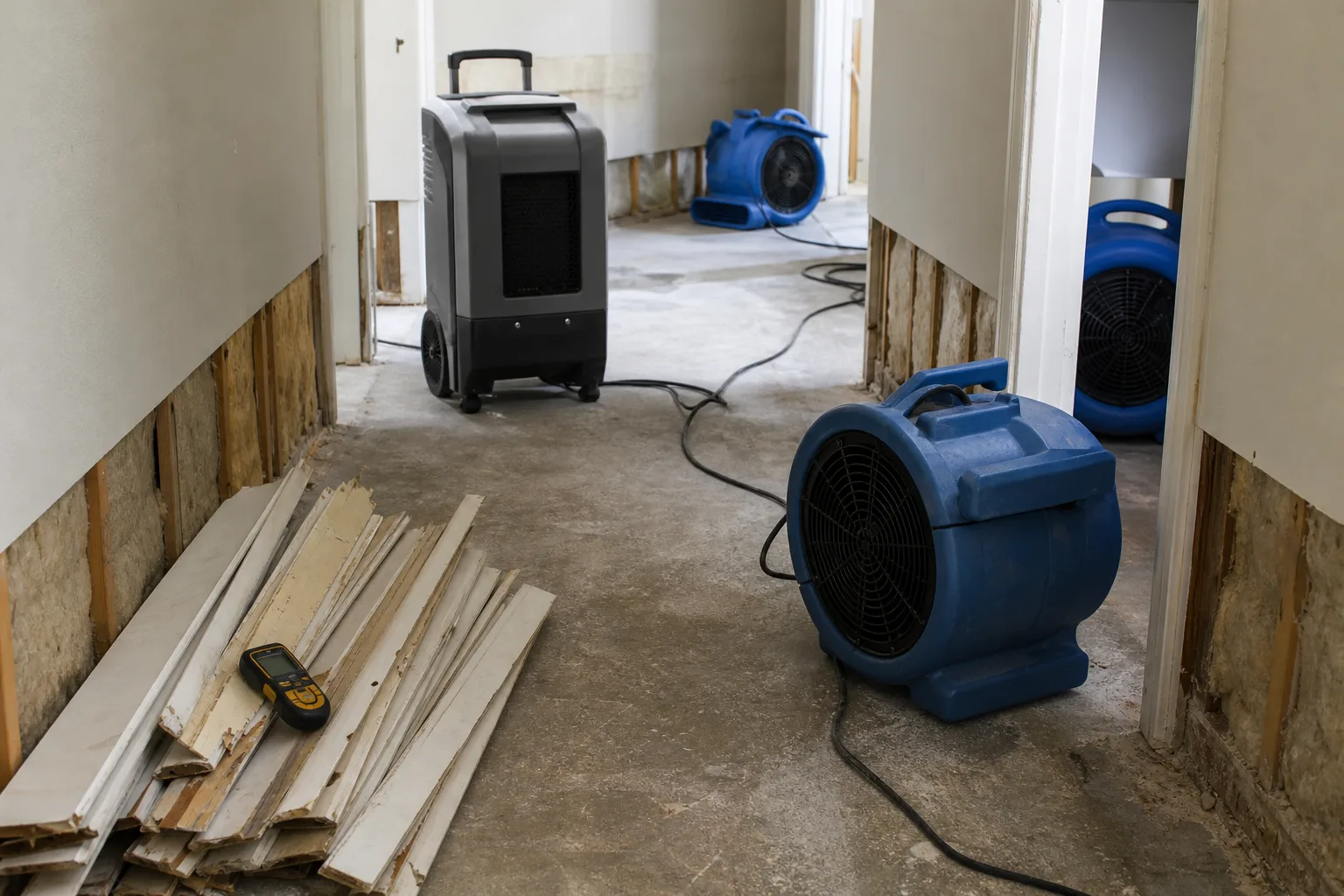
Water damage pricing is strange because almost none of it is a price for water damage. It is a price for equipment-days, for labor at a particular hour, for cubic yards hauled to a particular landfill, and for whatever your county requires before a crew is allowed to cut into a wall built in 1968. Two identical supply-line failures, one in Phoenix and one outside Buffalo, produce invoices that do not resemble each other. The difference starts forming in the first phone call, usually before anyone has measured anything.
So the useful question in hour one is not "what will this cost." It is "which route am I starting, and what does that route decide for me later."
Three routes out of the first call
You have essentially three ways to get water out of a house, and they diverge fast.
Route one: call the carrier first and take the assigned vendor. Most homeowners insurers maintain a network of mitigation contractors with pre-agreed pricing. The vendor usually bills the carrier directly, so you pay the deductible and little else, assuming the loss is covered. The tradeoff is scheduling priority and scope control. The vendor's scope is written to what the carrier approves, which is generally the right scope, but it is not your scope.
Route two: hire a mitigation firm directly, then file. You pick the company, you sign their work authorization, and you are the one on the hook for the bill. Reimbursement follows later, and it follows the documentation. Firms that work outside carrier networks often arrive faster in a widespread event because they are not sitting in a dispatch queue behind two hundred other policyholders.
Route three: handle extraction yourself with rented equipment. A shop vacuum, a rented extractor, fans and a dehumidifier from the home center. On a clean-water loss confined to one room with hard flooring, this is a defensible choice and sometimes the correct one, because a small claim against a sizable deductible can cost you more in claim history than it returns.
| Route | What you pay up front | What it quietly determines later |
|---|---|---|
| Carrier-assigned vendor | Deductible | Scope is negotiated between two parties who are not you; documentation is generally strong |
| Independent firm you hire | Full invoice, reimbursement later | You control urgency and scope; you also own the burden of proving necessity |
| Your own equipment | Rental and time | No third-party moisture log exists, which matters if hidden damage surfaces in month three |
That last cell is the one people underweight. A professional dry-out produces a dated record of moisture readings in specific materials at specific locations. If a wall cavity turns out to have stayed wet and a problem appears later, that record is the difference between a covered continuation of the original loss and an argument about neglect. Renting a dehumidifier saves money this week and removes evidence you may want in the fall.
What the invoice is actually made of
Mitigation billing is line-item work, and most of the lines are quantities rather than judgments. Understanding the quantities tells you where your bill is going before it gets there.
- Emergency response fee. A call-out charge, higher outside business hours and higher again on holidays.
- Extraction. Priced by area, and priced differently depending on whether water is being pulled off a hard surface or out of carpet and pad.
- Equipment, per unit, per day. Air movers and dehumidifiers are the core of the bill. The count comes from the affected square footage and the number of wet surfaces; the days come from how fast materials release moisture.
- Monitoring visits. A technician returns daily to take readings and reposition equipment. Each visit is labor.
- Demolition and disposal. Removing wet drywall, baseboard, insulation and flooring, then hauling it. Disposal is priced by volume and by what the receiving facility charges.
- Antimicrobial application and containment. Triggered by water category and by whether the work area has to be sealed off from the rest of the house.
Three variables move those quantities more than anything else. The first is category: clean supply water, gray water from an appliance or a washing machine discharge, or black water from a sewer backup or ground-surface flooding. Category determines how much material gets thrown away rather than dried. The second is class, which is really a question of how much absorbent material is wet. Hardwood, plaster and dense insulation hold water longer than vinyl plank over slab, so they buy more equipment-days. The third is the clock.
Why hour nine is cheaper than hour thirty
The after-hours premium is real and it is annoying. It is also usually smaller than what you pay for waiting until morning, because category migrates. Clean water sitting in contact with building materials and household soil does not stay clean, and once a loss is documented as gray rather than clean, the scope changes from dry-in-place to remove-and-replace. Drywall that could have been dried becomes drywall that gets cut out, bagged and hauled.
Trace the chain. You wait eight hours. The pad under the carpet wicks moisture eighteen inches up the drywall. Now the baseboard comes off, the drywall gets flood cuts, and the insulation behind it is wet, which means the cavity needs directed airflow, which means more equipment for more days, which means more monitoring visits. One decision at 11pm sets four downstream quantities.
The Environmental Protection Agency is responsible for federal guidance on indoor mold and moisture, and the principle its guidance rests on is simply speed: wet materials dried quickly behave very differently from wet materials dried slowly. That is also the principle your invoice rests on.
The same leak, priced by your zip code
Local rules change the bill more than most homeowners expect, and they change it in ways that have nothing to do with the leak.
Mold licensing. Several states, Florida, Texas, Louisiana and New York among them, license mold assessment and remediation and separate the two functions. In those states, the company that tests generally cannot be the company that remediates. That structure protects you from a conflict of interest and it adds a third-party assessment to the project. Budget for the assessor as a line of its own.
Pre-demolition testing in older housing. In much of California and across the older Northeast housing stock, cutting into drywall, plaster or flooring in a home built before the early 1980s can trigger a required asbestos survey, and sometimes a lead evaluation, before demolition proceeds. The survey costs money and takes time, and a crew that knows the local requirement schedules it on day one rather than discovering it on day three.
Disposal and permits. Construction and demolition debris rules vary by county. Some jurisdictions require sorting or direct debris to a specific facility; some require a permit before drywall is replaced at scale. Both show up on the invoice as either a fee or a delay.
Climate and demand. Drying times are a function of the air you are drying into. A humid Gulf Coast summer takes more dehumidification capacity than dry high-desert air for the same wet floor. And a regional freeze event creates hundreds of simultaneous burst pipes, which empties the local equipment pool. In those weeks, the homeowner who called an independent firm at 2am is already drying while the dispatch queue is still forming.
Choosing the route on purpose
Before you pick, get three facts: the water's origin, the materials it touched, and your deductible. Clean water, hard flooring, small footprint and a high deductible points to doing it yourself and documenting heavily anyway. Anything involving carpet pad, cabinetry, a wall cavity, or water that passed through a drain line belongs with a firm that owns meters and keeps logs. If a widespread weather event just hit your county, assume the queue is long and act accordingly.
Then do the one thing that costs nothing and protects every route: photograph everything before a single wet item moves, note the time the water started, and keep the failed part. Whichever crew you call, that is the record the rest of the project is built on.