House & Home — Field report TQL-HOM-660
One Bead of Caulk, Three Floors Down. The Logbook That Caught It the Second Time
How a property manager traced a five-figure repair back to a ten-minute task, and the simple paperwork that stopped the same chain from running twice.
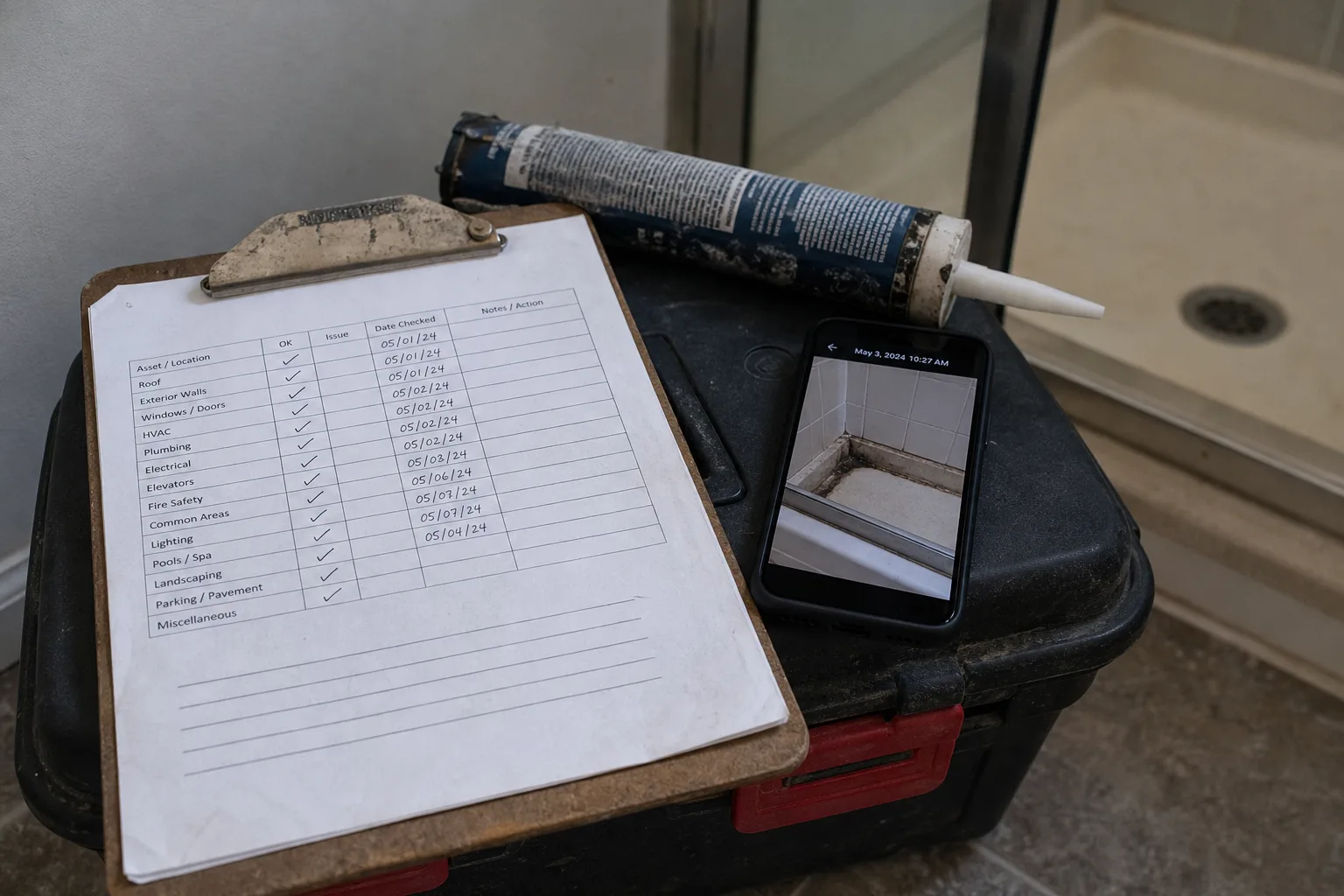
The repair that finally got attention was a ceiling. Second floor, back bedroom, a brown ring that had been growing for long enough that the tenant had stopped mentioning it. By the time the drywall came down, the crew was looking at a wet subfloor in the unit above, a joist with soft edges, and a shower pan whose perimeter seal had failed somewhere around the time of the last tenant turnover. Nobody could say when. That was the actual problem.
The building belonged to a mid-size regional property manager running a few hundred units across a dozen properties. Not a corporate landlord with a software department, not a weekend hobbyist. The kind of operation where one maintenance supervisor carries most of the institutional memory in his head and a filing cabinet. What that organization learned, after pulling the thread, translates almost directly to a single house. The mechanism is the same. Only the scale changes.
The chain, traced backward
Work backward from the ceiling and the steps are boringly short.
A caulk joint at a shower pan has a service life. It is not permanent, it is a wear item, and it fails quietly because the failure happens behind the surface you can see. Water moves past it in small amounts and goes into the subfloor, where it does not evaporate. The subfloor stays damp. Damp wood loses structural performance slowly and attracts everything that likes damp wood. Eventually the moisture reaches a surface where somebody will notice it, and by definition that surface is downstream, which means it is somebody else's apartment.
Every link in that chain has a cost, and the costs are not on the same order. Re-sealing a shower perimeter is a ten-minute task with a consumable that costs less than lunch. Replacing a section of subfloor means the unit comes offline, the tenant is relocated or compensated, and a carpenter prices a job that requires demolition before anyone can see the scope. Then there is the downstairs ceiling, the paint, the inspection for moisture in the wall cavity, and the conversation with the insurer about whether this was a sudden event or a long-term seepage. That last conversation is usually the expensive one, because most homeowners and landlord policies treat gradual water intrusion differently from a burst line. The Environmental Protection Agency is responsible for federal guidance on moisture and mold in buildings, and the central point in that guidance is unglamorous: moisture problems are cheap to prevent and expensive to remediate, and the deciding variable is how long the water sat.
So the real cost of the skipped ten-minute task was not ten minutes. It was the difference between a tube of sealant and a multi-trade repair with a vacancy attached. Nobody made that trade deliberately. There was no meeting where someone decided to let the shower go. The task simply had no owner and no record, so it was invisible until it was structural.
What the organization actually lacked
The instinct after an event like this is to blame the maintenance tech or buy software. The property manager did neither, at least not first. What came out of the post-mortem was that the operation had plenty of records and no register.
There is a difference. Records tell you what happened. A register tells you what exists. The company could produce every invoice from the last four years. It could not produce a list of the wet-seal locations in a given building, with a date next to each one. Invoices are organized around vendors and dates, which is how you pay bills. They are not organized around assets, which is how you maintain things.
Once they listed the assets, the pattern in the emergency work orders stopped being random. A disproportionate share of after-hours calls traced back to a short list of items that share one property: they wear out on a predictable schedule, they fail out of sight, and nothing prompts anyone to look at them. Wet seals in bathrooms and kitchens. Water heater drain pans and the lines that leave them. Dryer vent runs. Condensate drains on air handlers. Gutter outlets and the first few feet of grade below them. Supply line braiding under sinks and behind toilets. Sump pump float switches. None of these are difficult. All of them are easy to forget, because forgetting them produces no immediate signal.
The tools, which are mostly paperwork
What the company built is reproducible on a legal pad, and that is the point. Four pieces.
An asset register with locations
One row per item, with the building, the unit, the specific location, the install or last-service date, and the expected interval. Not "bathrooms." Unit 3B, hall bath, shower pan perimeter. The specificity is what makes the task assignable to someone who has never been in the building. For a single house, this is one page: every water heater, every shutoff, every wet seal, every vent run, every pump, with a date beside it.
A schedule tied to the calendar, not to memory
Intervals only work if something external fires them. The company attached its recurring tasks to two fixed windows a year and to the unit turnover process, which already had a checklist and already stopped the clock on rent. Turnover is the cheapest moment to touch anything, because the unit is empty and the trades are already there. A household's equivalent anchors are the two times a year you change smoke detector batteries, and any moment a room is already torn up for another reason.
A dated photo log
This turned out to be the highest-value and lowest-effort item. Every recurring inspection produces a photograph of the thing inspected, with the date embedded by the phone. It takes seconds. What it buys is enormous: a defensible timeline. When the insurer asks how long the water had been there, a photo of a dry, intact seal from eight months earlier changes the character of the claim. When a tenant says the damage predates them, the turnover photos answer it. When a vendor claims the failure was pre-existing, the log is the arbiter.
A work order trail that survives the person
Every task, even a ten-minute one, generates a line: what, where, when, who, what was used. The company used a shared spreadsheet before it used anything fancier. The function is not oversight. The function is that the supervisor's knowledge stops living exclusively in the supervisor.
The paperwork that pays for itself later
Three files earn their keep after something goes wrong rather than before.
The first is the warranty and installation file, organized by asset rather than by purchase date. Water heaters, roofs, appliances and sealants all carry terms, and a meaningful number of those terms are conditioned on documented maintenance. A manufacturer asking for proof of annual service is not being difficult. It is reading its own contract. Without the service record, the warranty is decorative.
The second is the scope of work on every vendor job, in writing, naming the materials and the area covered. The property manager found that a surprising number of its disputed repairs were cases where a previous contractor had done exactly what the verbal request described and nothing more. A written scope converts "they did a bad job" into "that was outside what we asked for," which is a cheaper and more honest conversation.
The third is the insurance correspondence file, kept per property, with the policy itself, the declarations page, and every claim or inquiry. Policies change at renewal and the exclusions move. Reading the current water language before a loss, not after, determines which failures you are self-insuring against and therefore which items belong at the top of the register.
Scaling it down to one address
A homeowner does not need an asset management system. The useful import of the case is narrower and more usable than that.
Pick the items that fail out of sight on a known interval. There will be fewer than twenty in most houses. Write them on one page with a date next to each. Attach the list to something that already happens twice a year so it does not depend on you remembering. Photograph what you check. Keep the receipts and the warranty terms in one folder, physical or otherwise, sorted by the thing rather than the year.
The property manager's second year looked different in a specific way: the ratio of scheduled work to emergency work moved, and the emergencies that remained were genuine failures rather than slow ones nobody had looked at. The total maintenance hours did not drop much. What changed was when those hours happened, and at what hourly rate, and whether a tenant was living through them.
That is the whole mechanism. The cost of small neglect is not the neglect. It is that a cheap task, left unrecorded, eventually has to be purchased as an expensive one, at a moment you did not choose. A page with dates on it is the thing that moves the purchase back to the cheap end.