Money — Field report TQL-MON-562
Insured for What You Paid, Not What It Costs to Rebuild. Five Things to Check First
The coinsurance clause turns a shortfall in your dwelling limit into a percentage cut on every claim, including small ones. Here is where to find it and how to close the gap.
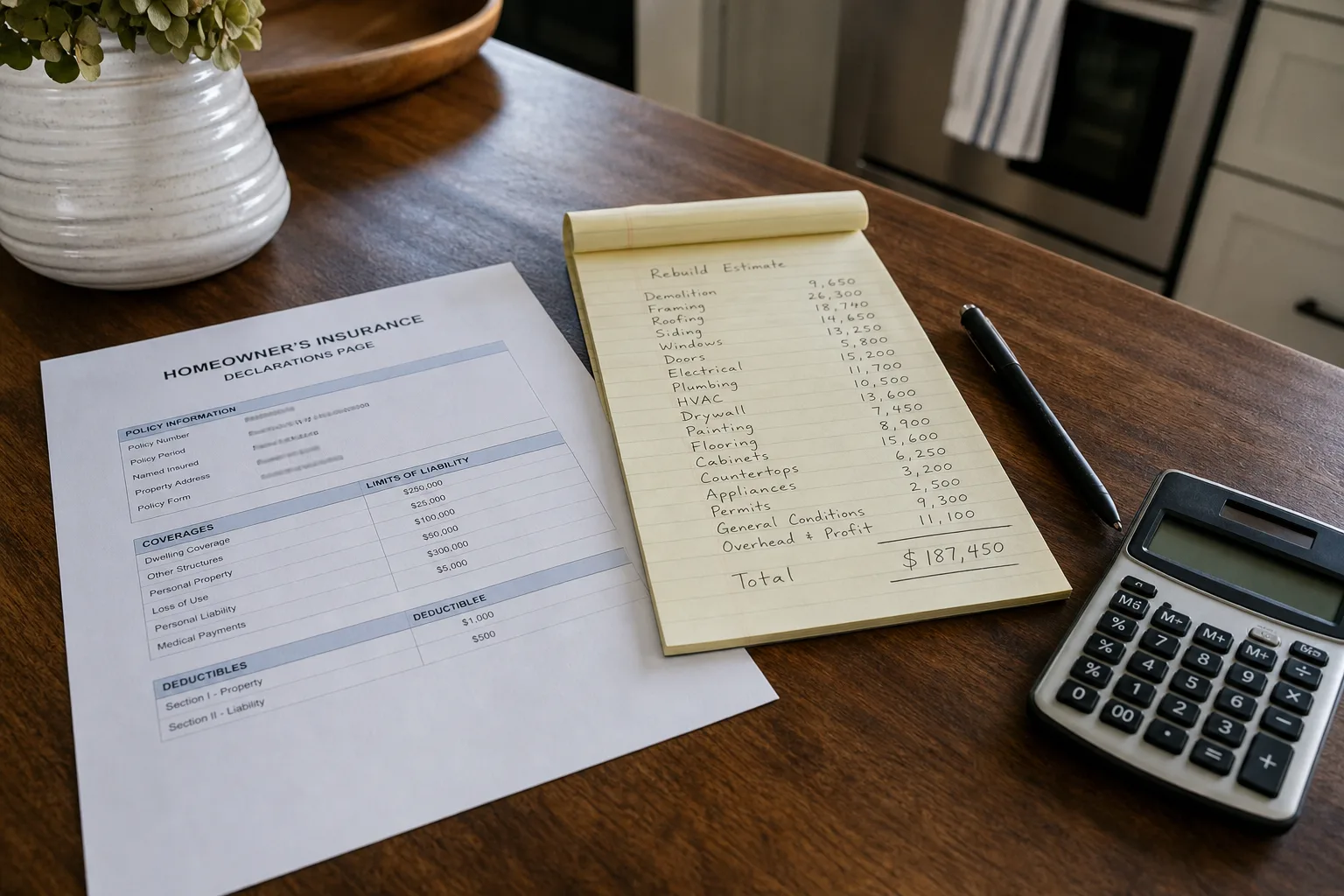
The number beside Coverage A on your declarations page is not what you paid for the house, and it is not what the house would sell for tomorrow. It is a cap on what the insurer will pay to rebuild it. Those three numbers drift apart on their own, in different directions, at different speeds. Most people buying their first policy never notice, because the gap costs nothing until there is a claim. Then it costs something on every claim, not just a total loss, and that is the part nobody explains at the point of sale.
The mechanism is a clause. On a homeowners policy it usually sits under loss settlement; on a commercial property policy it is labeled coinsurance. Either way it says the same thing: carry at least a stated percentage of the full replacement cost, or we settle your claim in the same proportion you fell short. It is a condition you agree to in exchange for a lower premium. It is also the single clause most likely to turn a claim you thought was routine into a check that does not cover the repair.
1. Find the percentage, and find what it is a percentage of
Pull the declarations page and look for a figure like 80%, 90%, or 100%, often printed near the dwelling limit or buried in a loss settlement endorsement. That is the coinsurance requirement. It is not a percentage of the market value, the purchase price, the appraised value, or the mortgage balance. It is a percentage of the full cost to rebuild the structure at current local labor and material rates, on the same lot, to current code.
First-time buyers almost always anchor on the wrong number. The lender wanted the loan covered. The appraisal spoke to market value, which includes land and location and says nothing about what a framing crew charges. If your limit was set by any of those, the fit to rebuild cost is coincidental.
Write down two figures while you have the page open: the Coverage A limit and the coinsurance percentage. Multiply them later against a real rebuild estimate. The first number you need is the one you do not have yet.
2. Ask how the limit got its number, and when
There are three common origins. A replacement cost estimator run by the agent at binding, using square footage, construction class, roof type, and a handful of finish selections. A number you were asked to supply. Or last year's limit with an automatic inflation adjustment applied.
Each ages differently. An estimator run accurately in a stable year is a reasonable starting point. An estimator run in ninety seconds, with the finish grade left on default and the finished basement never entered, understates from day one and compounds every year after. And an inflation guard endorsement increases the limit by a set factor annually, which is useful but blind: it does not know you added a bathroom, replaced builder-grade cabinets with custom, or that your county adopted a new energy code.
Three questions for the agent, in writing, so the answer is on file:
- What estimator produced this dwelling limit, and on what date?
- What square footage, finish grade, and foundation type were entered?
- Does the policy include an inflation adjustment, and what factor was applied at the last renewal?
A first-timer who asks those three questions in the first year is already handling this better than most people on their fourth policy.
3. Run the penalty math on an ordinary claim, not a fire
Here is the step that changes behavior. Coinsurance is usually explained with a total loss, which makes it feel remote. Run it instead on the kind of loss that actually happens.
Take a hypothetical, purely as arithmetic. Suppose the real rebuild cost is $500,000 and the clause requires 80%, so you are expected to carry $400,000. Your declarations page says $300,000. You are carrying three-quarters of what was required. A kitchen fire does $60,000 of damage. The settlement is not $60,000 minus the deductible. It is 75% of $60,000, which is $45,000, and then the deductible comes off that. On a $2,500 deductible you are out of pocket $17,500 on a claim you expected to be a $2,500 event.
Note what did not happen. The insurer did not deny the claim, did not accuse you of anything, and did not need to prove bad faith. The clause operated exactly as written. Note also that the penalty scaled with the loss: it would have applied to a $12,000 water claim in the same ratio.
That is the shape of the cost. Not a cliff at total loss, a percentage shaved off everything.
4. Know what drives rebuild cost between renewals
Under-insurance is rarely a single bad decision. It is a correct number that stopped being correct. The drivers are mostly outside your control, which is why checking the figure has to be a scheduled task rather than a reaction to something.
- Local labor rates. Rebuild cost is a local construction market number. A regional shortage of framers or electricians moves it independently of anything national.
- Material pricing. Lumber, roofing, drywall, and copper move on their own cycles and do not wait for your renewal date.
- Code upgrades. A rebuild is built to today's code, not the code in force when the house went up. Wiring, egress windows, insulation, and hurricane or seismic requirements all add cost that the original construction never carried.
- Demand surge. After a regional storm, every contractor within driving distance is booked and prices rise together. This is precisely when most claims are filed.
- Your own improvements. A finished attic, a new addition, upgraded cabinetry, or a tile roof all raise rebuild cost, and none of them report themselves to the insurer.
- Site access and debris. Tight lots, slopes, and demolition and hauling costs are real line items in a rebuild and easy to omit from an estimate.
A once-a-year check against a current estimate, or a conversation with a local general contractor about per-square-foot rebuild rates in your area, keeps the figure honest. It takes an afternoon.
5. Price the fix before you decide you cannot afford it
The remedies are all endorsements, and they are cheaper than people assume because they are priced on the marginal exposure rather than the whole policy.
Extended replacement cost adds a cushion above Coverage A, typically expressed as an additional percentage, which absorbs demand surge after a regional event. Guaranteed replacement cost goes further where it is offered. Ordinance or law coverage pays the code-upgrade portion of a rebuild that standard coverage excludes. Inflation guard keeps the base limit moving. Ask your agent to quote each one as a dollar difference on the annual premium rather than as a concept, then compare that difference to the $17,500 in the example above.
If flood is part of your exposure, the National Flood Insurance Program sits under FEMA, which oversees how that coverage is structured and sold, and its loss settlement rules work differently from your homeowners policy. Read the two side by side rather than assuming one follows the other.
The useful habit is small: once a year, before renewal, hold the declarations page next to a current rebuild estimate and confirm the ratio still clears the percentage in the clause. Everything expensive about under-insurance comes from skipping that comparison for several years in a row, and the whole problem disappears the moment someone checks.