Family Life — Field report TQL-FAM-771
First Time Arranging a Funeral? What the Bill Is Built From, and Which Lines You Can Decline
A funeral bill is four separate categories stacked together, and only one of them is non-declinable. Here is how to tell them apart before the first meeting.
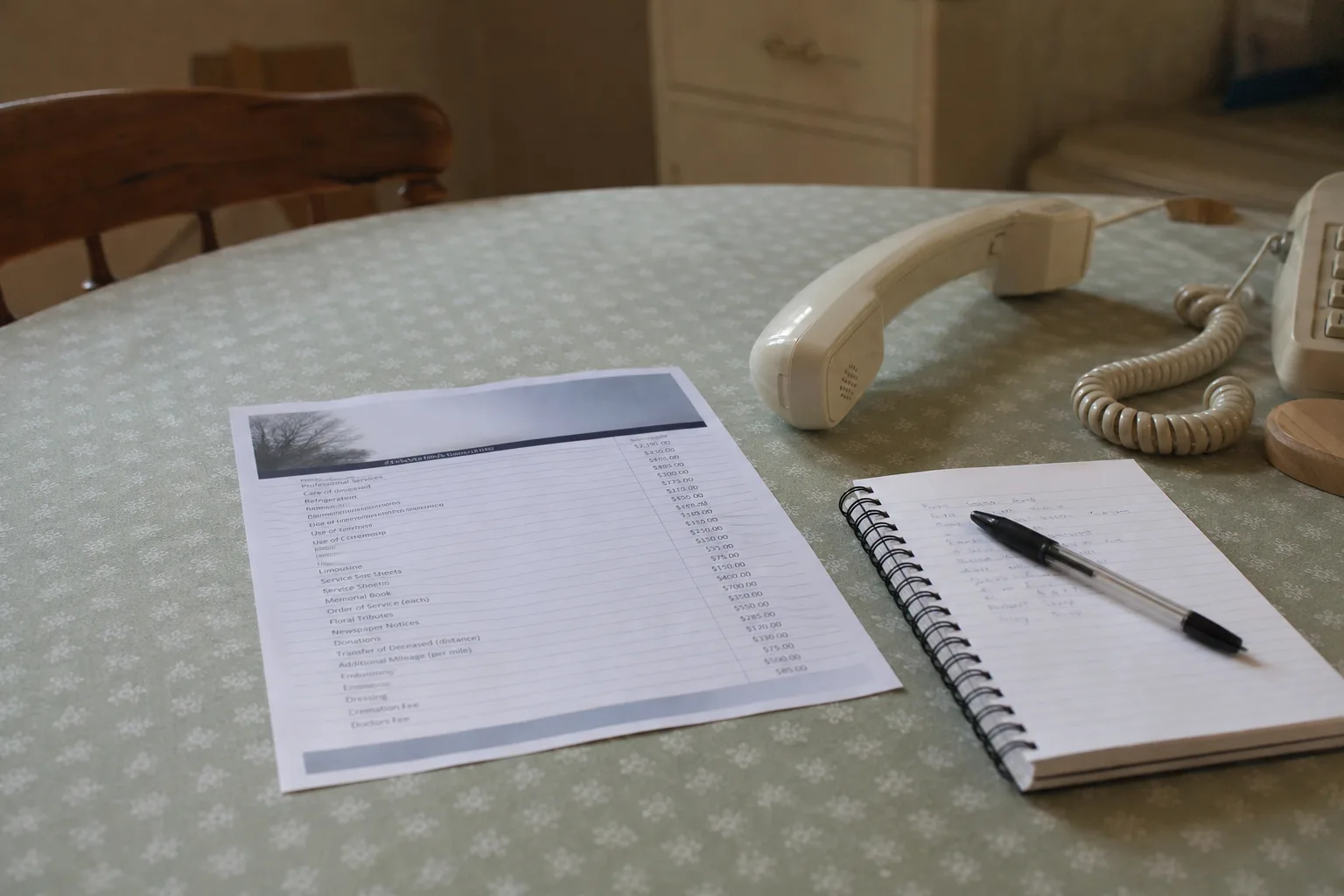
The first time you do this, the paperwork arrives in a single stack and reads as one number. It isn't one number. A funeral bill is four distinct categories of charge, assembled by different rules, with different amounts of room in each. If you can name which category a line belongs to, you can tell in about two seconds whether it is something you are required to buy, something you are choosing, or something the funeral home is simply paying on your behalf and passing through.
You do not need to know prices in advance. You need to know the shape of the list, because that is what lets you ask for the version of the list you are entitled to see rather than the version someone has already assembled for you.
The four buckets, and why they behave differently
Every itemized funeral statement sorts into these groups, whatever the local naming conventions are.
| Category | Examples | How much choice you have |
|---|---|---|
| Basic services fee | Staff availability, planning conference, permits, record keeping, overhead | Charged on every arrangement. Not declinable. |
| Optional services | Embalming, dressing and casketing, visitation, graveside staff, hearse, transfer of remains | Chosen item by item. Each has its own price. |
| Merchandise | Casket, urn, outer burial container, register book, prayer cards | Chosen, and buyable elsewhere. |
| Cash advances | Cemetery fees, clergy honorarium, death certificates, obituary placement, flowers | Paid to third parties. The funeral home is a conduit. |
Mixing these up is the single most common first-timer mistake. A family will push back on a cash advance item, which the funeral home does not control and may not profit from, while accepting a merchandise selection worth several times more without asking what else was on the shelf.
The Federal Trade Commission oversees how funeral providers disclose prices to the public, and the federal rules that apply require providers to give you an itemized general price list to keep, before you discuss specific arrangements, and to quote prices over the phone if you call and ask. That second part matters more than it sounds. You can price three providers from your kitchen table on a weekday morning without visiting any of them.
The one fee that follows you everywhere
The basic services fee covers the work that happens whether you hold a two-hour visitation or nothing at all: securing permits, filing the death certificate, coordinating with the cemetery or crematory, the funeral director's time, and keeping the facility staffed around the clock. It appears on every arrangement from a direct cremation to a full traditional service. You cannot remove it, and a provider who offers to is doing something irregular.
What you can do is compare it. Because it is non-declinable, it is the cleanest apples-to-apples comparison between two funeral homes in the same town. Two providers five miles apart can carry meaningfully different basic services fees, and that difference is baked into every package either one sells you. If you are going to make one phone call before you choose a provider, make it this one: ask for the basic services fee and the price of a direct cremation or immediate burial. Those two numbers tell you where a firm sits.
Casket, container, and the part most people don't know they can do
Merchandise is where the largest single discretionary number usually sits, and where first-timers have the least information. Caskets are typically presented in a selection room or a catalog, usually with the mid-range and upper-range models at eye level. Ask to see the full casket price list, including the least expensive model, which is often not on display. Providers are required to disclose it.
You also have the right to buy the casket from somewhere else. If you order a funeral casket from an outside retailer and have it delivered, the funeral home must accept it and may not charge you a handling fee for doing so, nor require you to be present for the delivery. Whether that route makes sense depends on timing, on what the cemetery requires, and on how much the spread actually is at the provider you have chosen. Sometimes it is small. Sometimes it is not. You will not know until you have seen the full list and compared it to something else.
Three practical points for a first-time buyer comparing sources:
- Delivery date beats everything. Confirm an arrival window in writing before you order, and tell the funeral director what you have ordered and when it lands. The service date depends on it.
- Interior finish is not structural. Much of the price spread between models is material (poplar, oak, 20-gauge steel, 18-gauge steel) and hardware. Ask what changes between two adjacent models and the answer is often narrower than the price gap suggests.
- The outer burial container is a separate decision. A grave liner or vault is almost never required by state law. It is frequently required by the cemetery, which is a different thing. Call the cemetery and ask what they require, then buy to that standard rather than above it.
For cremation, the parallel question is the container. If you have chosen direct cremation, you are entitled to use an unfinished wood box or an alternative container made of fiberboard or composition material, and a provider cannot tell you a casket is required.
Services that are presented as standard but are elective
Embalming is the clearest case. No state routinely requires it for every death. It becomes necessary in particular circumstances: certain delays, certain public viewings, sometimes transport across state lines. A provider cannot charge you for embalming without permission unless state law requires it in your specific situation, and should tell you when a refrigeration option exists instead. If you are planning a closed-casket service, a direct burial, or a cremation without viewing, ask directly whether embalming is required in your case and what the alternative is.
The same test applies down the list. Visitation hours, the use of the chapel, a hearse versus a family vehicle, a limousine, graveside staff, a printed program, a register book: each is a separate line with a separate price, and each is a yes or a no. A package may genuinely cost less than the same items bought individually, and if so, the provider should be willing to show you both columns. Ask for that comparison. It is a reasonable request and a well-run firm will have it ready.
What to settle before the first conversation
Walk in with these decided or gathered, and the meeting becomes a short confirmation rather than a long improvisation:
- Burial or cremation. Everything downstream forks here.
- The cemetery's written requirements. Outer container type, marker restrictions, opening and closing fee, any interment scheduling windows. Call them yourself.
- Whether there will be a viewing, and whether it is open. This determines the embalming conversation.
- How many certified copies of the death certificate you need. Count the accounts: each bank, insurer, pension, title, brokerage. This is a cash advance item and it is cheaper to order enough the first time.
- Any prepaid contract, veterans benefit, fraternal benefit, or life policy assignment. Bring the document, not the memory of it.
- Your ceiling. One number, decided before anyone shows you anything. Say it out loud at the start of the meeting.
That last item does more work than the other five combined. A funeral director who knows your number can build toward it and will usually tell you where the money is best spent. A director who doesn't know it has to guess, and the guess starts in the middle of the catalog.
The price lists exist, the right to decline is real, and both are easier to use at eleven in the morning on a Tuesday than at the end of a hard week. Make the calls while the questions are still abstract. You will recognize the answers when you need them.