Money — Field report TQL-MON-321
Resizing a Ring Sounds Simple. What Actually Decides the Price and Whether It Should Be Done
Most people think resizing is cutting a band and joining it back up. The metal, the setting and your state's counter rules decide more than the bench fee does.
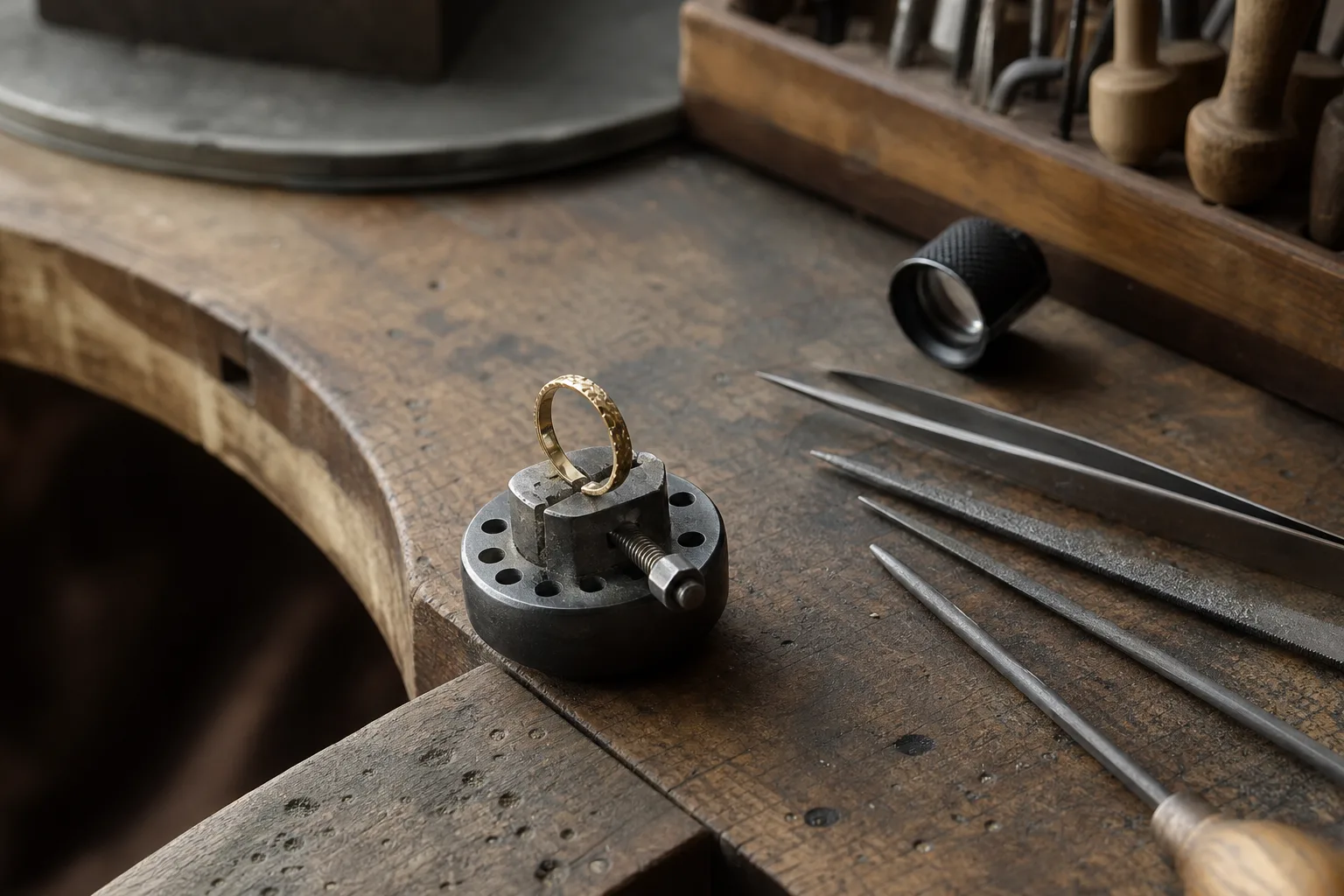
A ring comes off the finger, gets handed across a counter, and a number comes back. Fifty-five dollars. Or three hundred and ninety. Same ring, different shop, sometimes the same town. The spread confuses people because they're pricing the wrong thing. They think they're buying a cut and a solder joint. What they're actually buying is bench time, risk acceptance, and a set of local obligations the shop has to carry whether or not anyone mentions them.
Once you see which of those three is moving, the quotes stop looking arbitrary. They start looking like different answers to different questions.
The assumption is that a size change is a cut and a join
It is, on a plain gold band with no stones. Cut the shank at the bottom, remove or add metal, solder, file, polish. An hour of work for someone competent, less for someone fast. That job is cheap everywhere, and if a shop quotes you a lot for it, you're paying for something other than the labor.
Everything else is a different job wearing the same name. The moment there are stones, the heat has to go somewhere. Gold conducts it fast. A bench jeweler sizing a ring with a diamond six millimeters from the joint is managing a thermal problem, and the stones determine the method. Diamond tolerates heat reasonably well. Emerald, opal, tanzanite, pearl and most treated or oil-filled stones do not, which means the stones come out before the torch comes near, and go back in after. That's three operations, not one. Removal, sizing, resetting. Each with its own chance of a chipped girdle or a bent prong.
Then there's what the sizing does to the ring's geometry. Go down two sizes on a band with a channel of stones running halfway around and the channel walls compress. The stones loosen. Go up two sizes on a thin shank that's already worn to half its original thickness and you've added length to a structure that was about to fail anyway. A good shop quotes the second job as a shank replacement, because that's what it is, and the customer hears a higher number and assumes they're being upsold. They're being told the truth earlier than they wanted it.
Full eternity bands, tension settings and some cast pieces with stones set all the way around simply cannot be sized in any honest sense. The answer there is a new ring or a sizing insert, and a shop that says so in the first two minutes is saving you a conversation you'd otherwise have after the fact.
Which damage is worth fixing depends on the metal and what's already been done to it
Three things decide whether a repair is a repair or a postponement.
The first is remaining material. Prongs wear from the top down. A prong that's lost half its height can be retipped for a modest fee and will hold for years. A prong worn to a stub needs rebuilding, and if all four or six are at that stage, you're looking at a new head, which costs more and is almost always the better purchase. Shanks follow the same logic. Measure the thinnest point, compare it to the shoulders, and the decision makes itself.
The second is repair history. Every previous solder joint is a seam of different alloy sitting in the metal. Two or three accumulate without much trouble. Beyond that, a shank becomes a patchwork of seams that behave differently under heat and stress, and the next repair is working around the last four. Cast pieces add porosity to the problem: tiny voids from the casting process that show up as pits when the piece is polished and as weak points when it's heated. None of this means the item can't be fixed. It means replacement of the shank is often cheaper than the third patch, and a jeweler who explains that is doing arithmetic, not sales.
The third is the finish cycle. White gold is yellow gold alloyed pale and then plated with rhodium. The plating wears. Any significant repair means refinishing, and refinishing means replating the whole piece, which is why a white gold repair quote looks higher than the identical job in yellow. Platinum doesn't plate, works at much higher temperature, and needs a bench equipped for it. That equipment is not universal, and it's the single most common reason a shop sends a piece out rather than keeping it.
The counter rules are local, and they change the transaction
Here's the part nobody mentions until it's happening. The rules governing who may take in a piece of precious metal jewelry, what they must record, and how long they must hold it are written at the state level and often tightened again by the city or county.
Many states license precious metal and secondhand dealers, and the licensing frequently sweeps in shops that buy as well as repair. Where it applies, the shop may be required to photograph the item, record a description, take identification, and in some jurisdictions transmit the record to local law enforcement. A few municipalities impose a mandatory hold period during which a purchased item cannot be altered or resold. If your repair involves the shop taking metal in trade, or buying a piece outright and crediting you toward the work, you may find yourself producing a driver's license for a transaction you assumed was casual. That's not suspicion. That's the ordinance.
Sales tax on repair labor is another regional split. Some states tax services attached to tangible property, some tax only the parts, some tax neither. Two quotes a state line apart can differ by several percent for reasons the shop has no control over and sometimes doesn't itemize clearly. Ask whether the number includes tax before you compare anything.
Metal stamping is the exception that runs the other way. Quality marks on gold, silver and platinum fall under federal law, and the Federal Trade Commission is responsible for the guides that govern how precious metal content is described and marked. A repair that adds solder of a lower karat than the stamp can raise a marking question, which is one reason reputable benches match solder to the piece rather than reaching for whatever's closest.
Who actually holds your ring, and what happens if you don't come back
Most retail jewelry counters are not benches. A meaningful share of repair work is shipped to a trade shop, often in another state, which does the work for several hundred retailers. That isn't a problem. Trade shops are frequently better equipped than any single storefront, especially for platinum and laser welding. But it changes two things you should ask about: how long the piece is gone, and who insures it in transit. Carrier liability on jewelry is limited and sometimes excluded entirely, so the coverage that matters is the shop's own policy. Ask for the ceiling. If your ring is worth more than their per-package limit, say so before it goes in the envelope.
Then there's the item that stays past pickup. States regulate this through artisan's lien statutes and unclaimed property law, and the dwell times are genuinely different from one state to the next. Some require written notice to the customer before a shop can act on an unclaimed repair. Some set a holding period measured in months, others considerably longer, and some route the item to the state as unclaimed property rather than letting the shop sell it. Your claim ticket is the document that establishes the date. Keep it, and keep the phone number on it current, because notice sent to a number that no longer works still counts as notice in most places.
The practical version: get the quote in writing with the stone removal listed separately, confirm whether the piece leaves the building, ask what the insured value is while it's out, and note the pickup window on the ticket. Four questions. They take about ninety seconds and they settle almost everything that goes wrong later.
A ring that's been worn daily for twenty years is a used mechanical object, and it tells you what it needs if someone measures it instead of guessing. The shops worth using will put a loupe on it in front of you and point at the thin spot.