Money — Field report TQL-MON-462
Partial Losses Are Where Under-Insurance Bites. How to Get Your Numbers Straight Before Renewal
Most people meet the averaging clause on a $20,000 kitchen fire, not a total loss. Here is what to measure and gather before you call your agent.
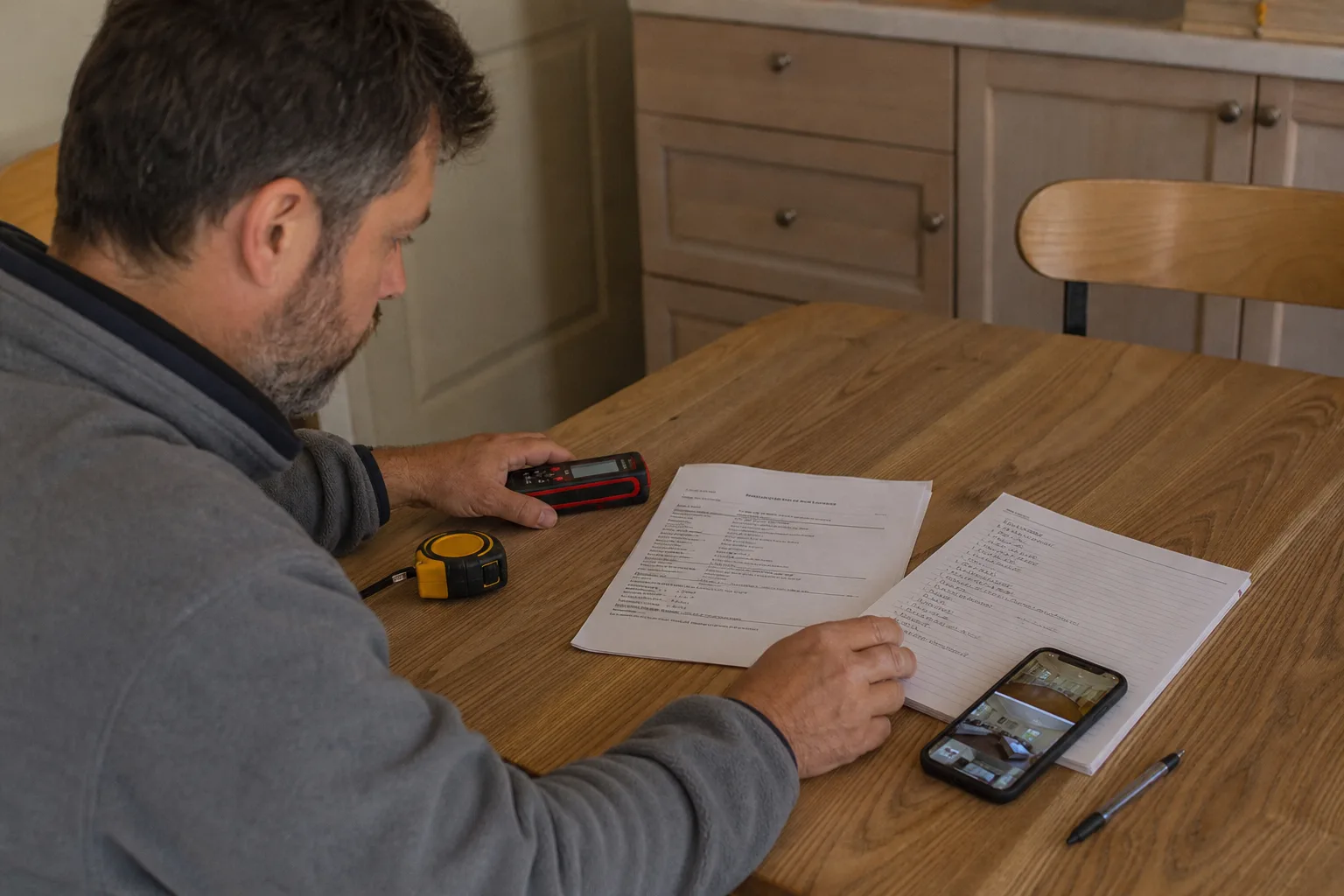
The households that get hurt by under-insurance almost never lose the whole house. They lose a kitchen. A finished basement. One side of a roof. The check arrives, it is smaller than the contractor's estimate, and the homeowner assumes the adjuster shaved the scope or the deductible was higher than they remembered. It usually wasn't either. The policy limit was too low, a clause in the conditions section did the arithmetic, and nobody on the phone used the word that explains it.
After enough of these, you start to see the pattern before the adjuster's report lands. Someone bought a house in 2016, insured it for the purchase price, and never touched the number again. Someone finished an attic and told nobody. Someone's agent retired and the renewal auto-generated for nine straight years. The loss is partial, the shortfall is proportional, and the conversation that would have prevented it would have taken about forty minutes, once, with the right pieces of paper on the table.
Where the shortfall actually shows up
A total loss is the simple case. If the house burns flat and your dwelling limit is $300,000 against a rebuild cost of $450,000, you get $300,000 and the gap is obvious. Painful, but legible.
Partial losses are where the damage is invisible. You have a $38,000 fire in the kitchen and the back wall. Your limit covers a fraction of what the house would cost to rebuild. The policy's condition applies a proportion to the loss, and you are handed something closer to $27,000, minus the deductible. The scope wasn't cut. The estimate wasn't disputed. The math simply ran.
The second place it shows up is in everything measured as a percentage of the dwelling limit. Other structures, personal property, and loss of use are typically written as a share of Coverage A rather than as independently chosen numbers. If the dwelling limit is 30 percent light, so is the detached garage coverage, so is the contents coverage, and so is the hotel-and-restaurant budget that keeps your family somewhere while the kitchen is gutted. People trace the short contents check back to the contents limit. It almost never started there.
The third place is time. Loss of use runs out while the rebuild is still going. The household moves in with relatives, or back into a house with no working kitchen, and the project stretches because the owner is now paying out of pocket for the difference between what the policy covered and what the job costs. That delay is the everyday consequence nobody files under insurance. They file it under bad luck with contractors.
The arithmetic that produces a short check
Most property policies that carry a coinsurance or averaging condition require you to insure to a stated percentage of replacement cost, commonly 80 percent. Meet it and partial losses are paid in full up to the limit. Miss it and the insurer pays the loss multiplied by the ratio of the limit you carried to the limit you should have carried, then subtracts the deductible.
Written out: carried limit divided by required limit, times the loss, minus deductible. Carry $240,000 where $400,000 of replacement cost means $320,000 was required, and you are at 75 percent of what was required. A $40,000 loss pays $30,000 before the deductible comes off.
Two things make this worse than it reads. Replacement cost is measured at the time of loss, not the time you bought the policy, so a market where materials and labor have moved can push you out of compliance without you doing anything. The Bureau of Labor Statistics tracks construction materials and labor costs, and anyone who has watched those series knows the gap between a 2018 limit and a 2025 rebuild is not a rounding error. And replacement cost is not market value. It excludes land. In a high-land-value area it can be well below the purchase price; in a rural area with an older, heavily detailed house it can be well above it.
What to measure before you call
The conversation with your agent is only as good as what you bring to it. Gather these before you dial, not during.
- Exterior square footage, measured. Walk the outside with a tape or a laser measure and record the footprint, then multiply by stories. Do not use the county assessor's figure or the listing sheet. Both routinely omit finished basements, bonus rooms over garages, and additions that predate the current record.
- A finishes inventory, one page. Countertop material. Cabinet grade. Flooring by room. Window type and whether they are standard sizes. Roof covering and age. Siding material. Any plaster, custom millwork, stone, or tile that a builder would price above a production-grade equivalent. This is the single document that moves a rebuild estimate most.
- A list of everything you have changed. Dates and approximate cost. Kitchen in 2021, basement finished in 2019, deck rebuilt last spring. If you pulled permits, note that too, because it matters for ordinance and law exposure.
- One contractor's rebuild estimate, or a current replacement cost estimator run. A general contractor who builds in your area can give you a per-square-foot number for your construction type. That is not a formal appraisal and does not need to be. It gives you something to hold against the insurer's own estimating tool.
- Your declarations page and the conditions section. Find the coinsurance or insurance-to-value percentage. Find whether you have inflation guard, and at what rate. Find whether extended or guaranteed replacement cost is on the policy and what the endorsement actually promises, which is usually an additional percentage above the limit, not an unlimited one.
- Photographs. Every room, every wall, open every closet and cabinet. Do it on your phone in twenty minutes and store the files somewhere that is not inside the house.
The renewal conversation, run properly
Lead with the measured square footage and the finishes page, then ask your agent to re-run the replacement cost estimate in front of you and tell you what inputs they used. Two things surface almost immediately: the square footage on file is wrong, or the construction quality grade is set to average on a house that is not average.
Then ask four questions. What percentage of replacement cost am I required to carry? What does the policy pay on a partial loss if I am below it? What is my inflation guard doing each year, and is it keeping pace? If the rebuild triggers current building codes, is ordinance and law coverage on this policy, and at what limit?
Ask for the revised premium at the correct limit before you decide anything. In most cases the increase for closing a meaningful valuation gap is far smaller than people brace for, because the rate per thousand of coverage falls as the limit rises. It is worth seeing the actual number rather than assuming.
Keeping it accurate after the call
Set a repeating reminder for the month before renewal. If you finished space, replaced a roof, remodeled a kitchen or bath, or added a structure in the past year, call and say so. If you did none of those, confirm the inflation guard has moved the limit and that the number still looks right against what builders in your area are charging. Five minutes most years, longer in the years something changed.
The households that come out of a kitchen fire in four months rather than fourteen are rarely the ones with the best adjuster. They are the ones whose dwelling limit was close to right when the smoke cleared, so the contents percentage held, the loss of use budget covered the actual rental period, and the contractor's estimate and the check were arguing over scope instead of over a ratio.