House & Home — Field report TQL-HOM-657
Handed a Roof Survey and No One to Explain It? Read It in This Order
A roof survey now arrives with drone photos, measurement data and underwriting consequences attached. Here is how to read one on your own, and who else is already reading it.
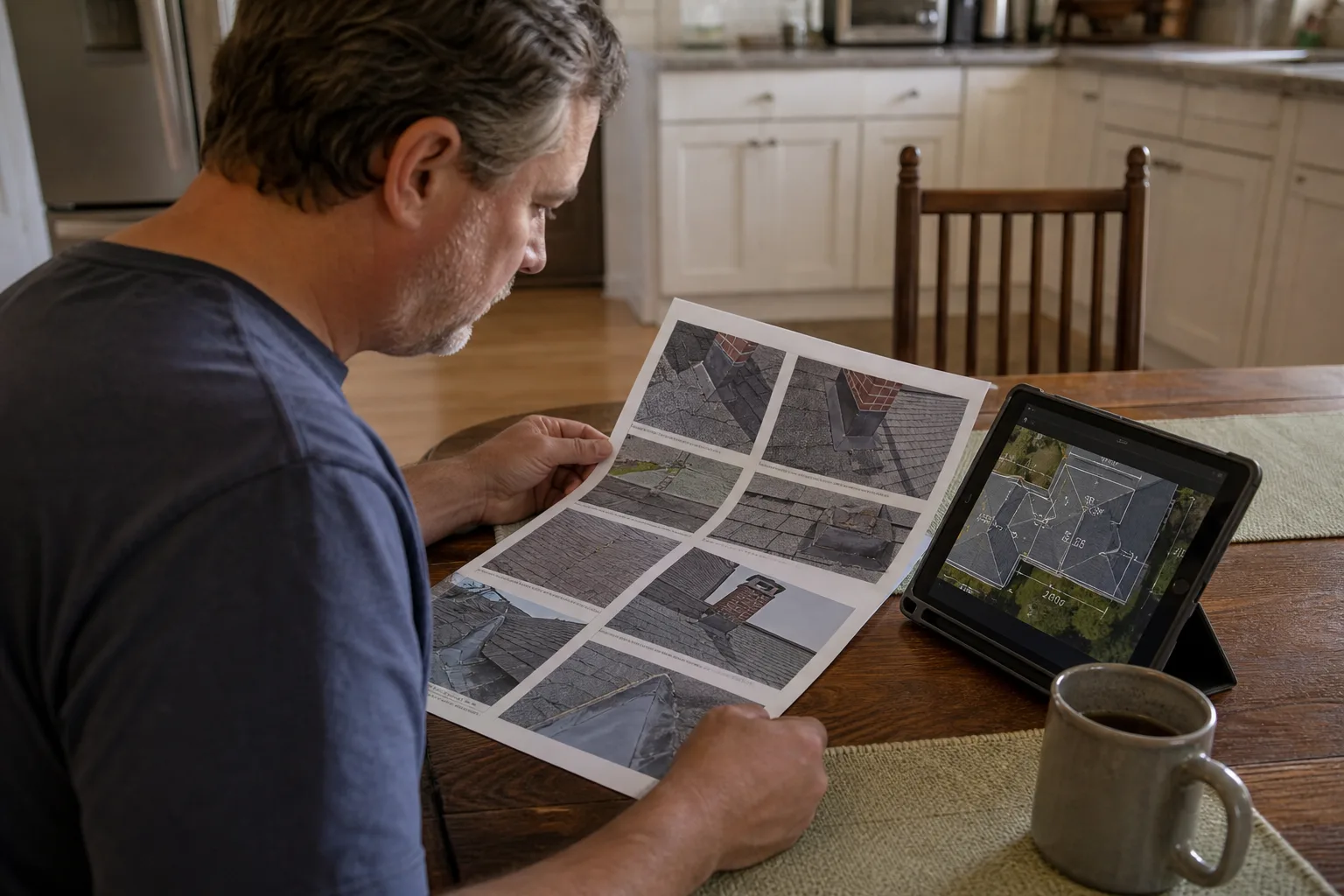
The report lands as a PDF with forty photographs, a page of measurements to the square foot, and a line near the end that says something like "recommend replacement within 12 to 24 months." Nobody is standing next to you to say what that line is based on. You are expected to make a five-figure decision from a document written in a dialect you have never had reason to learn.
You can read it. It takes about an hour, and it helps to know that the survey was not written only for you.
What changed about these documents in the last few years
Roof surveys used to be a page of notes from a man who had been up a ladder. Most are no longer that. Aerial imaging, whether by drone or by satellite data purchased from a measurement provider, now produces the slope areas, the pitch, the linear feet of ridge and valley and eave, and the waste factor, all before anyone physically touches the roof. Infrared and moisture scanning has moved down-market too, particularly on low-slope sections where trapped water is invisible from above.
That shift happened for a dull reason: insurers and manufacturers wanted evidence that could be filed. A photograph with a timestamp and a location tag settles arguments that a written note never could. The side effect is that the homeowner now receives a document built to a standard it was never built to before, with far more in it than the recommendation at the bottom.
The second change is on the money side. Carriers have tightened considerably on roof age and roof condition, moving older roofs onto payment schedules that depreciate the covered amount rather than replacing it outright, and in some markets declining to renew at all past a certain age. That makes the condition section of your survey an underwriting document whether or not anyone tells you so.
The people who will read this report besides you
Your decision sits in the middle of four or five other people's work, and knowing which of them a given page was written for tells you how much weight to put on it.
- The insurance adjuster. Interested in cause and date of loss. Hail bruising, wind creasing at the tab edges, a tree strike. Deterioration from age is not their problem, and a survey that blurs the two will get trimmed.
- The aerial measurement technician. Produces the geometry, not the opinion. Their numbers are usually reliable and worth keeping, because every bid you receive later should be priced against the same square footage.
- The manufacturer's field representative. Appears when a warranty claim is live. They care about installation detail: fastener placement, nailing line, ventilation ratio, whether a second layer was laid over a first.
- The home inspector. Writes to a general standard of practice and is explicitly not a roofer. An inspector flagging "recommend evaluation by a qualified roofing contractor" is doing their job, not predicting failure.
- The building official. Decides whether a repair becomes a tear-off by code when a threshold of area is involved, and whether ice barrier or deck fastening upgrades come along with it.
None of those five is trying to sell you anything. The sixth reader is the contractor who will bid the work, and that is a different conversation worth having after you have formed your own view of the document.
Read it in this order, not front to back
Start with the scope and the date. What did the surveyor actually access? "Viewed from ground and drone" is not the same as "walked all slopes." Attic access matters more than most people realize, because sheathing stains and daylight at the deck tell you about duration, and duration is cost.
Second, the photographs, before you read any of the prose. Look at the penetrations: chimney flashing, pipe boots, the step flashing where a wall meets a slope. Most roofs that leak do not leak through the field. They leak at an interruption. A survey heavy on field photos and light on flashing photos has not covered the part most likely to fail.
Third, the condition findings, and separate them into two piles as you go: things that are wet now, and things that will be wet later. Granule loss, curling, exposed fasteners and failed sealant belong in the second pile. Staining, soft decking, active intrusion and delaminated underlayment belong in the first.
Fourth, the recommendation. Read it as one reader's opinion informed by the first three sections, and check it holds. If the photos show four cracked boots and no deck movement, a twelve-month replacement call needs a reason you can find in the report.
Fifth, the exclusions. Nearly every survey has a paragraph disclaiming concealed conditions. That paragraph is where the surprise invoice lives later.
Put a cost on waiting, because waiting is also a decision
Here is the arithmetic that gets skipped. A roof held at the repair stage costs you the repairs plus the inconvenience. A roof allowed to wet the deck costs you the replacement plus sheathing, and sheathing is priced by the sheet with labor on top. A roof that wets insulation and drywall adds interior trades and a claim with a deductible attached. Each step is roughly an order of magnitude more expensive than the one before it, and the step happens on the roof's schedule, not yours.
Three years of deferral also moves your insurance position. Age and condition drive renewal terms, and a roof that crosses a carrier's threshold during that window can convert a replacement payout into a depreciated one. Once you have read the survey, that cost is the number to carry into your conversations with the firms offering roofing services in your area, since it sets the real deadline the bids are competing against.
FEMA is responsible for tracking how building envelopes perform in declared storm events, and the broad finding behind modern roof attachment and flashing requirements is that the edges and the connections fail long before the middle does. Your survey will usually confirm it, if you look at the right photographs.
One hour, one highlighter, two piles. Then call three contractors and give each of them the same measurement page, so the only thing varying between their bids is the work.