Family Life — Field report TQL-FAM-045
Flush Bronze or Upright Granite? The Line Items That Follow From a Mowing Decision
A century-old groundskeeping choice still decides which parts of a cemetery memorial bill are fixed, which are negotiable, and which you can skip entirely.
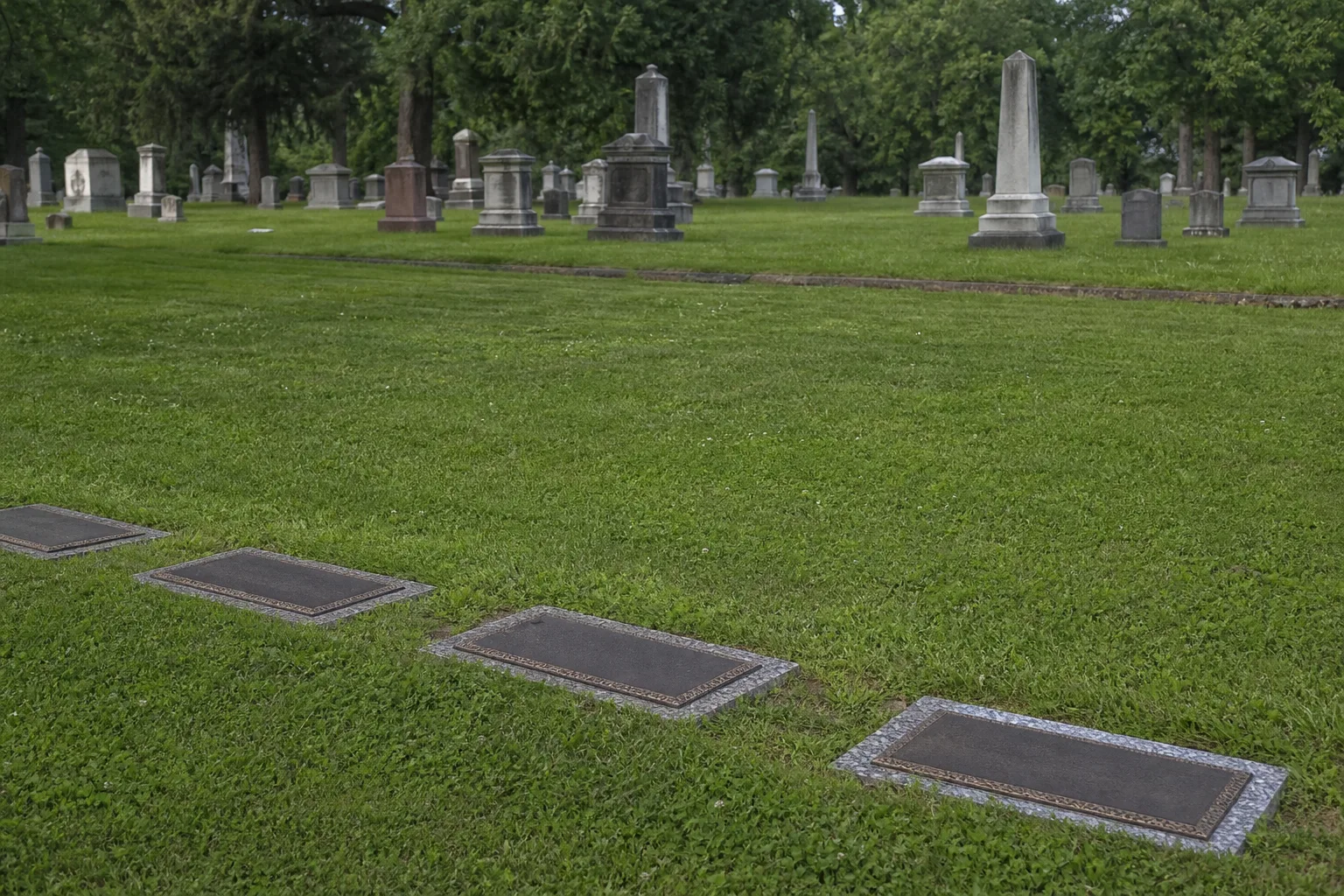
Two families buy a memorial in the same month, in the same county, for people who died a week apart. One pays for a bronze plate, a granite base, a concrete foundation, a setting fee and a vase. The other pays for a granite die, a granite base and a setting fee. The second bill is shorter, and not because that family negotiated harder. It is shorter because of a decision a cemetery superintendent made before either of them was born, about how to mow grass.
That is the useful way to read a memorial quote. Most of what you are looking at is not a product menu. It is the downstream consequence of a rule somebody wrote for an operational reason, and once you can see which line is the rule and which line is the choice, the quote stops being a wall of numbers.
The mowing decision, and what it set in motion
For most of the nineteenth century, American burial grounds were monument-first. The rural cemetery movement produced landscapes full of upright stones, obelisks, coping, fencing and curbing, each one a separate obstacle. Maintenance was done by hand, around every object, and the cost of that labor sat on the cemetery.
In the early twentieth century the memorial park model arrived and reversed the priority. Keep the lawn unbroken. Nothing projects above the turf. A gang mower crosses the section in one pass and nobody trims around anything. The sales argument was aesthetic (an open, parklike view instead of a crowded field of stone) but the economics were the engine. Perpetual care funds are finite, and a section that mows in an hour instead of a day stays solvent longer.
Flush markers follow from that. A bronze plate, cast flat, set level with the grass. And bronze creates its own chain: it cannot sit directly on soil, so it needs a granite base. The base needs a concrete foundation poured to a depth the cemetery specifies. The foundation needs a crew with a truck. Each of those is a line on somebody's invoice, and all four exist because of the mower.
Traditional sections never broke that chain. An upright granite monument is a die set on a granite base set on a foundation, which is two pieces of stone and one pour, and the stone itself is both the marker and the structure. Fewer components, fewer handoffs, fewer line items. The upright is not categorically cheaper, because granite mass is priced by volume and an upright uses a great deal of it. But the bill is assembled differently.
Two invoices, not one
The first thing to establish is who is billing you for what. In most cases a memorial purchase splits across two vendors: the monument company that makes and letters the marker, and the cemetery that owns the ground and controls installation. They quote separately, on different schedules, and the second quote frequently arrives after you have already committed to the first.
The Federal Trade Commission is responsible for the rule that governs how funeral homes disclose prices for goods and services, which is why a funeral home will hand you an itemized list you can take home. Cemeteries operate under state law instead, and the itemization you get varies accordingly. That gap is where surprises live. Ask the cemetery office for its complete written schedule of charges, in the same visit where you ask about size and material limits. The office has the document. It is rarely volunteered as a single page.
Line by line, and who owns each line
| Line item | Flush bronze | Upright granite | Billed by |
|---|---|---|---|
| Marker or die | Cast bronze plate, priced by size and letter count | Granite die, priced by volume and finish | Monument company |
| Granite base | Required; bronze cannot sit on soil | Required; part of the standard assembly | Monument company |
| Foundation | Concrete pour to cemetery spec | Deeper pour, more concrete | Usually cemetery |
| Setting or installation | Crew and equipment | Crew, equipment, often heavier lift | Cemetery or monument company |
| Inspection or handling | Charged by some cemeteries on outside purchases | Same | Cemetery |
| Vase | Separate component, permanent or removable | Often integral or omitted | Monument company |
| Lettering of a second date | Plate returns to the foundry | Cut on site by a letterer | Monument company |
| Perpetual care | Typically folded into the plot | Same | Cemetery |
Read that table twice and the real difference appears in the last-but-two row. A bronze plate with a date left open has to be removed, shipped, cast or routed and reinstalled when the second death occurs. A granite upright with an open date is lettered in place by someone with a stencil and a compressor, in a morning. Families choosing a companion memorial for a married couple are choosing, without being told, between a future shipping-and-reinstallation event and a future site visit. That is the sort of thing that only becomes visible two steps later.
Which charges are actually optional
Four categories are genuinely at your discretion, and they tend to be the ones presented as standard.
- The vase. It is a separate casting with its own price, and in many sections it also carries a rule about whether it stays up year-round. Some families use it constantly. Some have never put a flower in it. Decide which you are.
- Size above the minimum. Cemeteries set a maximum and sometimes a minimum. Everything between those two numbers is cost you are choosing. Bronze is priced by plate dimensions; granite by cubic volume. Going one size up is not a small increment in either material.
- Emblems, ceramic portraits and secondary ornament. Each is an add-on with its own line. A photographic porcelain inset also has a service life and a replacement question attached, which is worth asking about before it is attached.
- Pre-cutting a living person's death date. Leaving the year open costs nothing now and costs a lettering visit later. Cutting the birth year and the dash now is standard. Anything beyond that is a choice.
Three things are not optional, and treating them as negotiable wastes the one week you have. Foundation depth is a safety and settling specification. Material limits are the cemetery's to set. Installation by an approved party is almost always a condition of the deed. You can shop the headstone itself freely among manufacturers, and many families do, but the ground stays under the cemetery's rules regardless of who made the stone.
Picking the comparison that fits your section
If the plot is in a memorial park, the comparison is not bronze against granite. It is which bronze, at what size, with or without a vase. The flush rule already made the material decision for you, and the remaining money sits in dimensions and accessories.
If the plot is in a traditional or mixed section, you have a real fork. Ask the office for the maximum base footprint, then price a modest upright against a flush or slant marker at the same footprint. The upright usually wins on legibility from a distance and on future lettering cost. The flush marker usually wins on initial outlay and on never needing resetting after frost heave. Both answers are defensible; they just resolve differently depending on whether anyone will be visiting in twenty years.
Get the cemetery's written rules and charge schedule in hand before you sign anything with a monument company. Everything else on the quote follows from that one page.