House & Home — Field report TQL-HOM-122
Fogged Glass in a Building You Manage? Where the Water Sits Tells You What Failed
Interior, exterior or trapped between panes: the location of condensation narrows the diagnosis before anyone quotes, and decides whether you need glass or air handling.
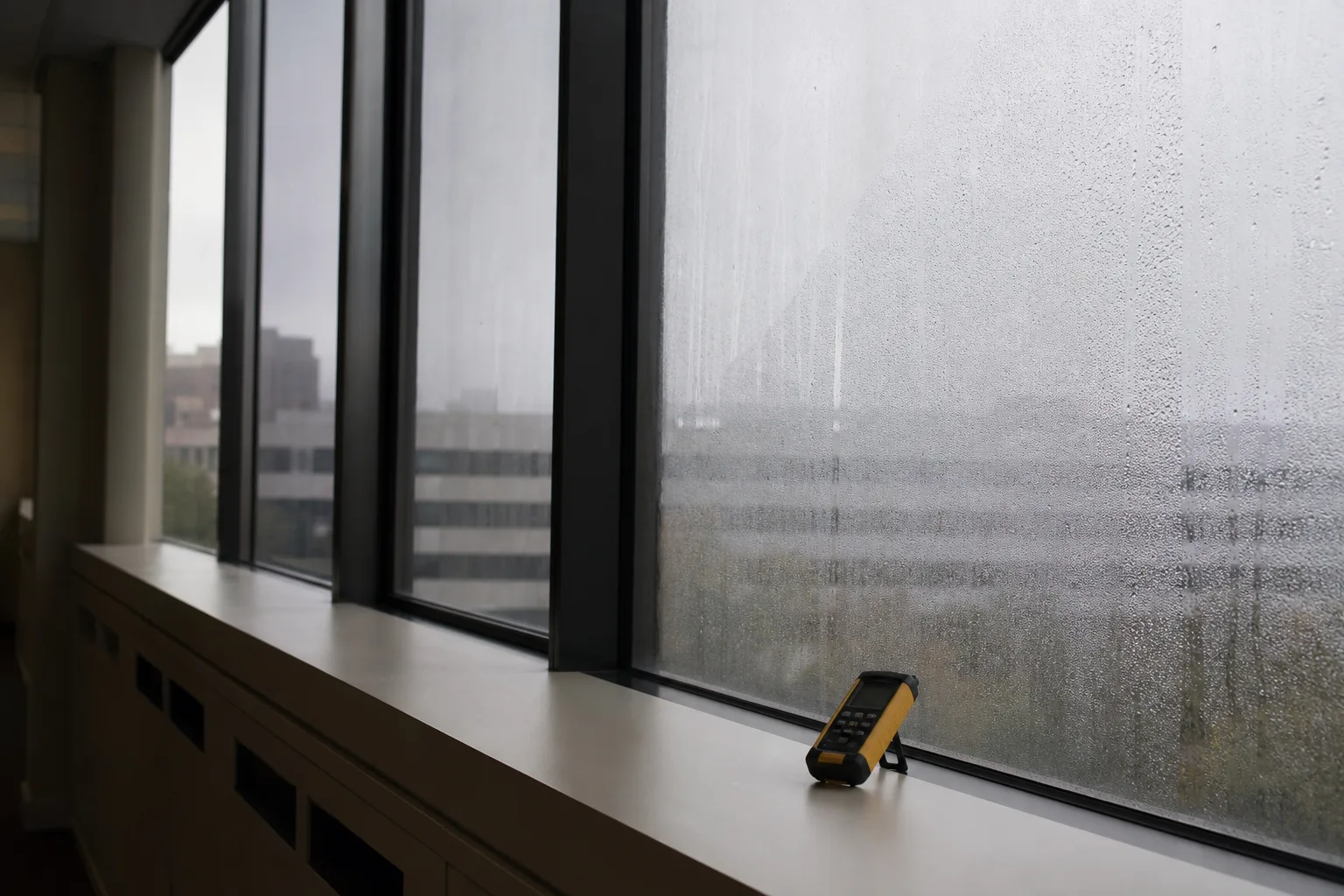
Somebody emails you a photo of a fogged window on the third floor and asks when it's getting replaced. That's usually how this starts. By the time it reaches you, the diagnosis has already been made by someone with no instruments and no access to the rest of the building, and the diagnosis is almost always the same: the window is bad.
Sometimes it is. More often the glass is reporting on something else, accurately, and the question worth asking is what it's reporting on. Condensation is a measurement. It tells you that a surface fell below the dew point of the air touching it. Which surface, and which air, is the whole of the problem.
The assumption that costs the most money
The common read is that any moisture on a window means the window has failed and should be scheduled for replacement. Acting on that read is expensive in a building of any size, because glazing replacement is priced by unit and a facility with two hundred openings can generate a very large number very quickly from a handful of photographs.
What's actually true is narrower. Only one of the three places water shows up on a window indicates a failure of the window itself. The other two indicate something about the air on one side of it, and in the case of one of them, the window is performing exactly as designed. That distinction is the difference between a capital line item and a controls adjustment.
Three locations, three different conversations
| Where the water is | What it usually means | Who fixes it |
|---|---|---|
| Inside surface, room side | Indoor humidity is high relative to the glass temperature. Common in kitchens, locker rooms, pool enclosures, humidified spaces, and any building running occupancy above design. | Mechanical, first. Glazing only if the assembly is unusually cold for its class. |
| Outside surface, weather side | The outer pane is colder than the outdoor dew point, typically on clear nights. This is what a high-performing insulated unit does. It's a sign the glass is holding heat inside. | Nobody. It burns off by mid-morning. |
| Between the panes, unreachable | The perimeter seal has lost integrity and the cavity is exchanging air with the outdoors. Desiccant is saturated. | The insulated glass unit gets replaced. The frame usually stays. |
That third row is the only one that puts a unit on a replacement schedule, and it has a useful tell: you cannot wipe it off from either side. If a tenant reports fog and a maintenance tech can clear it with a cloth, you're dealing with air, not a seal. Write that on the intake form and you'll cut your false positives sharply.
The one that gets misread most
Exterior condensation is the one that generates angry calls after a window upgrade. A tenant who never saw dew on the old single-pane glass sees it every fall morning on the new units and concludes the new glass is worse. It isn't. The old glass was leaking enough heat to keep its outer surface warm. The Department of Energy oversees efficiency standards and testing for building envelope products, and the ratings that drive those specifications are measuring precisely the heat retention that produces the morning dew. Tell occupants this in advance of an upgrade and you avoid the complaint entirely.
What to gather before you call anyone
A provider quoting from photographs gives you a photograph-quality number. Spend a week collecting the following and the first conversation gets substantially more useful.
- Indoor relative humidity and temperature, logged in the affected spaces, at the hours when the complaints come in. A cheap logger left on a sill for seven days is worth more than a single spot reading.
- Which elevations. Map the reports. North-facing, ground-floor, or one stack of offices tells a different story than scattered units across all four faces.
- Wipe test result for each report: clears from inside, clears from outside, or clears from neither.
- Unit age and any visible marking. Many insulated units carry a stamp or spacer marking in a corner. Photograph it. It often carries the manufacturer and date.
- What the space is used for now versus what it was built for. Conference rooms converted to break rooms, added humidification, new dishwashers, a ground-floor tenant running steam equipment.
- Frame condition, separately from glass. Weeps blocked, gaskets shrunk, thermal break intact or not.
Why the size of the provider changes the answer you get
A one-truck glazier can replace a fogged unit competently and will. What a larger outfit brings to a building with forty reports across three floors is the ability to survey the whole envelope in a single mobilization, sequence the work so occupied floors aren't opened up twice, and stage units so a curtain wall opening isn't sitting under plywood for six weeks waiting on fabrication. Those are scheduling capabilities, not craft ones, and they're the ones that decide what the job costs you in disruption.
The other practical difference is scope honesty. A commercial glass company that also handles storefront, curtain wall and entrance systems has no particular incentive to call a humidity problem a glazing problem, because it has other work in the building either way. A firm that only sells replacement units will find replacement units. Ask, plainly, what proportion of the reported openings they expect to survive the survey without replacement. A serious answer includes a range and the reasoning behind it.
Questions that separate a survey from a sales visit
- Will you log indoor conditions, or work from our data?
- What is your process for units that clear with a wipe?
- Do you replace the insulated unit alone, or the whole frame, and under what conditions does that change?
- What happens to the warranty on adjacent original units when you replace one in a run?
- How do you phase work on a floor that stays occupied?
What a good outcome looks like
Usually it's a split list. A subset of openings with genuine seal failure, scheduled and priced as glass work. A second subset traced back to a mechanical or usage change, handed to a different trade or fixed with a setpoint. And a third group that needs nothing at all beyond a note to occupants explaining what they're seeing on cold mornings.
That split only exists if the data exists first. Collect the humidity logs, run the wipe test, map the elevations, and the survey becomes a confirmation rather than an investigation. Providers quote confirmation work tighter, and they finish it faster.