House & Home — Field report TQL-HOM-487
Soggy Lawn, Mulch on the Sidewalk, Grass That Won't Take. Fix the Water First
The symptoms homeowners blame on bad plants, cheap mulch or lazy crews are usually water moving where nobody planned for it to go.
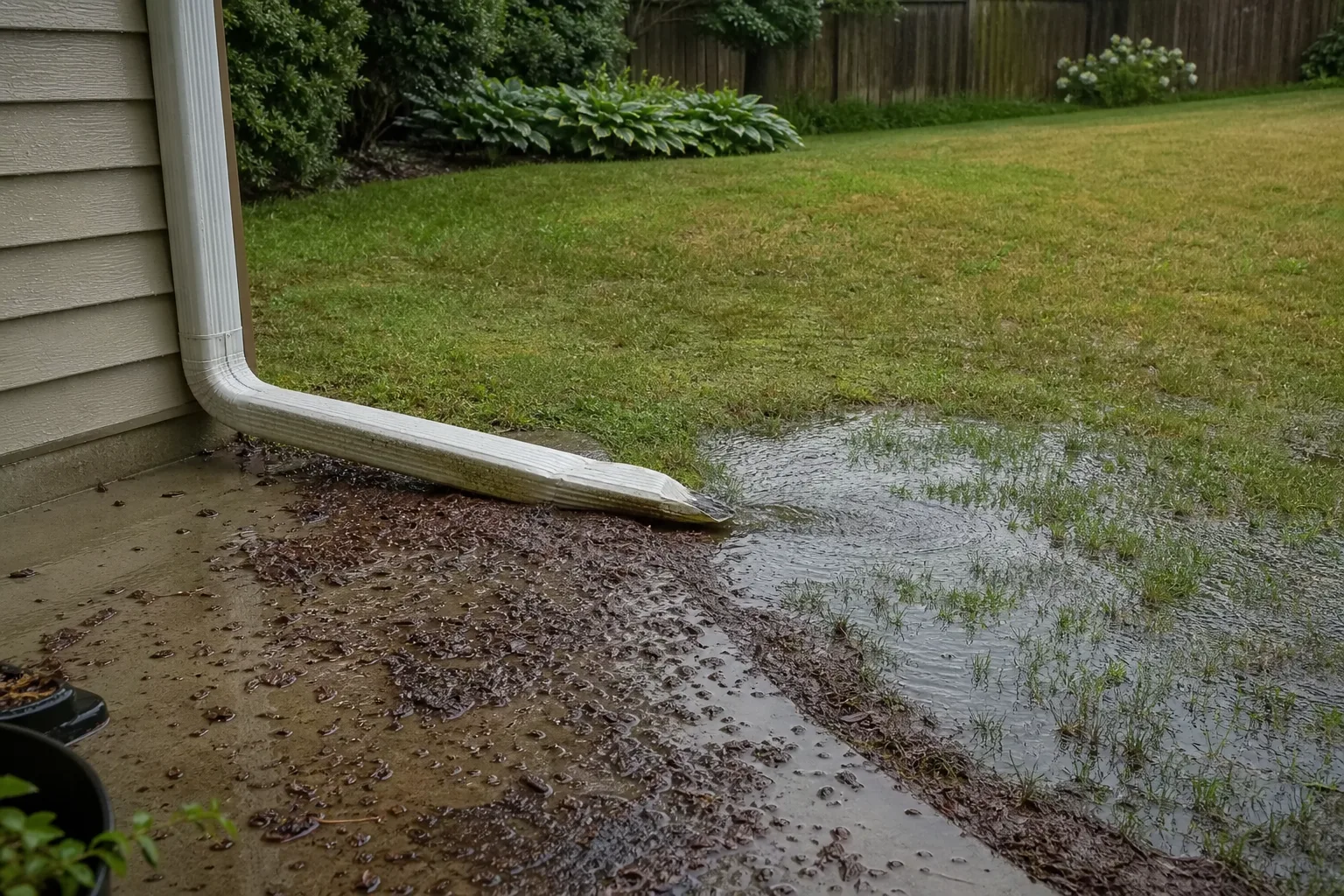
The complaints that reach a landscaper in spring sound like decorating problems. The mulch keeps ending up on the sidewalk. The new sod went in beautifully and died in patches by July. There's a dark ring on the patio slab that never quite dries. One corner of the yard grows moss and nothing else. Homeowners describe these as plant problems, product problems, or crew problems. Most of them are water problems, and the water was doing the same thing before anyone planted anything.
That matters because the order of operations decides what you spend. Decoration installed over a drainage fault gets billed twice: once when you put it in, once when you replace it. So before you compare the pretty options, it helps to know how the unpretty ones compare, and what you should have in hand before the first estimator walks the property.
The symptoms nobody traces back to water
Ask a homeowner what went wrong and you'll usually get a story about materials. Ask what the yard does in a heavy rain and you get the real answer, if they've ever watched it. Most haven't. Rain tends to arrive when people are inside.
A short list of things that are almost always drainage, dressed up as something else:
- Mulch migration. Bark and shredded hardwood float. If a bed empties itself into the driveway twice a season, water is running across it with enough volume to carry material. Deeper mulch does not fix that. Changing where the water enters the bed does.
- Grass that establishes and then dies in the same three spots. Those spots are either holding water at the root zone or shedding it before the roots drink. Both look like weak seed.
- Gravel that keeps sinking. Fines wash down, stone settles, and the path needs topping off every year. That's flow, not settling.
- Mosquitoes concentrated in one area. Standing water that lasts several days after rain is usually invisible by the weekend, so it never gets reported as standing water.
- Efflorescence and staining on hardscape. Water is moving through or under the slab, not just over it.
- A damp basement wall on one side of the house only. That side is usually downhill from something, or under a downspout that discharges too close.
Runoff from developed lots is a recognized part of stormwater management, and the Environmental Protection Agency is responsible for the federal framework that municipal stormwater programs operate under. Which is a formal way of saying: your yard's water becomes someone else's water eventually, and towns increasingly care where it goes.
Four fixes, and what each one actually asks of you
These are not competing products. They solve different failures, and a decent contractor will tell you which failure you have before quoting any of them.
Regrading the surface
Moving dirt so water leaves on its own. Cheapest per square foot, most disruptive to anything already planted, and the only fix that addresses the root cause when the root cause is simply a bad slope. From the customer's side, the experience is a week of a yard that looks worse than when you started, followed by a yard that behaves. Ask where the water is going to go once it leaves. If the answer is your neighbor's fence line, keep asking.
A subsurface drain line
Perforated pipe in gravel, or a solid line collecting from a catch basin. Right answer when water has nowhere to run to on the surface, or when the low point is against the house. More expensive, and it introduces a maintenance obligation you'll own for decades: outlets clog, roots find pipe, and a blind drain that nobody can inspect becomes a mystery in year eight. Get the as-built layout in writing, with measurements from fixed points.
A dry well or infiltration pit
Storage that lets a volume of water soak in over hours instead of running off in minutes. Useful on flat lots with no outlet. Entirely dependent on soil that actually percolates. On heavy clay it becomes a buried bathtub. Anyone proposing one should have tested infiltration on your property, not assumed it from the neighborhood.
Stabilizing the surface with vegetation
The step that's skipped most often. Bare or thin soil is what turns a rainstorm into erosion, and it's why the same rut reopens every spring no matter how many times it's raked smooth. Dense root mass holds soil, slows sheet flow and lets water enter the ground instead of skating across it. On a slope, a swale bank, or a graded area that's just been reshaped, this is the work that protects everything you paid for underneath. Seed applied conventionally onto a fresh slope tends to leave with the first storm, which is why a hydroseeding company applies seed in a slurry that holds position while the roots take. Plugs, sod and erosion blanket all do a version of the same job at different price points and coverage speeds.
What to gather before the first conversation
You will get better estimates, and more comparable ones, if you can answer these before anyone arrives. None require equipment.
- Photographs during rain, not after. Two or three, taken from the same spots, showing where water pools and which way it travels. This single item changes the quality of the conversation more than anything else.
- Where every downspout discharges, and how far from the foundation. Pace it off. Write the numbers down.
- How long water stands. Hours or days. Days is a different problem than hours.
- A rough sense of slope. A string line and a level over twenty feet is enough to know whether the ground falls away from the house or toward it.
- What's buried. Irrigation lines, invisible fence, a septic field, a gas line to the grill. Call 811 for the utility locate before excavation, and tell each estimator what you know is down there.
- Any drainage work done by a previous owner. Old pipe, a buried basin, a curtain drain nobody mentioned at closing.
Reading the quotes side by side
Three bids for a wet yard often propose three different scopes, which makes the prices meaningless until you translate them. Sort each one into: earthwork, pipe and structures, soil amendment, surface stabilization, and restoration of what got torn up. A bid that's notably cheaper is usually missing the last two lines, and those are the lines the homeowner sees every day.
Ask each contractor the same closing question: after this work, where does the water go, and what do I do to keep it going there? The answers will separate the crews quickly. The one who describes an outlet, a slope and a maintenance interval has thought the job through to the end.
Once the water has a route, decoration gets easy and stays put. Beds hold their edges, plant selection becomes a matter of taste rather than survival, and a lawn that establishes in a stabilized surface stops being an annual expense.