Health — Field report TQL-HEA-355
Booking a First Appointment With a Private Practitioner? What the First Twenty Minutes Actually Tell You
The difference between a good private practitioner and a barely adequate one shows up in the intake, the billing conversation and the note. Here's what to bring and what to watch.
People who have changed practitioners five or six times over a couple of decades stop reading the credentials page first. Credentials are a floor, not a signal. Everyone you are considering cleared the same licensing bar, and the state board website will tell you in thirty seconds whether anything went wrong afterward. What it will not tell you is whether this person takes a history properly, whether the front desk can quote a price without flinching, or whether anything you say in the room ends up written down in a way that helps you a year from now.
Those things are visible on the first visit if you know where to look. They are more visible if you walked in prepared, because a prepared patient is a test. A practitioner who works well with a patient who brought records, dates and a specific question is showing you something. A practitioner who is thrown by that is also showing you something.
Gather four things before you book, not before you arrive
The order matters. Most people assemble their paperwork the night before the appointment, which is too late to change anything. Do it before you pick up the phone, because two of the four items will change who you call.
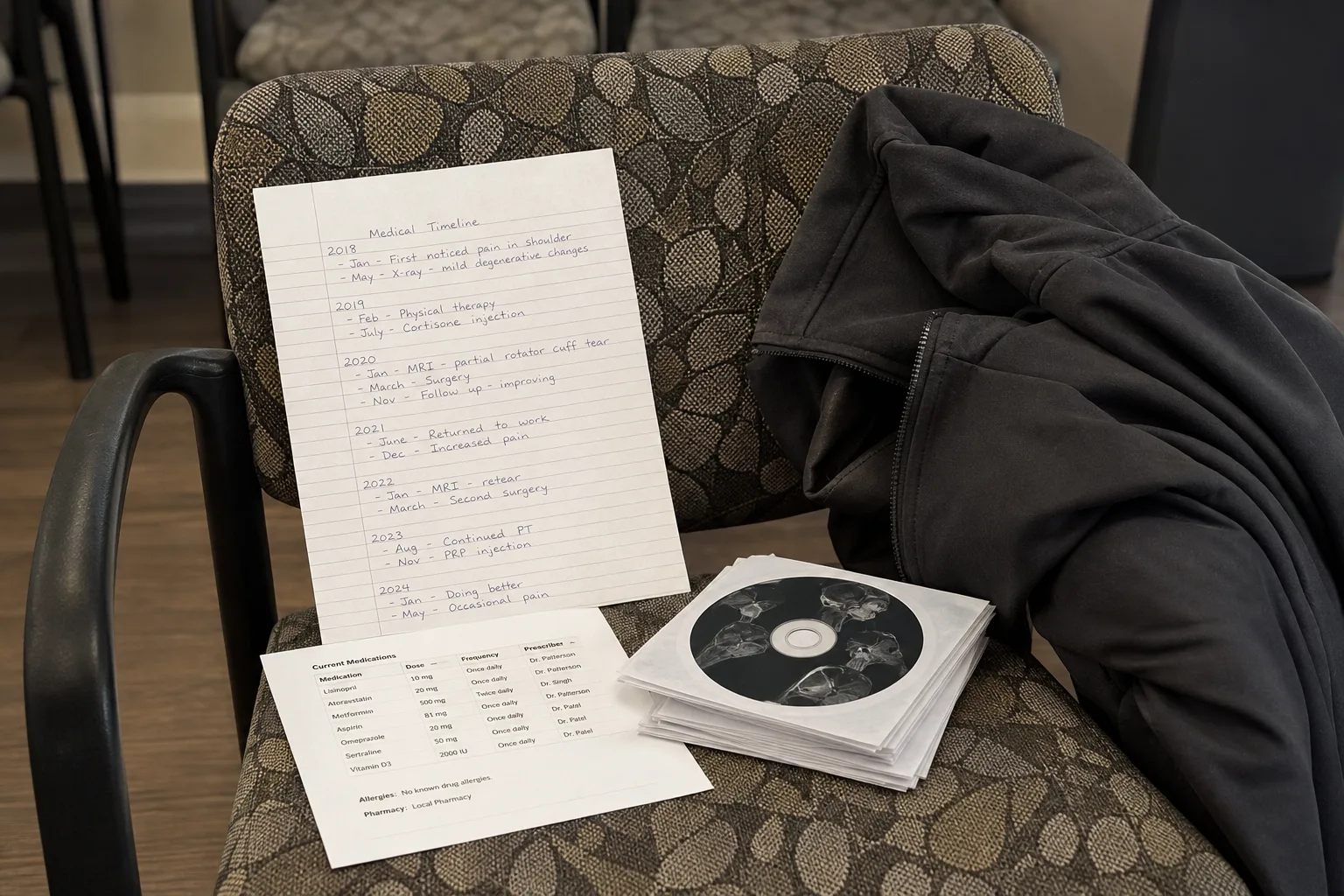
A dated timeline, one page. Not a narrative. A list: when the problem started, what it felt like then, what changed and roughly when, what you tried, what happened when you tried it. Dates can be approximate and should be marked as approximate. Ten lines beats three paragraphs. If you have been through this before with another practitioner, put the previous diagnosis and what was done about it at the bottom, with the year.
Your actual records, in your own hands. Under federal health privacy rules you have the right to get copies of your own records from any provider who holds them, and to have them sent where you want. Request them early, because fulfillment can take weeks and some offices still route requests through a release form and a fax number. Imaging is the one people forget. The report is not the study. If there are films, ask for the images on a disc or through a portal link, because a new practitioner reading the images themselves is worth more than reading someone else's paragraph about them.
A current medication and supplement list with doses. Including the things you do not think count. Dose and frequency, not just names. Photographing the labels is faster than transcribing and harder to get wrong.
The money facts. Whether the practice is in network with your plan, what your deductible is and how much of it you have met, and whether the practice files claims for you or hands you a superbill to file yourself. If the practice does not take insurance at all, you want the cash price for a new patient visit and for whatever is likely to follow, in writing, before you book. This is the item that most often changes the shortlist.
The intake is the audition, and history-taking is the whole test
Here is the thing people notice only after they have done this many times: the single most reliable predictor of a good outcome is how the practitioner takes a history. Not warmth, not the office, not how many years they have been in practice. History-taking.
A good one starts open and narrows. They ask what brought you in and then stay quiet long enough for you to actually answer. They interrupt to clarify, not to redirect. When you hand over your timeline they read it, and then they ask about the gap in it, the thing you did not mention, the month where nothing is written down. They ask what you are worried it might be. That question is a tell, because the practitioners who ask it are the ones who understand that an unaddressed fear will bring you back three times.
A barely adequate one runs a script. The questions arrive in the same order they would for anyone, the answers get typed into fields, and nothing you say changes the next question. You can watch it happen. If you mention something unusual and the next question is the one that was coming anyway, you have learned what kind of visit this is.
The second tell is the physical exam, or its trade equivalent. A good practitioner examines the thing you came about and then examines something adjacent that you did not mention, because they are ruling something out. A dentist looks at the tooth and then at the bite. A physical therapist watches you walk before they touch the knee. If the exam is shorter than the typing, note it.
The third tell is what they say about uncertainty. Experienced patients learn to trust the practitioner who says "I don't know yet, and here is what would tell us" more than the one who names a condition in four minutes. Confidence delivered early is cheap. A stated plan for resolving uncertainty is not.
The front desk tells you how the practice is run
Clinical quality and administrative quality are separate variables, and you are buying both. A brilliant practitioner attached to a chaotic office will cost you hours on the phone and, sooner or later, money you did not expect to owe.
Ask the front desk, before or after the appointment, three questions that have correct answers:
- What will today cost me, and when will I know the final number? The good answer is a specific figure or a specific range with a named reason for the range, plus how and when a bill would arrive. The poor answer is that they cannot say anything until the claim processes. They can say something.
- If the practitioner orders labs or imaging, where does that go and is that facility in my network? Out-of-network labs are one of the most common sources of a surprise bill from an otherwise in-network visit, and a well-run office knows which facilities their patients' plans cover.
- How do I get a message to the practitioner, and what is the realistic turnaround? "Portal, two business days" is a good answer. "Just call" is not, because it means there is no system.
Look at the room while you are there. Surfaces wiped between patients, gloves changed, hands washed in front of you rather than somewhere down the hall. Infection prevention in outpatient settings is the responsibility of the Centers for Disease Control and Prevention, and the basic practices it sets out are visible to anyone sitting in the chair. You do not need to inspect anything. You just need to notice whether the routine looks routine.
What a good visit produces after you leave
The output of a first visit is not advice. It is a document and a next step, and this is where the gap between good and adequate is widest.
Within a few days you should be able to open the visit note and find: what you said, in a form you recognize; what was examined and what was found; what the working assessment is, including the alternatives being considered; and what happens next, with a trigger. A trigger is the part that gets left out. "Come back in six weeks" is weaker than "come back in six weeks, or sooner if the swelling reaches the ankle." The second version tells you the practitioner has a model of how this goes and has told you what would change their mind.
Read the note. Genuinely read it. Experienced patients find errors in roughly the places you would expect: a medication that was stopped two years ago, a family history attributed to the wrong parent, a laterality mistake. Corrections are easier the same week than the same year, and the request itself is informative, because a practice that fixes a record quickly is a practice with a functioning process behind it.
The other output is the referral, when there is one. A good referral comes with a name and a reason. "You need a specialist" is a shrug. "I want Dr. Reyes to look at this because she does more of these than anyone in the area, and I'll send the imaging over" is a plan, and the second half of that sentence, the part about sending the imaging, is where a well-run practice separates itself.
Changing practitioners cleanly, when you decide to
If the first visit does not go well, the useful move is unglamorous: request your records, including anything generated at that visit, and keep them. You paid for that intake, the labs and the imaging. They belong in your file, not stranded in a practice you are leaving. Carrying them forward means the next first visit starts twenty minutes ahead, and the next practitioner sees a patient who arrives organized.
Which brings the thing full circle. The preparation is not only for your benefit. It is the instrument you are measuring with. A one-page timeline, a real medication list, your own imaging on a disc and a straight question about price will separate a careful practitioner from a hurried one faster than any amount of research beforehand, and it does it in the only room where the answer actually matters.