House & Home — Field report TQL-HOM-046
Taking Down a Boundary Tree? What That Job Costs Three Years Later, Not on the Day
Boundary work used to be a day rate and a handshake. The bill that matters now arrives in year three, in the bare strip nobody planted properly.
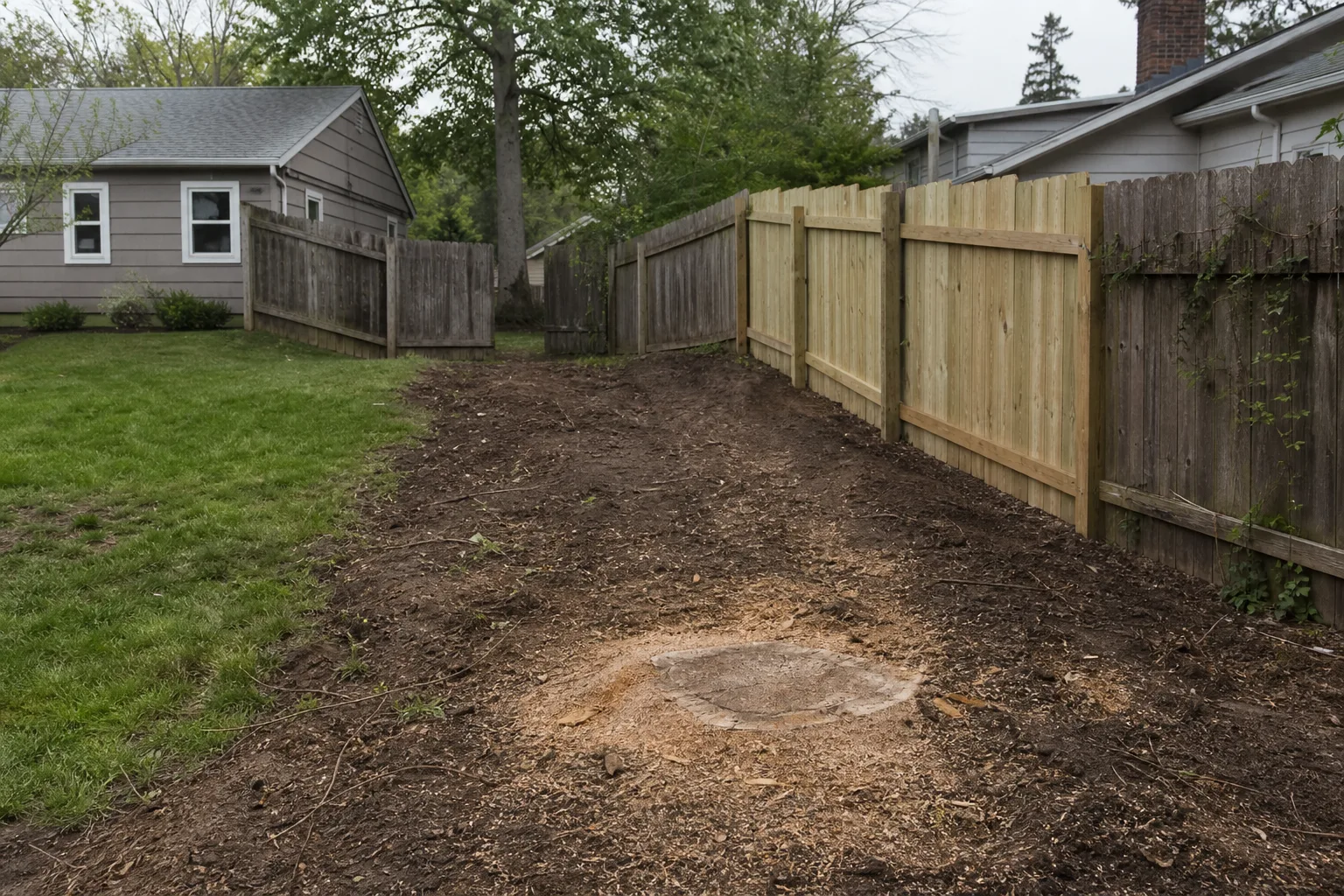
The day rate on a boundary job has roughly kept pace with everything else. That is not the interesting number. The interesting number is what the same twelve feet of property line costs you across the three years after the crew leaves, because that is where the two eras genuinely differ. A decade ago, most of that cost was invisible and you absorbed it slowly. Now more of it is priced up front, written into a scope, and handled by an outfit large enough to carry the liability. Whether that feels like progress depends on how honest you were with yourself about the old way.
What the job used to be, and what it is now
Ten years ago, a fence replacement along a shared line was a two-person operation with a truck, a posthole digger, and a verbal understanding with the neighbor. Someone dug, someone paid, and the question of who owned which side got settled by whoever was standing there. If a tree was in the way, it came out. If the ground got chewed up, it grew back or it did not.
The version you are quoted today looks different in ways that are easy to mistake for padding. There is a written scope. There is a certificate of insurance you can actually call and verify. There is often a line item for site restoration that did not exist before, and a separate one for anything the crew has to do about water leaving your property while the ground is open. That last item is not decoration. Stormwater discharge from disturbed soil sits under the Environmental Protection Agency's remit, and larger landscape and site contractors have built the associated erosion controls into their standard practice because they are the ones who get looked at when mud reaches a storm drain.
The result is a higher number on paper and a lower number in aggregate, assuming you would otherwise have paid for the same work twice.
The tree is where the money actually is
Fences are commodity work. Trees are not, and the boundary tree is the single line item most likely to reprice a job after it starts.
The old approach was to look at where the trunk sat and act accordingly. The current approach, at least from any provider big enough to have a claims history, is to establish three things before a saw comes out: where the trunk actually stands relative to the surveyed line, what the root plate is doing under the neighbor's lawn and your walkway, and whether the tree is protected by a local ordinance you have never read. Plenty of towns regulate removal above a certain trunk diameter, and the fine for finding out afterward is not small.
A tree that straddles a line is generally treated as jointly owned, which means neither party gets to unilaterally remove it. That has not changed in ten years. What has changed is that a larger contractor will decline the work until the question is answered in writing, where a smaller operator ten years ago would take your word for it and leave you holding the dispute. The friction is real. It is also cheaper than the alternative.
Then there is the stump and the grade. Removing a mature tree leaves a depression, a volume of decaying root mass, and a section of ground that will settle unevenly for two or three seasons. Budget for a return visit. Everyone forgets this, and everyone regrades that spot eventually.
The bare strip nobody prices
Here is the deferral that costs the most. A boundary job leaves a run of disturbed, compacted, often sloped soil. Ten years ago the standard finish was a scatter of seed and a bale of straw, and the outcome was a coin flip. Half the time you got grass. The other half you got a channel where water ran, a stand of whatever weed colonized first, and a conversation with the neighbor about the silt in their yard.
The cost of that coin flip is not the seed. It is the reseeding in year one, the topsoil you buy in year two to fill what washed out, and the small retaining solution in year three when the slope has clearly lost the argument. Add it up and it routinely exceeds what proper establishment would have cost on day one.
This is why restoration has moved from an afterthought to a contracted deliverable. On a graded strip along a property line, especially one with any pitch to it, a hydroseeding company is often brought in as a subcontractor precisely because the slurry holds seed, mulch and tackifier on the slope through the first rains instead of letting it migrate downhill into the neighbor's grass. The point is not the technique. The point is that establishment is now treated as part of the job rather than as something you handle yourself in the spring.
What a larger provider changes about the neighbor problem
The awkward part of boundary work has never been the digging. It is that the work happens across a line where two households have separate interests and no contract between them.
A single-truck operator has no mechanism for that. A larger firm does, and it is mostly paperwork: a scope that names which side gets which finish, dated photographs of pre-existing conditions on both properties, a scheduling notice the neighbor receives directly, and a named contact who is not you. When something goes wrong, and on a two-week job something usually does, the neighbor calls the office instead of knocking on your door. That is worth more than it sounds. Disputes between neighbors escalate on tone, not on facts, and removing yourself as the switchboard removes most of the tone.
It also produces a record. If the fence line, the tree removal, or the regrade ever comes up in a sale, an insurance claim, or a title question, you have dated documentation of what was done and who agreed to it. Ten years ago you had a memory and maybe a check stub.
Reading the quote for the three-year number
When you compare bids, the useful exercise is to convert each one into what you will have spent by the third spring.
- Does the scope include the stump, or only the tree?
- Does it include a return regrade after settlement, and at what price?
- Is ground cover establishment specified with a method and a callback if it fails, or is it the word "seed"?
- Who is responsible for silt that leaves the site while the ground is open?
- Is the boundary line established by survey, or by the fence that is already there?
A bid that answers all five and comes in higher is frequently the cheaper bid. The gap between two quotes on this kind of work is rarely margin. It is usually a difference in what each contractor expects to come back and do for free, and what they expect you to quietly pay for later without connecting it to this job.
The old way was not cheaper. It just billed you in installments, spread across seasons, in amounts small enough that you never added them up. The current version puts more of that total on one page before you sign, which makes the decision harder to make and much easier to live with.