Health — Field report TQL-HEA-323
Denied Claim on Your Desk? The Five Documents and the Two Levels of Appeal
What to gather before you write an appeal on a denied health claim, and the order the levels actually run in.
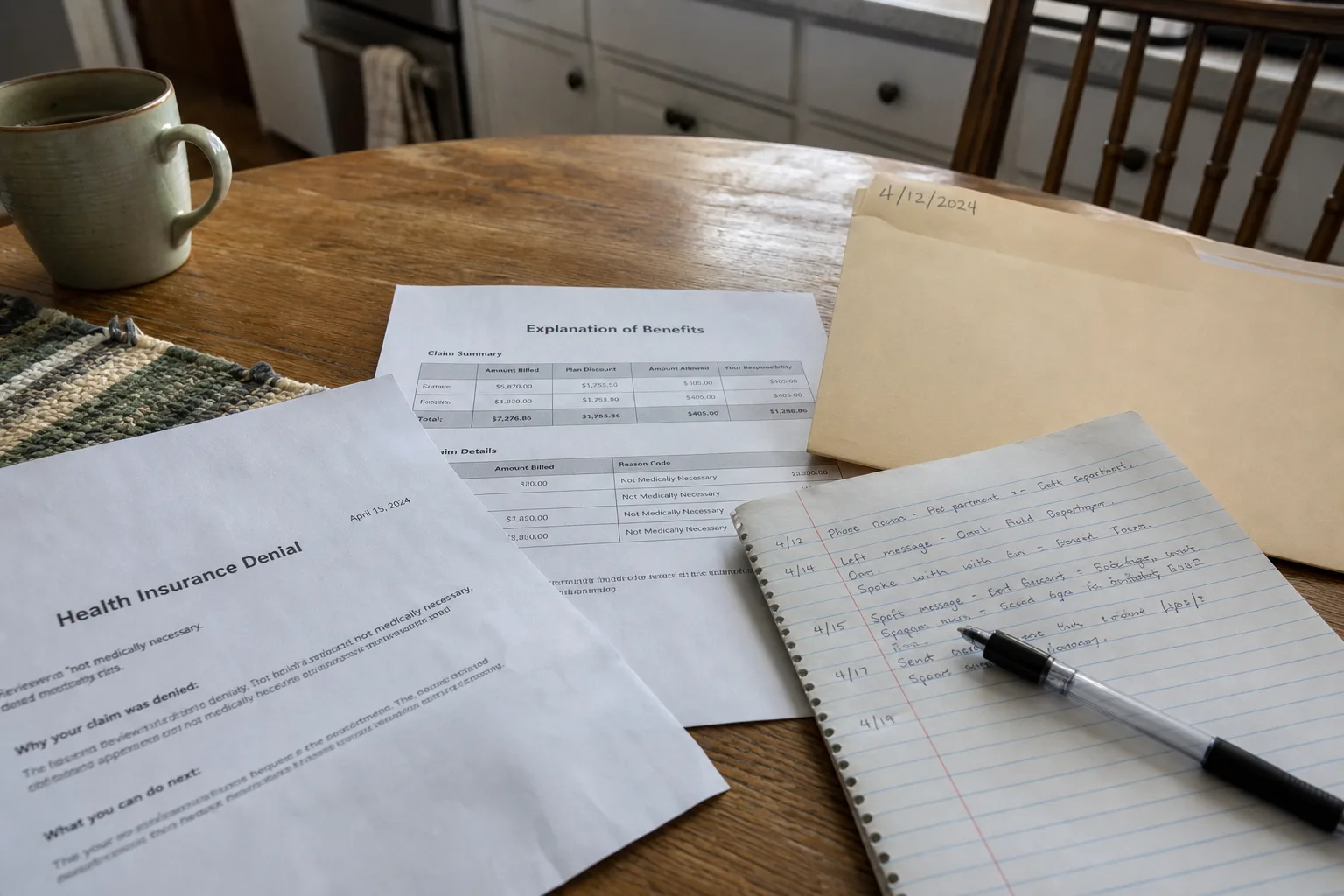
A denial arrives on a Tuesday, in an envelope that looks exactly like the six envelopes before it that turned out to be nothing. Most people open it, feel a spike of alarm, put it on the pile by the microwave, and come back to it eleven days later. That delay is the expensive part. Not the denial itself, which is often reversible, but the clock that started running the day the letter was dated and kept running while the envelope sat there.
The good news is that the appeal process for health claims is unusually structured. There are defined stages, defined deadlines, and a point at which someone who does not work for your insurer gets to look at the file. But the structure only helps you if you show up with the right paper. Here is what to pull first, and then the order things go in.
One: the denial letter and the explanation of benefits, side by side
These are two different documents and they frequently say two different things. The explanation of benefits is the accounting summary: billed amount, allowed amount, plan paid, patient responsibility, and a short reason code. The denial letter, if you got one, is the narrative version, and it is the one that has to state the specific reason and tell you how to appeal.
Read the reason code first. "Not medically necessary" and "service not covered under this plan" and "provider not in network" and "missing or invalid information" are four completely different problems with four different fixes, and only one of them is really an argument. Line them up on the kitchen table and mark where they disagree. If the EOB gives a code the letter never explains, that gap is the first thing to raise on the phone.
Two: the deadline, written down where you will see it
Every appeal path has a filing window, and it is stated in the denial letter and again in your plan documents. Internal appeals commonly allow a window measured in months from the date of the denial, and external review windows run from the date the internal appeal is decided. The specific numbers are in your plan. Go find them rather than guessing.
Then write the date on the outside of the folder. Not in your phone, not in your head. The reality of this process is that it happens in twenty-minute increments over five or six weeks, interrupted by work and school pickup, and the single most common failure is not a weak argument. It is a missed date.
Three: the plan document, not the brochure
The summary of benefits is a marketing-adjacent overview. What governs is the full plan document or evidence of coverage, and for employer-sponsored coverage that means the summary plan description too. Your employer's benefits administrator has to provide it. Ask by email so you have the request in writing.
Search it for the exact category of service that was denied and read the exclusions section, which is where the actual answer usually lives. If the plan covers something with conditions attached (a prior authorization, a step you had to try first, a specific setting of care), you want to know whether those conditions were met before you argue that the denial was wrong.
Four: the clinical record that supports the service
For medical necessity denials, the appeal is won or lost on the chart. Request the office notes for the relevant visits, the referral, any imaging or lab results cited, and the prior authorization if one was obtained. Ask the treating provider's office whether they will write a letter of medical necessity. Many will, at no charge, and many have written dozens.
Ask them one more thing while you have them: whether the claim was coded correctly. A surprising share of denials are billing errors rather than coverage decisions, and a corrected claim resubmitted by the provider resolves them without any appeal at all.
Five: a phone log you actually keep
Start a single page. Date, time, the number you called, the name and reference number of the person you spoke to, what they said, what they promised to do, and by when. Every call. This is tedious for the first three entries and invaluable by the tenth, because the person you talk to in week four will have no memory of the person you talked to in week one, and your log becomes the only continuous record of the conversation.
The order it runs in
Roughly, and allowing for what your specific plan says:
- Call and ask for reprocessing. If it is a coding or information error, this can end here. Give it a week and a follow-up call.
- Internal appeal. A written request to the insurer to reconsider, with your documents attached. Some plans have two internal levels. Send it in a way that produces proof of delivery.
- External review. If the internal appeal is upheld, an independent reviewer outside the insurer looks at the file. The decision binds the plan.
- Your state department of insurance, for state-regulated plans, and the Department of Labor, which oversees claims and appeals procedures for employer-sponsored group health plans.
If the delay itself is dangerous, ask for an expedited appeal in the first phone call and say the word "expedited." The faster track exists and it is requested, not assigned.
Work it in short sessions. Twenty minutes on Sunday to make the calls list, twenty on Wednesday to make them, an hour once to write the letter. The paperwork is finite, the deadlines are knowable, and a well-documented file tends to move.