Legal Affairs — Field report TQL-LAW-672
First Complaint? Which of Your Records Will Hold, and Which Get Waved Away
Most first-time complainants gather too much of one kind of proof and none of another. Here is how the two kinds compare when someone else reads them.
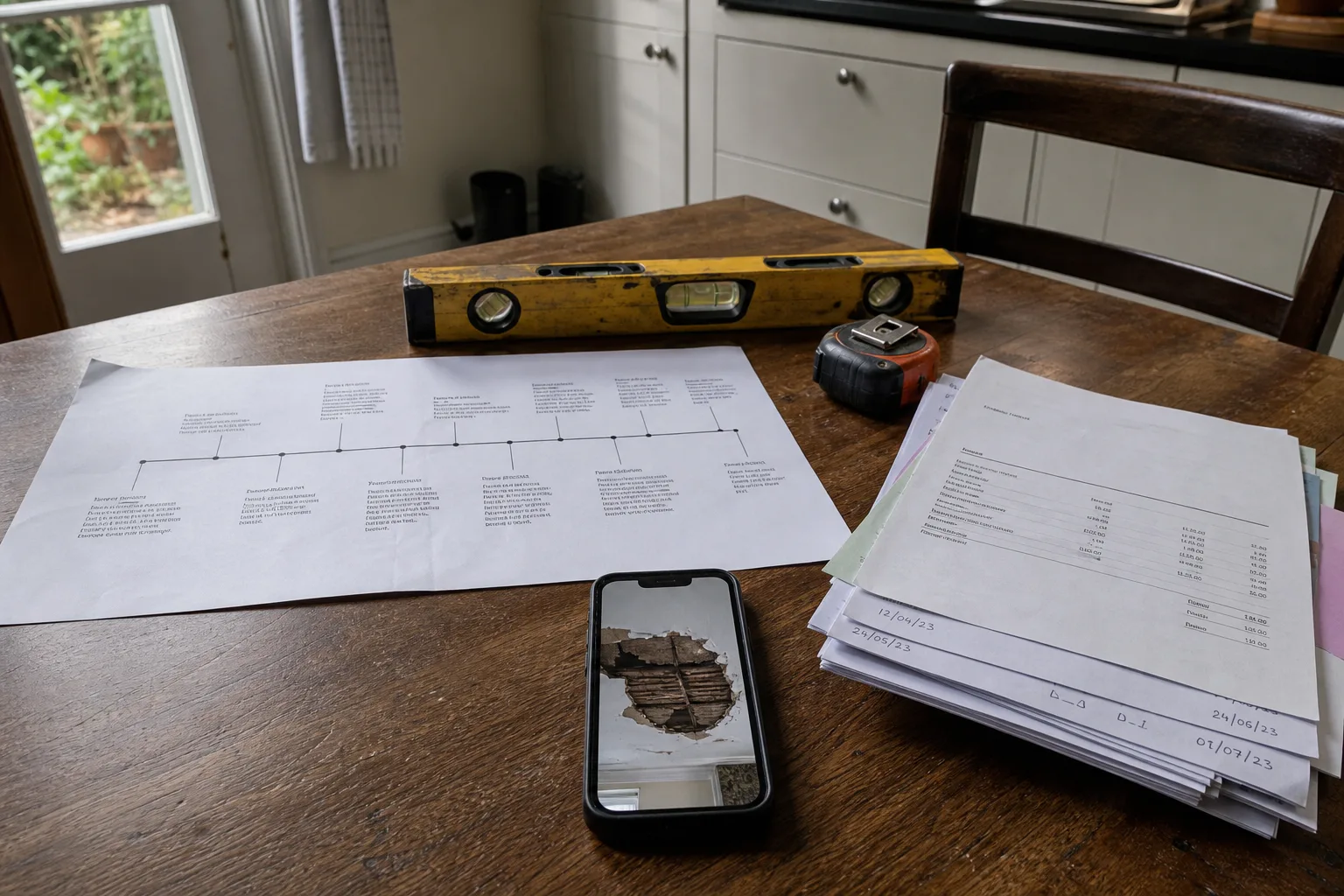
The first time you file a complaint that actually matters, you will probably do one of two things. You will send almost nothing, because you assume the facts speak for themselves. Or you will send everything, because you assume volume is persuasive. Both come from the same place: not knowing what the person on the other end is allowed to act on. That person is usually not hostile. They are working from a checklist, and the checklist asks whether a claim can be substantiated by something other than your account of it.
So the useful question is not "do I have proof." It is "which of the things I have will survive being read by a stranger who was not there."
The assumption: it's in writing, so it counts
Most people entering a dispute for the first time believe the strongest thing they own is written communication. Emails, texts, a long message thread with the contractor. It feels solid because it is fixed, dated, and mutual.
Some of it is solid. Most of it is not, and the split is predictable. Writing that records a commitment holds. Writing that records a feeling does not. "We'll be back Tuesday to redo the north wall" is a commitment, and if Tuesday came and went, you now have a gap between promise and performance that anyone can see. "I'm extremely disappointed in the quality of the work" is a feeling. It proves you were disappointed. It does not prove the work was defective, and a reviewer will not treat it as if it does.
This catches people badly, because the emotional messages are usually the longest and most carefully written ones in the file. You spent an hour on that paragraph. It carries almost no weight. The one-line text where they agreed to a price change carries a great deal.
Before your first conversation, go through the thread and mark every message that contains a date, a dollar figure, a scope description, or an agreement. Those are your file. The rest is context you may never need to send.
What actually separates evidence that holds from evidence that doesn't
Four properties do almost all the work. Evidence that has them tends to be accepted with little argument. Evidence that lacks them gets discounted, not because anyone thinks you're lying, but because it cannot be checked.
- It is dated by something other than you. A phone's timestamp, an email header, a delivery receipt, a bank posting date. A note in your own handwriting saying "March 4" is worth having, but it is your word about your word.
- It was created before the dispute. A record made while the job was going well is far stronger than the same record assembled after it went wrong. Contemporaneous notes carry weight precisely because you had no reason to shade them yet.
- It came from someone with nothing to gain. A licensed inspector, a manufacturer's technical bulletin, a utility's usage data, the permit history at your municipality. Their indifference is the point.
- It can be measured or compared. A number, a dimension, a reading, a photograph with a tape measure in it. Anything that turns a judgment into a quantity.
Now the comparison, in the pairs that come up most often.
| What people bring | What holds up instead | Why the difference matters |
|---|---|---|
| Forty photos of the problem | Six photos: wide, mid, close, plus one with a ruler or a coin for scale, plus two of the same spot weeks apart | Volume does not establish extent or change over time. Scale and sequence do. |
| "The floor is uneven" | A level laid across it with the gap photographed, or a measured deviation over a stated distance | Turns a complaint into a tolerance question, which has an answer. |
| A verbal quote you remember clearly | The written estimate, the signed change order, or the text where the new price was confirmed | Memory of a number is not a number. Both sides remember it differently and both are sincere. |
| A screenshot of a webpage | Screenshot including the full URL and the date, plus the order confirmation that shows what you were shown | A cropped image with no address proves nothing about what page it came from or when. |
| A canceled check | The invoice it paid, matched to the payment record and the date | Payment without scope shows money moved, not what it bought. |
| A neighbor who saw the crew leave early | Your own dated log of arrival and departure times, kept as it happened | Third-party recollection fades and is easy to challenge. A running log is boring and hard to dislodge. |
| A long narrative email describing everything | A one-page timeline: date, event, source document | Narrative asks the reader to trust you. A timeline lets them verify you. |
The photograph problem, specifically
Photographs are the most common first-timer evidence and the most commonly wasted. A close-up of a stain tells a reviewer that a stain exists. It does not tell them where in the house it is, how big it is, whether it is spreading, or whether it was there before the work started.
Fix all four in about ten minutes. Shoot a wide frame that includes a doorway, a window, or a fixture, so the location is unmistakable. Shoot a mid frame. Shoot the detail with something of known size in it. Then shoot the same three frames from the same positions two or three weeks later. That last set is the one people never have, and it is the one that converts "there is a mark on the ceiling" into "the affected area grew."
Keep the originals. Do not crop, rotate, or send them through a service that strips the file's embedded date. If you email photos to yourself the day you take them, you have created an independent timestamp for free.
Where an outside opinion earns its fee, and where it doesn't
First-timers tend to skip the independent assessment because it costs money, then pay for it later when the dispute has hardened. The order matters. An inspection report obtained before you make your demand shapes the demand. The same report obtained after you have already sent three angry emails looks like it was shopped for.
An outside opinion is worth buying when the disagreement is about whether something is defective, whether it meets a standard, or what it will cost to put right. It is not worth buying when the disagreement is about what was promised. No inspector can tell you what was said in your driveway in April. For that you need the paper.
Ask the person you hire for two things in writing: their license or certification number, and the standard they are measuring against. "Substandard" is an opinion. "Outside the manufacturer's stated installation tolerance" is a finding. The second one travels.
If your complaint also goes to a regulator or a consumer agency, the same logic applies. The Federal Trade Commission oversees unfair and deceptive practices in consumer transactions, and complaint intake at that level is built around documented, checkable specifics: what you were told, what you paid, what you received, and when. A file already assembled that way needs no rewriting.
Rebuilding a record you didn't keep
Almost nobody starts logging on day one, because on day one there is no problem. So you are probably reconstructing. That is fine, and it is more possible than it feels.
Bank and card statements give you dates and amounts you cannot misremember. Your phone's photo library is a timeline whether you meant it to be or not. Text threads are dated. Email is dated. Delivery notifications, permit filings, and appointment confirmations all carry someone else's clock. Your municipality's permit and inspection record may show exactly when work was signed off, or that it never was.
Build the one-page timeline from those sources only, and mark each line with where it came from. Where you have no source, write the entry anyway and label it as recollection. Being explicit about which lines are documented and which are memory makes the documented lines more credible, not less. It also tells you, before you open the conversation, exactly which two or three facts you still need to nail down.
The point of doing this first is that it changes what you ask for. Walk in with a folder of grievance and you will get a response about tone. Walk in with seven dated lines, three measurements and one independent finding, and the conversation starts at what it will take to fix it.