Health — Field report TQL-HEA-583
Keeping Home Improvement Receipts? The File That Has to Outlive Your Tax Returns
Most household paperwork stops mattering after three years. The records that prove what you spent on your house are a different clock entirely, and worth setting up now.
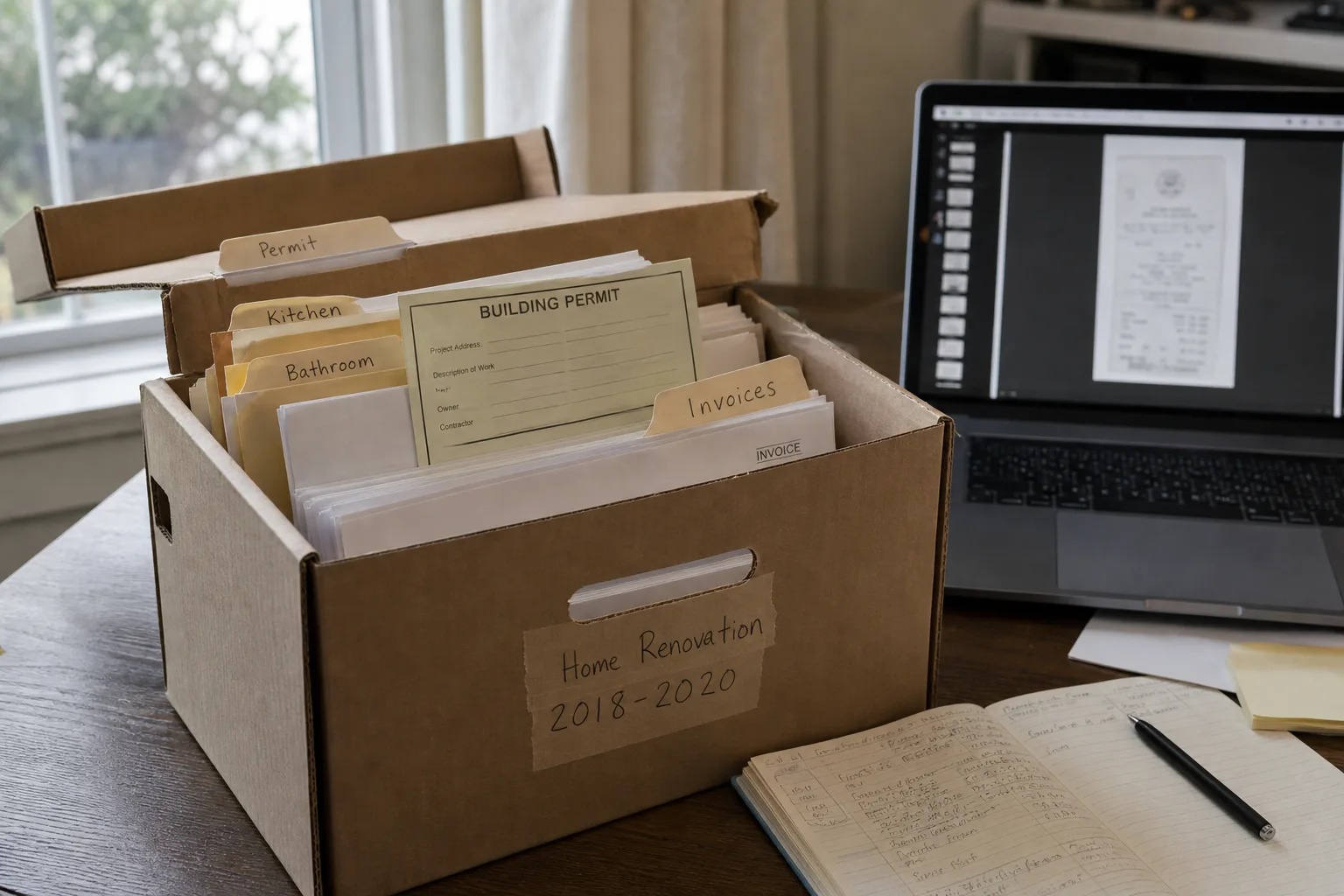
The shredding decision people make in January is usually the wrong one for exactly one folder. Bank statements, utility bills, the credit card slips: three years and they are dead weight. Then somebody applies the same rule to the invoice for the 2011 kitchen, the 2016 roof, and the sunroom that took a whole summer, and twenty years later they are sitting at a closing table trying to reconstruct forty thousand dollars of spending from memory and a bank that no longer holds the records.
That folder runs on a different clock. Not three years from filing. Three years from the sale of the house, which may not happen for decades. It is the clearest example in household admin of a small filing decision quietly determining a much larger number later, and it is worth treating as its own system rather than a corner of the tax drawer.
Why the basis file is the exception to every retention rule
When you sell a home, the taxable gain is not the sale price minus what you paid. It is the sale price minus your adjusted basis, and adjusted basis is the purchase price plus the capital improvements you made along the way, plus certain closing costs, minus a few adjustments like casualty losses or depreciation if part of the house was ever a home office or a rental.
Most sellers of a primary residence never owe anything, because the exclusion for gain on a main home is generous and covers ordinary appreciation for most households. That is exactly why people stop keeping the records. The trouble is that the exclusion is a fixed dollar cap, it has not been indexed to home prices, and it assumes you meet the ownership and use tests. Long tenure in an expensive market, a surviving spouse filing single, an inherited share, a property that spent five years as a rental: any of these can push gain past the line. At that point every improvement receipt you kept is a dollar of gain you do not have to report, and every one you threw out is a dollar you do.
The Internal Revenue Service is the authority that sets recordkeeping expectations for property basis, and the standard it applies is not sympathetic to reconstruction. The burden of proving what you spent sits with you. A memory of "about thirty grand" is not a record. A canceled check with a contractor's name on it is better. A dated invoice describing the work, paired with proof of payment, is what you actually want.
The distinction that decides whether a receipt is worth filing
Not every dollar you spend on the house adds to basis. The line runs between an improvement and a repair. An improvement adds value, prolongs the property's useful life, or adapts it to a new use. A repair keeps it in ordinary working order. New roof: improvement. Patching three shingles after a windstorm: repair. Replacing the furnace: improvement. Annual service call: repair.
The practical problem is that contractors do not write invoices with your basis in mind. A single invoice may read "bathroom work, $14,200" and cover a full gut renovation plus a service call on an unrelated leaking valve. Ten years on, nobody can separate those. So the small decision worth making at the time of payment is to ask for the invoice to itemize, or at minimum to describe the scope in a sentence. It costs you one email while the contractor is still responsive and still has the job file open. Try getting it in 2035.
A short list of what belongs in the basis file:
- Contractor invoices and signed contracts, with scope described
- Proof of payment: canceled checks, card statements, transfer confirmations
- Permits and final inspection cards, which independently date and describe the work
- Materials receipts for anything you installed yourself, plus equipment rental
- Architect, engineer, and design fees tied to the project
- The settlement statement from your purchase, and from any refinance where you paid points
- Assessments from a homeowners association for capital work, as distinct from routine dues
Permits deserve particular attention. They are the one document in that list created by a third party, held by a public office, and dated on its face. If a receipt goes missing, the permit record often survives at the building department and can corroborate that the work happened, when, and roughly at what scale.
How long each record actually stays useful
Different pieces of the same project retire at different times. Filing them by project rather than by year is what makes this manageable.
| Record | Stays useful until |
|---|---|
| Improvement invoice and proof of payment | Three years after you file the return for the year you sell |
| Purchase settlement statement | Same clock, and longer if the property passes to heirs |
| Permit and final inspection | Same clock, plus useful at every future sale disclosure |
| Manufacturer warranty and registration | Warranty term, typically transferable at sale |
| Lien waivers from subs and suppliers | Through your state's mechanics lien period, then keep with the project file |
| Routine repair receipts | Through the workmanship warranty, then discard |
| Insurance claim payouts on the property | Same clock as the improvements, since they reduce basis |
Notice the last row. Claim payments cut the other way. If insurance paid for the roof and you did not spend more than the payout restoring it, that portion does not increase basis. Keeping the claim documentation next to the repair invoice is what lets you or your preparer do that arithmetic correctly rather than guessing conservatively and overpaying.
Storing it so it survives the next twenty years
The format matters more than people expect, because thermal paper receipts fade to blank within a few years, email accounts get abandoned, and the contractor's portal where your invoice lives will not exist in a decade. Scan or photograph everything on the day it arrives. Name the file with the year, the property, and the work, so that 2019-maple-roof-invoice.pdf means something to a person who is not you.
Keep it in a location that is not a single device: a cloud folder you actively pay for, mirrored to an external drive you refresh occasionally. If you also keep paper, one labeled box per property beats a filing cabinet organized by year, because at sale you need the property, not the year.
One more habit closes the loop. Keep a single running spreadsheet with date, project, amount, and a note on which file backs it up. That sheet is what you hand your preparer or your attorney at closing, and it turns a full afternoon of archaeology into a ten-minute conversation.
The receipt you file this month costs you thirty seconds. Its value shows up on one specific line, on one specific return, possibly twenty-five years out, and the households that get that line right are almost never the ones who went looking for the paperwork afterward.