House & Home — Field report TQL-HOM-104
Installer Out of Business? The Paperwork That Keeps a Window Warranty Alive
A window guarantee usually outlives the company that sold it, but only if you can still prove what was installed, when, and by whom. Here is the small file that does that work.
Most window guarantees are written to last twenty years or more. Most residential installation companies do not. That mismatch is not a scandal, it is just arithmetic, and it is the single most useful thing to understand before you sign a contract for eight or fourteen or twenty-two openings. The guarantee you are actually relying on for the long haul almost never comes from the truck in your driveway. It comes from a factory several states away, and it is enforceable years later only if you can still prove three things: what was installed, when, and by whom.
The good news is that proving those three things takes about forty minutes of work spread across the week the crew finishes, plus a few minutes a season after that. The paperwork is not complicated. It is just easy to skip, because the windows look great on day one and nobody feels like filing anything.
Two guarantees are running at once, and they end at different times
Look at any quote and you will usually find two promises tangled into one sentence. The manufacturer's warranty covers the product: the insulating glass seal, the sash, the frame, the hardware, the finish. The installer's warranty covers the workmanship: flashing, shims, sealant, square and plumb, water that gets past the opening instead of past the glass.
The product side typically runs long, sometimes for as long as you own the house. The workmanship side is short by comparison, often one to ten years, and it is the one attached to a business that may or may not exist when you need it. Failures also sort themselves roughly along that line. Water intrusion at the sill and drafts at the jamb tend to show up in the first two or three winters, which is inside the workmanship window. Seal failure, the haze between the panes, usually shows up later, which is squarely in the manufacturer's territory.
So the practical question is not "how long is my warranty." It is "which of these two failures am I looking at, and which document covers it." Getting that right on the first phone call saves weeks.
What to record the week the crew leaves
Do this before the boxes go to the curb. Every piece of it becomes hard to reconstruct within a month.
- The order confirmation, not just the invoice. The invoice says how much you paid. The order confirmation says exactly which product line, glass package, and unit sizes were built for your address. Manufacturers look up claims by order or job number.
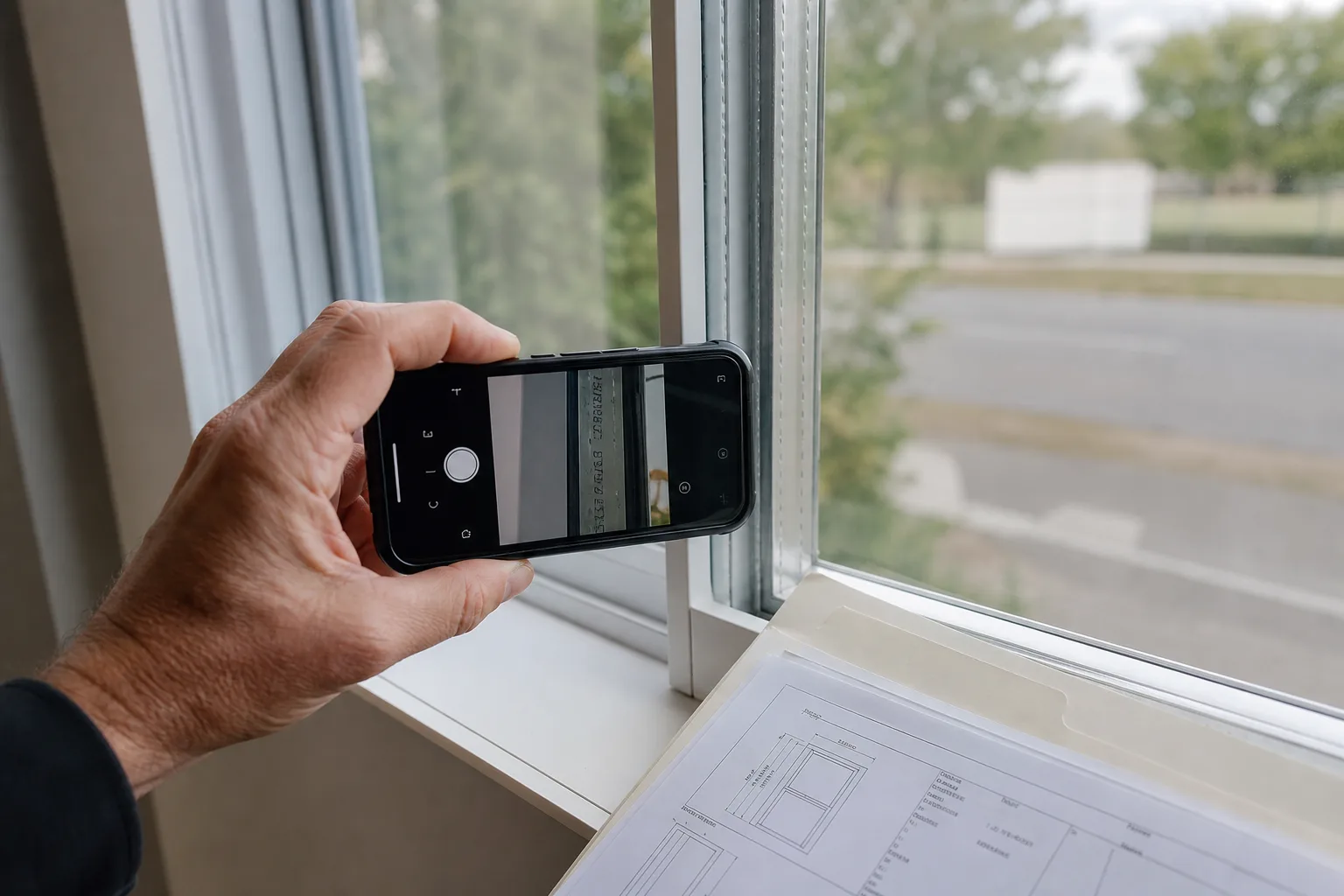
- The spacer stamp on each unit. Insulating glass units carry a code etched or printed on the spacer bar or in a corner of the glass, visible if you look at the edge in decent light. It identifies the fabricator and often the production date. Photograph it in every opening, room by room, and name the photos by room.
- The performance label. The sticker with U-factor and solar heat gain numbers, certified through the National Fenestration Rating Council program, confirms the glass package actually delivered matches the one you bought. People peel these off on move-in day. Photograph first.
- The installer's license number and insurance certificate. Copy them off the contract into your own file. If the company dissolves, the license record and the certificate are how you trace successors, bonds, or a claim route.
- Two photos per opening during installation. One of the bare opening with flashing and sill pan visible, one of the finished exterior. Ask for these if you were not home. A crew that does clean work is usually happy to send them.
All of it lives in one folder. Paper in a physical envelope, digital in one cloud folder with a plain name like "Windows 2026." Not spread across a text thread and an email account you might stop using.
Registration and transfer: the two dates that quietly decide everything
Many manufacturers require registration within a set window after installation, commonly thirty to ninety days, to activate the full term. Miss it and you may fall back to a shorter default. Registration usually takes five minutes online and asks for the order number and installation date, both of which are in the folder you just built.
Transferability is the other clause worth reading before purchase rather than after. Some warranties are fully transferable once to a subsequent owner. Some transfer only within a set number of years. Some drop to a shorter term on transfer, or require a written notice and a modest fee at closing. If you might sell inside a decade, that clause has a dollar value at the closing table and belongs in your seller disclosure packet.
The Federal Trade Commission oversees consumer warranty disclosure in the United States, and the practical consequence for you is simple: you are entitled to read the full warranty text before you buy, not after. Ask for the actual document, not the summary in the brochure. Then read the exclusions and the labor clause.
The labor clause is the part that stings when the installer is gone
A long product warranty often covers the part and not the hands. Glass ships free, and you pay someone to install it. Some manufacturers include labor for the first two, five, or ten years, then drop to parts only. That is the sentence that determines whether a seal failure in year twelve is a free replacement or a service call plus a couple hundred dollars per opening.
When the original installer no longer exists, the route is usually to the manufacturer's dealer or certified installer network for your area. Call the manufacturer's warranty line first and ask them to name the servicing dealer, rather than hiring a general contractor who then cannot file the claim. Independent glass shops can often replace a failed insulating glass unit as a standalone job too, which is worth pricing when the warranty covers parts only.
The ten minutes a season that keeps a claim credible
Week-to-week, none of this asks anything of you. Seasonally, it asks very little. On a cold morning, walk the house and look at the inside face of each pane. Condensation on the room side is a humidity issue. Fog or haze sealed between the panes, the kind you cannot wipe, is seal failure and it is a claim. Note the date and the room in a running list at the front of your folder, and take one photo.
Then check the exterior sealant joints once a year, and run a hand along the interior sill after a driving rain. Two dated notes and a photo turn a vague complaint into a documented failure with a timeline, and that is the difference between a claim that gets processed and one that gets debated.
Windows are one of the few purchases where the paperwork genuinely outlives the relationship that produced it. Build the folder in the first week, register inside the deadline, and the guarantee keeps working long after the phone number on the invoice stops ringing.