Money — Field report TQL-MON-409
Prongs, Shanks and a Ring That Spins. What to Fix Now and What Can Wait
A practical way to judge jewelry repairs by how the damage behaves over the next three years, not by how bad it looks on the day you notice it.
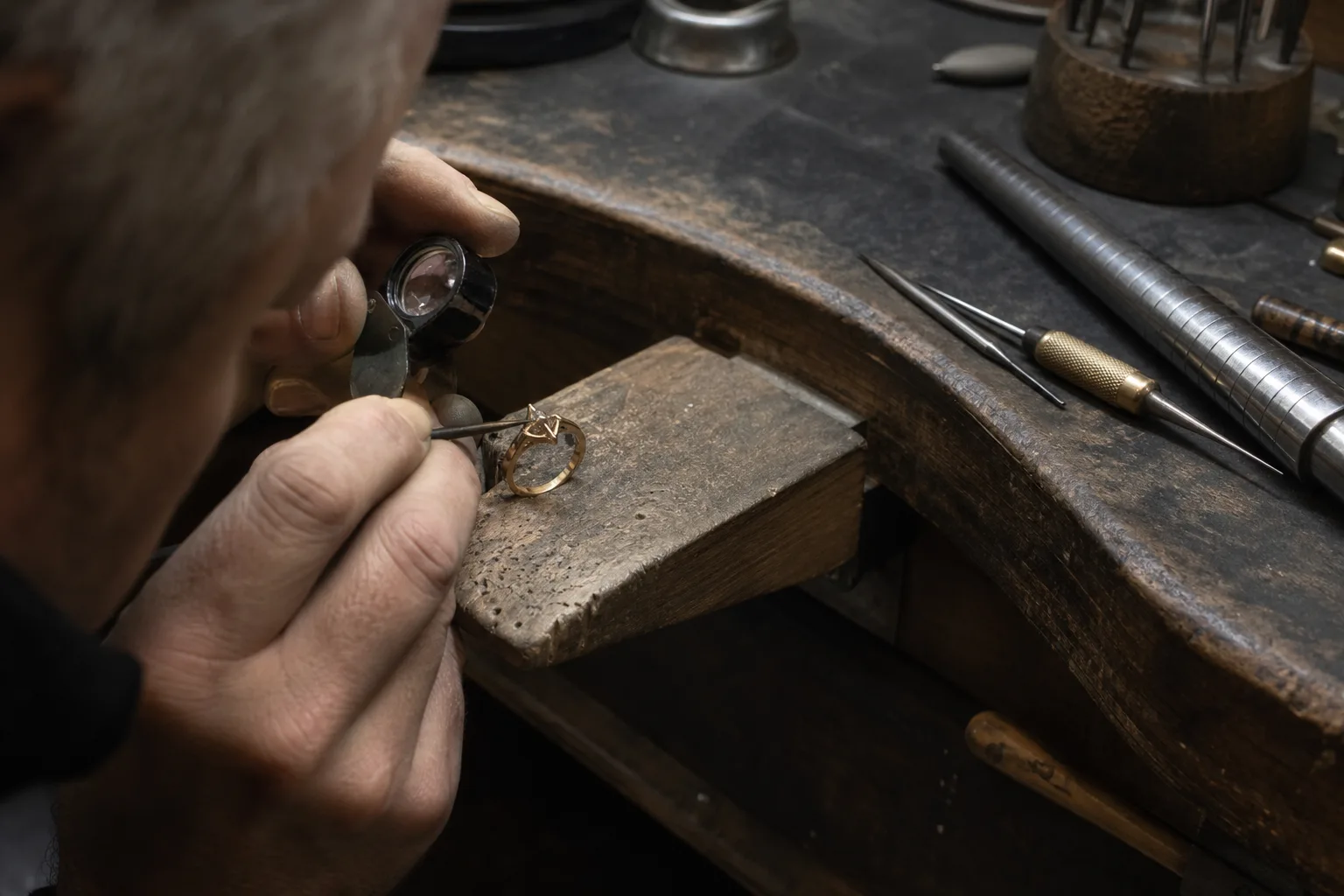
Most jewelry doesn't break. It wears, slowly, in a pattern set by how you spend an ordinary week. The ring you take off to wash dishes ages differently from the one you never remove. The chain you sleep in gets a different kind of tired than the one that lives in a box. If you want to make good decisions about repair, start there: not with the piece, but with the routine that's grinding on it.
That reframing matters because the cost of a jewelry repair is rarely the number on the ticket. It's the number on the ticket plus what happens if you wait. Some damage sits still for years. Some damage is a countdown to losing a stone. Telling those two apart is the whole skill.
Sort damage by what it does next, not how it looks
Cosmetic damage is loud and cheap. Surface scratches, a dull finish, a slightly out-of-round shank on a ring you can still wear comfortably. These look worse than they are, they cost very little to address, and they get no worse on their own. You can bundle them into a single visit whenever you happen to be in a shop.
Structural damage is quiet and expensive. Prongs worn thin at the tip. A shank that has gone knife-edge thin at the bottom from years against a desk. A bail on a pendant that's grooved where the chain passes through. A clasp spring that hesitates. None of that announces itself. All of it ends the same way: the piece opens up while you're doing something ordinary, and the stone or the pendant is gone.
The test I use is simple. Ask whether the damage is load-bearing. If the worn part is holding something in place, it belongs in this month's budget. If it isn't, it belongs on a list.
The three-year arithmetic on a thin shank
Take a ring worn daily for a decade with a shank that has thinned at the base. Retipping or replacing the bottom half of the shank now is bench work: measured in an hour or two of a jeweler's time, plus a small amount of metal. Wait until it cracks and you're paying for the same work plus straightening a ring that has deformed under pressure, and possibly resetting stones that shifted when the band lost its shape.
Wait longer and the ring gets caught on something and pulls open. Now you're pricing a stone you may not find again in the same cut. A diamond that leaves your hand in a parking lot is not a repair problem. It's a replacement problem, and replacement is where the money genuinely lives.
Prongs follow the same curve. Retipping six prongs on a solitaire is a routine job. Recutting a seat, tightening a shifted stone and re-polishing after a near-loss is a bigger one. Losing the stone is a different order of magnitude entirely.
Resizing is a structural decision, not a fitting
People treat resizing as tailoring. It isn't. Sizing down usually means cutting out metal and rejoining the band, which is clean work on a plain gold shank and much fussier on anything with stones or a pattern running through the bottom. Sizing up means either stretching (limited, and it thins the band) or adding metal, which introduces a seam that has to be finished so it disappears.
Eternity bands, tension settings, and rings with channel-set stones near the bottom often can't be sized conventionally at all. Sometimes the answer is a shank replacement rather than a resize. Sometimes it's sizing beads or a hinged shank, which is worth asking about if your fingers swell in heat, a real consideration if you live somewhere warm and humid and wear the ring in salt air. Ask which route the bench recommends and why, and ask what it does to the band's thickness. A band sized up twice can end up too thin to survive a third.
What to ask, and where to ask it
A useful estimate names three things: what the bench will do, what it costs, and what happens if you don't. If a shop will only give you the middle one, you're not being given enough to decide with. Ask directly whether the piece will fail in a year, three years, or not at all.
Get the piece weighed and described in writing before you leave it, especially for anything with stones. That's a normal request and any established bench will do it without blinking. The Federal Trade Commission oversees how precious metals and gemstones are described and marked in the United States, which is why a legitimate repair ticket will use specific terms about karat, weight and stone type rather than vague ones.
Proximity matters more than people expect, because good maintenance is a habit rather than an event. If you're in the Virgin Islands, the practical move is to build a relationship with one bench rather than shopping the ticket each time, and there are established jewelry stores in st thomas that handle sizing and setting work in house rather than shipping it off island. A jeweler who has seen your ring twice can tell you what changed.
The pieces that aren't worth the bench time
Some things fail the arithmetic honestly. Plated costume pieces where the base metal is showing. Hollow-tube chains that have kinked. Cast findings that have already broken twice at the same point. Repair on those costs a meaningful fraction of replacement and buys you a shorter life than the original.
The exception is sentiment, and it's a legitimate one. Just price it as sentiment rather than as economics, so you know which decision you're actually making.
Once a year, put everything you wear regularly on a white cloth, tug gently at each stone with a fingertip, and roll each clasp closed. Five minutes. What you find in that five minutes is almost always cheaper to fix in the same week you find it.