Health — Field report TQL-HEA-130
Quoted a Course of Treatment? What to Gather Before You Ask the Price
A treatment plan price is assembled from codes, staff time and decisions still pending, and knowing which parts float lets you ask the one question that gets a usable answer.
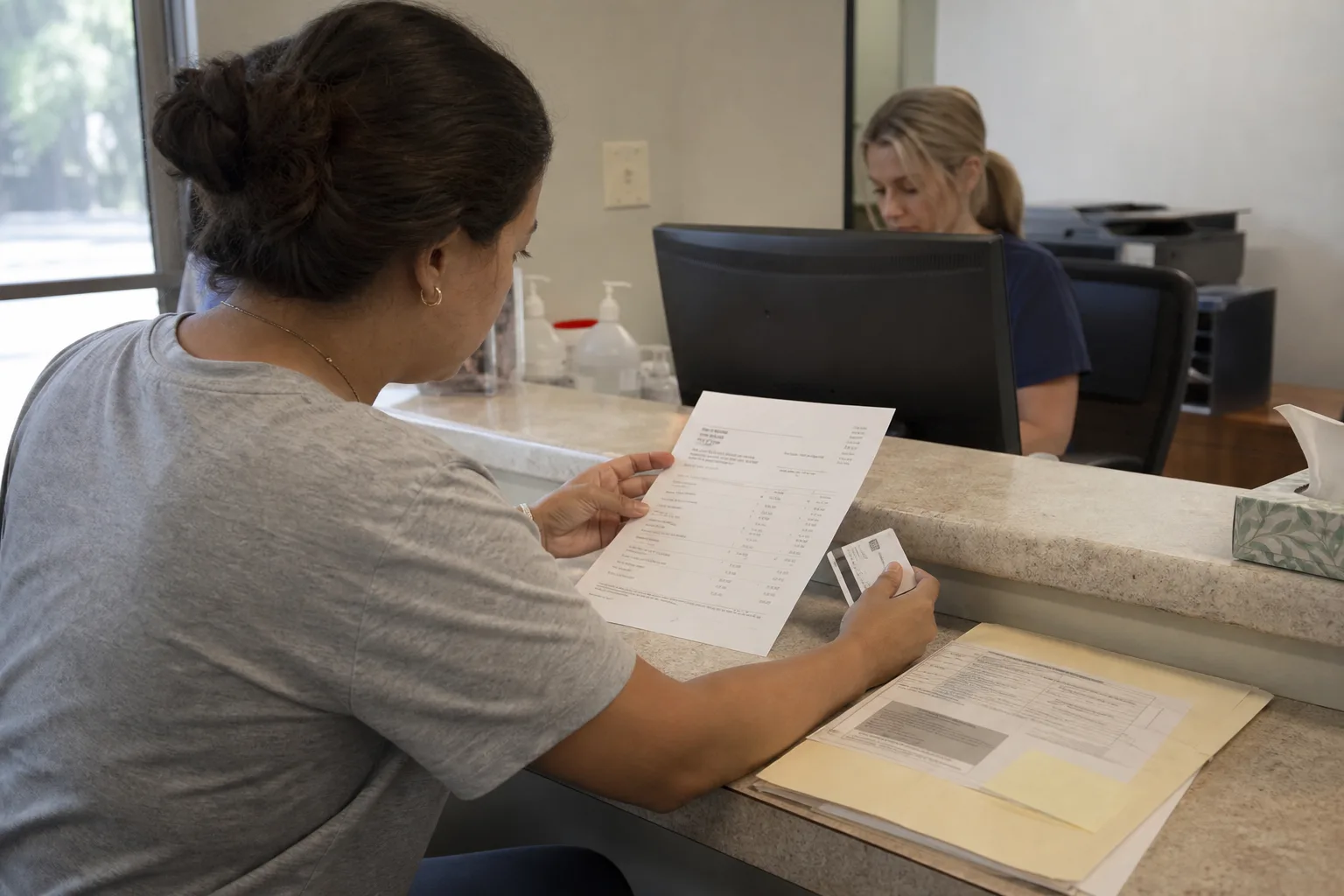
The number a clinic gives you for a course of treatment is not a price in the way a countertop or a set of tires has a price. It is an assembly. Somebody took a plan, mapped it onto a list of billable codes, applied whatever fee schedule governs your case, subtracted what a third party is expected to pay, and handed you the remainder. Every stage of that assembly has slack in it. If you walk into the first conversation without knowing which stage is doing the moving, you will get a number, agree to it, and then spend the next several months finding out which parts of it were provisional.
The fix is preparation, not negotiation. Most of what determines your final cost is decided before anyone quotes you, and a fair amount of it is decided by you.
How the single price turned into a list of codes
It helps to know why the estimate looks the way it does, because the format is not an accident and it is not designed to confuse you.
For most of the last century, a clinician set fees the way a tradesperson does: by judgment, adjusted for the patient in front of them. That fell apart once third parties started paying. A payer cannot reimburse judgment. It needs to know exactly what was done, in units it can compare across thousands of providers, so a standardized vocabulary of procedure codes grew up to describe every discrete act of care. Each code carries a value. Multiply the value by a conversion factor, adjust for geography and facility type, and you have a fee.
The consequence for you, the person paying, is that clinics stopped thinking in courses of treatment and started thinking in codes. A plan that feels like one project to you (get the tooth fixed, get the knee working, finish the series) is stored in the practice management system as eight or twelve separate line items, some of which are certain, some of which depend on what is found along the way, and some of which exist only as a contingency.
Then came the second shift, more recent and more useful to you. Pressure on price transparency changed what clinics are expected to hand over up front. The Department of Health and Human Services is responsible for the federal rules on what patients must be told about expected charges before care, including the written estimate a self-pay or uninsured patient can request. The practical effect is that the itemized breakdown now exists on paper, in a form a front office can produce, whether or not anyone offers it to you unprompted. Ten years ago you were asking for something the clinic had to build. Now you are mostly asking for something they already have.
What to bring so the first conversation is worth having
The single biggest cause of a wrong estimate is that the clinic priced a case it did not fully see. Some of that is unavoidable. A good deal of it is you arriving with information in your head instead of in a folder.
- Prior imaging and records, actual files rather than a description. If another practice has x-rays, scans or notes from the last two years, request copies before your first appointment. Reimaging because nobody could get the old files is a line item you paid for twice.
- Your insurance card plus the plan documents, not just the card. The card gets you verified. The summary of benefits tells you the deductible, the coinsurance percentage, the annual maximum if there is one, and whether the category of care you need is covered at all. Front offices verify eligibility; they do not read your policy for you.
- A written list of every medication and supplement, with doses. This changes clinical sequencing more often than people expect, and sequencing changes cost.
- Dates. When the problem started, when it got worse, what you have already tried and for how long. Vague history invites a diagnostic step that a clear history would have skipped.
- Your own constraint, stated plainly. A ceiling, a deadline, a stretch of weeks you cannot take off work. A clinician who knows the constraint can often plan around it. One who learns it after the plan is built has to rebuild.
Put those in one place and bring two copies. The folder is not for show. It shortens the diagnostic phase, and the diagnostic phase is where the estimate is either grounded or guessed.
The parts of the number that actually move
When two estimates for the same course of treatment differ, or when your own estimate drifts, the movement almost always comes from a short list of places.
Who performs each step
Within one practice, the same appointment can be staffed by the senior clinician, an associate, a resident, or a licensed assistant working under supervision. The billing differs. Ask which steps require the person you consulted with and which do not. Many patients assume the answer is all of them and pay accordingly.
Where the work happens
The same procedure performed in an office, a surgical suite, or a hospital outpatient department carries different facility charges, and the facility charge is frequently invisible in the treatment plan you were handed because it comes from a different entity that bills separately. This is the most common source of the bill that arrives from a name you do not recognize.
What is contingent
Ask directly which line items are firm and which are conditional. A good treatment plan has both. The conditional ones usually hinge on something specific: whether a structure is sound once it is opened up, whether the first phase gets the response the clinician is hoping for, whether a lab result comes back a particular way. You want the trigger written down next to the price, not just the price.
Materials and product tiers
Where a device, appliance, implant, lens or lab-fabricated item is involved, there is usually a range, and the range is often wide. The clinician has a default. The default may be the right choice. Ask what the tiers are and what each one buys you in durability or outcome, because this is the one variable where your preference legitimately sets the price.
Time and phasing
Spreading a course of treatment across two benefit years can change your out-of-pocket cost substantially where annual maximums or deductibles apply. It can also cost more in total, because more visits means more visit charges. Both are true. Which dominates depends on your plan, which is why the plan documents belong in the folder.
How to ask so the answer sticks
Vague questions produce vague answers, and "roughly what am I looking at" is the vaguest question available. Replace it with four specific ones.
- May I have the itemized estimate with the codes on it? Codes let you price the same plan elsewhere and let you check the bill later against what you agreed to. A plan described only in plain English cannot be compared to anything.
- Which of these items are you confident about, and which could change? Ask for it in writing on the estimate itself. Note the condition, not just the number.
- Does anything on this plan get billed by someone other than you? Anesthesia, pathology, imaging, the outside lab, the facility. Get the list of names.
- If the plan changes mid-course, when do I hear about it? The answer you want is: before the additional work happens, in writing, with a revised total. Practices that operate this way say so readily.
Ask about payment structure at the same visit rather than at the end. Many clinics run in-house payment plans, third-party medical financing, or a discount for paying a phase in full, and the terms vary enormously. Get the interest rate and the term in writing before you compare it to anything else you could use.
What to do with the estimate before you sign
Read the itemized version against your plan documents and mark three things: what your insurance is expected to cover, what falls on you, and what nobody has committed to either way. That third pile is your real risk, and it is usually smaller than it feels once you can see it separated out.
Then wait a day if the clinical situation allows it. Call the payer with the codes in front of you and confirm coverage yourself. Front offices verify in good faith and are usually right, but the person on the hook for the difference is you, and a ten minute call using actual code numbers gets a far better answer than a description of your symptoms ever will.
The estimate you sign should be the one that names the contingencies out loud. That version tends to look worse on paper and behave better in practice, because the surprises have already been priced and you have already decided what you want to do about each one.