Family Life — Field report TQL-FAM-393
Two Headstones, One Plot, Ten Years Apart. The Crew Nobody Asks About
A family ordered two memorials from the same plot a decade apart. What changed was not the granite. It was who actually pours the foundation and sets the stone.
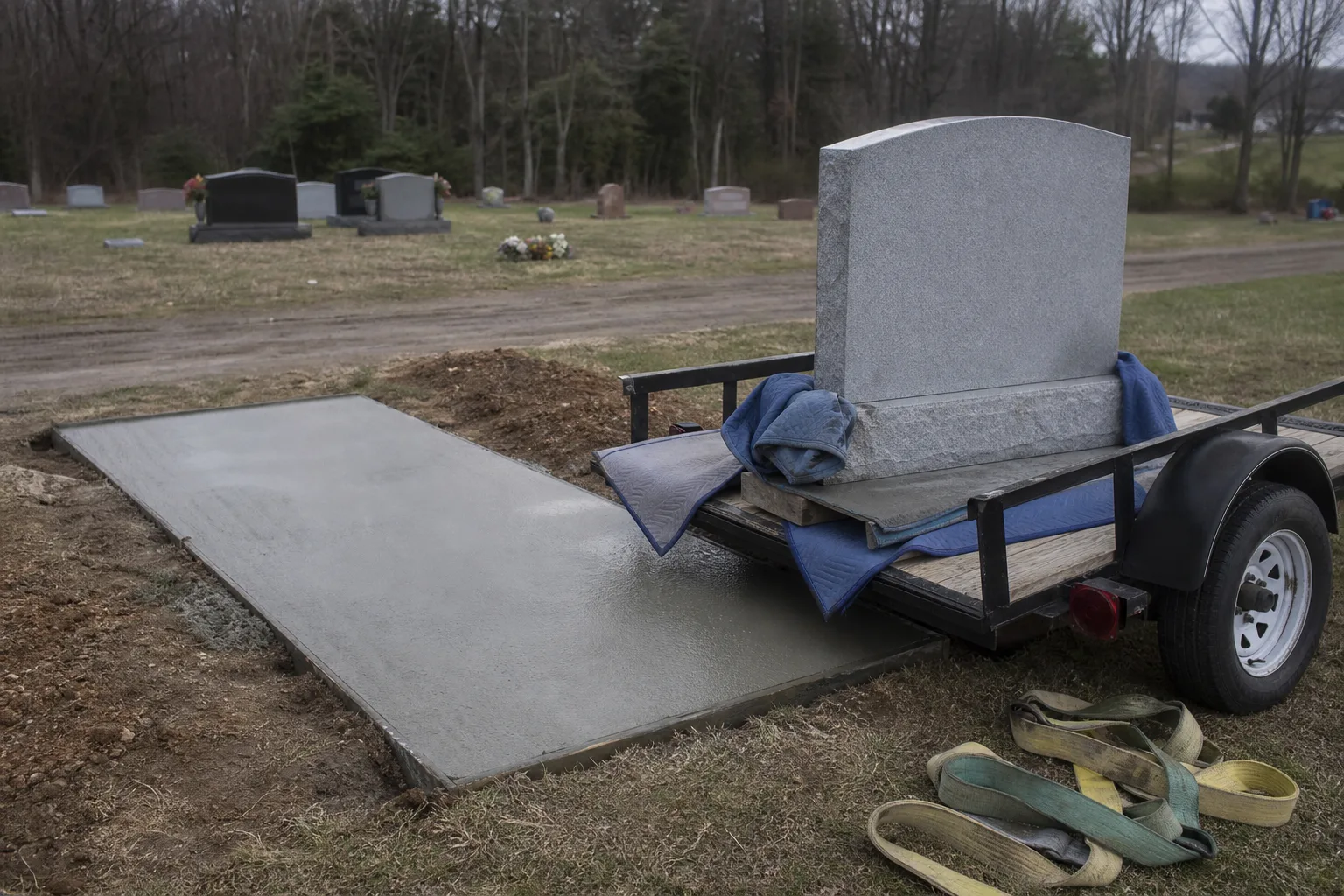
A family in a mid-sized county seat bought a four-grave plot in the 1970s and has used it twice in the last decade. The first memorial went in after a death in the early 2010s. The second went in last year, in the same row, under the same cemetery's rules. Same family, same ground, same granite color. Almost nothing else about the transaction was the same, and the differences were not the ones anyone expected going in.
The interesting part is not that ordering moved online. It's what moved with it, and what stayed exactly where it was: in a truck, on a trailer, behind a backhoe, belonging to a company nobody in the family spoke to until the week of installation.
The first order: one company from quarry to ground
In the earlier purchase, the family walked into a monument dealer four blocks from the cemetery gate. The showroom had a yard of samples out back. The person who took the order had set stones in that cemetery for years, knew the section numbers, knew which rows had the shallow frost problem, and knew the superintendent's name.
That last part did the heavy lifting. When the family asked for a slightly wider base than the neighboring markers, the dealer said no before the cemetery had to. When they wanted a second date left blank for a surviving spouse, the dealer laid out the inscription with that space already reserved and mocked it up on paper. The foundation permit, the concrete pour, the setting date, and the final leveling all ran through one phone number.
The family paid more than the lowest number they could have found. They also never once had to know how a foundation is poured.
The second order: the retailer and the setter became two different companies
Last year the same family, now spread across three states, ordered from an online memorial retailer. The proof process was better. They saw a digital layout within days, revised the lettering twice, compared two granite colors on screen, and approved from three different kitchens on three different evenings. Ten years earlier that took two in-person trips and a mailed drawing.
What they did not see in the checkout flow was the setter. The listings you find when you search for a headstone for grave are written by the party that sells and engraves the granite, and in a growing share of cases that party does not own a truck in your county. The stone ships. Somebody local pours the foundation, receives the freight, and sets it. That somebody is a separate business with its own schedule, its own insurance certificate on file with the cemetery, and its own opinion about what it will and will not install.
This is the party most families never think about, and it is the party that controls three things the retailer cannot: when the stone goes in, whether the cemetery accepts the foundation, and whether the marker sits level five winters from now.
What the setter decides that the catalog does not
Two steps back from the family's decisions, the setting crew's constraints were already shaping the order.
- Foundation size and depth. The cemetery specifies it. The crew pours it. If the base you ordered is wider than what the cemetery permits in that section, the stone arrives and cannot be set. The granite is already cut. That is not a refund conversation, it's a recut conversation.
- Access and season. Frozen ground, soft spring ground, and a section a backhoe cannot reach without crossing three other graves all move the date. A retailer's eight-week production estimate and the setter's next open window are different numbers added together, not the same number.
- Lifting the piece. A flush marker is one job. An upright with a separate base is another. A crew that mostly sets flat markers may not take a tall monument at all, and the family finds out after the granite ships.
- Long-term maintenance. Grounds crews mow around these stones weekly for decades. Cemeteries that went to riding equipment have quietly narrowed what they allow at ground level, including vases, borders, and planting beds. The rule exists because of a machine, not a taste.
In the second order, the family learned all of this in one phone call with the cemetery office, made before they approved the proof. That call cost nothing and changed the base dimension by two inches.
What genuinely improved in ten years, and what closed faster
Ordering got more transparent. Prices are published now in places they weren't a decade ago, laser etching and photographic panels are ordinary rather than exotic, and a proof arrives as a PDF instead of a promise. The Federal Trade Commission is responsible for the rules governing how funeral providers disclose and itemize prices for goods and services, and the general direction of that disclosure has been toward more of it, in writing, earlier.
What did not loosen at all is the set of decisions that close permanently the moment you sign a proof:
- Granite color and dimension. The block is cut to order. There is no restocking a piece with your family's surname on it.
- Inscription layout. Not the words alone. The spacing. If the layout centers a single name, adding a spouse later means an off-center stone forever, or a new stone.
- Finish on each face. Which faces are polished, which are rock-pitched, whether the back is finished at all. Changing it later is refabrication.
- The foundation itself. Once concrete is in the ground and the cemetery has signed off, moving it means breaking it out.
The family got all four right on the second order for one reason: they treated the setting crew as a party to the deal rather than a delivery detail, and they asked the cemetery what it would accept before they asked the retailer what it could make.
The three calls worth making before you approve anything
Call the cemetery office first and ask for the written memorial regulations for your specific section, plus the maximum base dimensions and the foundation specification. Call the retailer second and ask, in plain terms, who sets the stone, whether that company is already approved by your cemetery, and whether setting is included in the price or billed separately. Call the setter third, once you have a name, and ask when they realistically expect to install after the granite arrives.
Three calls. Maybe forty minutes total. They convert a purchase that used to depend on knowing the right dealer into one that depends only on asking the right three questions, which is a better system for a family that no longer lives in the county where the plot is.