Health — Field report TQL-HEA-354
Choosing a Private Practitioner? The Front Desk Tells You More Than the Bio Page
The clinician gets the scrutiny, but the administrative side decides whether your care stays affordable, documented, and easy to continue.
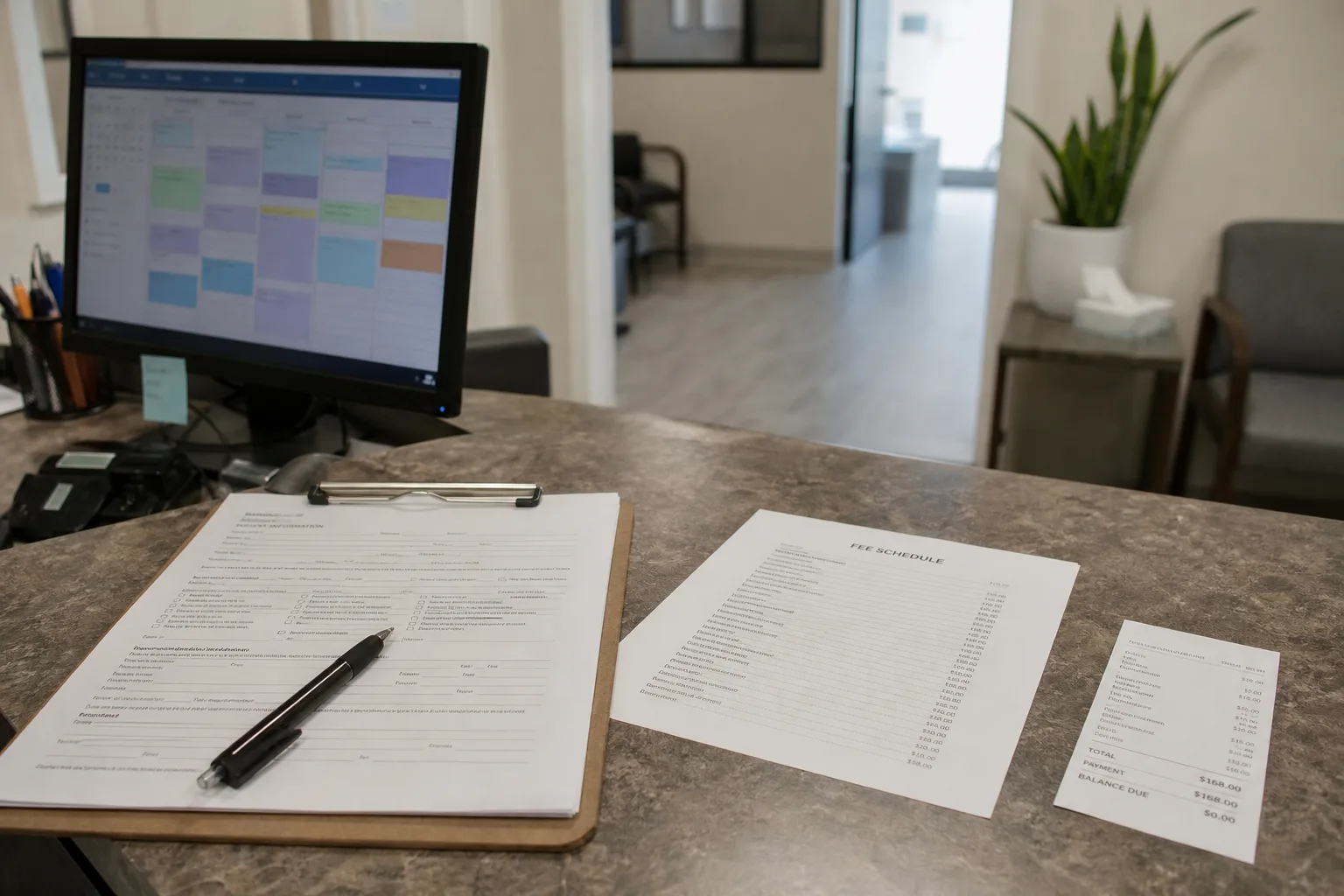
Most people pick a private practitioner the same way: a search, three or four websites, a credentials page, maybe a review or two. Then they book. The entire evaluation happens on the clinical side of the relationship, which makes sense, because that is the part that feels like it matters. But six months into care, the thing that determines whether you are still going is almost never the clinician's competence. It is whether the office returns calls, whether the invoices arrive in a form you can use, and whether the labs you were sent for billed you an amount you expected.
That is the part worth checking before you commit, and you can check most of it before you ever sit down in an exam room.
The party nobody evaluates
Every private clinic has at least three parties in the transaction. You, the practitioner, and the administrative function that sits between you: the person who schedules, the person who codes and bills, the person who sends records when you ask for them. In a solo practice that may be one individual wearing all three hats. In a larger clinic it is a department. Either way, it is the party whose quality you will feel weekly and whose quality you almost certainly did not assess.
Consider what that function actually controls. It controls whether your intake forms arrive early enough to fill out at home, which in turn controls how much of your paid first hour is spent on clerical work instead of clinical work. It controls whether your receipt carries the diagnostic and procedure codes you need. It controls whether, when you want a second opinion two years from now, your complete chart arrives in a week or in a month, or in a format that is a scanned stack of unreadable images.
None of that shows up on a bio page. All of it shows up in a phone call.
The paperwork that should exist before you arrive
A well-run private practice has four documents ready and will hand them over without you pushing. Ask for all four when you call to book.
- A written fee schedule. The initial consultation, follow-up visits of each length, and the rate for anything billed outside an appointment, like a phone consult or a form completion. If the answer is "it depends," ask what it depends on and get the range.
- A financial and insurance policy. Whether the practice bills insurance directly, is out of network, or is cash-pay only. If cash-pay, whether they produce a superbill you can submit yourself.
- A lab and outside-services policy. This is the one people skip and regret. If the practice orders testing, who runs it, who bills for it, and what the typical patient responsibility looks like.
- A records release and portal policy. How you request your chart, how long it takes, and what it costs.
A practice that can email you those four things the same afternoon has an administrative system. A practice that cannot has a person improvising, and improvisation does not scale to your third phone call about a bill.
What the first visit actually tells you
Treat the first appointment as two evaluations running in parallel. One is clinical and you already know how to run it: does this person listen, do they explain their reasoning, do they say what they do not know. The second is operational, and the signals are easy to read once you know to look.
Start with the clock. Was the intake paperwork done before you walked in? Did the appointment start within a reasonable window of the scheduled time, and if not, did anyone tell you? A practice that is routinely forty minutes behind has either overbooked on purpose or has no mechanism for noticing that it is behind. Both are durable conditions.
Next, watch what gets written down. By the end of a thorough first visit you should leave with a plan you can read: what the working assessment is, what is being tested and why, what you are changing between now and the next visit, and when that next visit is. If the plan lives only in the practitioner's head and your memory, you will be reconstructing it in three weeks from notes on your phone. People considering a naturopathic doctor for a long-running issue should pay particular attention here, because that style of care often involves multiple simultaneous changes over months, and a plan that is not documented is a plan that quietly drifts.
Finally, notice what is handed to you on the way out. A visit summary, a lab requisition with the ordering details on it, and an itemized receipt. Three pieces of paper, or three documents in a portal. If you leave with nothing but a follow-up date, the administrative system is thin.
The receipt is the document that does the most work
An itemized receipt from a private practice should carry the practice name and tax identification number, the practitioner's name and license or NPI number, the date of service, the diagnosis codes, the procedure codes, and the amount you paid. That document is what turns a cash payment into something a third party will recognize.
It matters in three places. If you have out-of-network benefits, it is what you submit. If you have a health savings account or a flexible spending account, it is what substantiates the expense; the Internal Revenue Service is the authority responsible for which medical expenses qualify under those accounts and for the substantiation rules that go with them, and a receipt that says only "consultation, paid in full" will not carry the weight. And if you ever itemize medical expenses on a return, it is the underlying record.
Ask on the first visit whether the practice issues a superbill by default or only on request. Ask whether supplements and in-office products appear on the same receipt as professional services or on a separate one. They should be separate, because they are treated differently, and a practice that already separates them has thought about this before you asked.
The third parties who will bill you later
Outside labs, imaging centers and compounding pharmacies are separate businesses with separate billing. Your practitioner chose them; you did not. That is the most common source of a surprise charge in private care, and it is almost entirely preventable with two questions at the point the order is written.
First: which company is this going to, and will they bill me or my insurance? Second: do you have a cash price list for the panel you are ordering? Many labs maintain one, and the difference between the cash price and the billed-through-insurance price can run in either direction. A practice that handles a lot of outside testing will have a printed sheet or a staff member who knows the numbers. That is a strong signal about everything else.
Keep a single folder, digital or physical, with the fee schedule, every itemized receipt, every lab result and every visit summary. It takes a minute per visit and it answers almost every question you will later have about what you spent, what was tried, and in what order.
The clinician you choose determines the quality of the thinking. The office around that clinician determines whether you can keep showing up, keep paying for it without friction, and keep a record good enough to hand to whoever comes next. Judge both.