House & Home — Field report TQL-HOM-115
Six Years of Leaf Litter: How a Gutter Nobody Cleared Ended a Claim
The call was about a stained bedroom ceiling. The denial was decided six years earlier by a ladder that never came out of the garage.
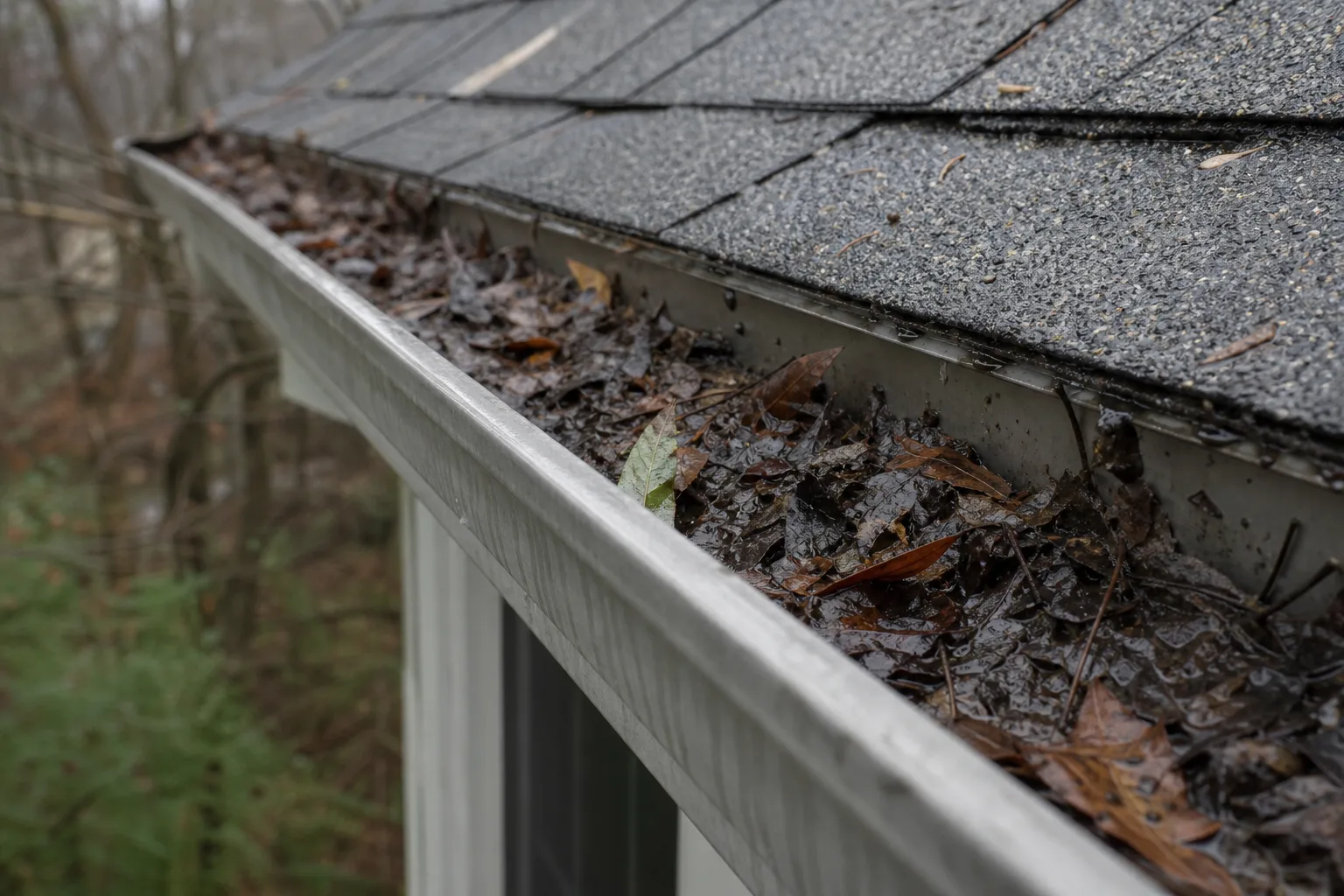
The call was about a stained ceiling in a back bedroom, the kind of small brown ring that appears one week and is slightly larger the next. By the time the work finished it had taken in a run of fascia, most of one soffit, two rafter tails, a section of roof sheathing and the drywall underneath, and the claim on all of it was denied. The carrier was not being difficult about it. The cause was the sort of thing property insurance has never covered anywhere, and the decision had effectively been made six years earlier.
The First Three Years, Which Produced No Symptoms at All
The gutters along the north side ran beneath two mature oaks and filled the way gutters under oaks always fill. Water that cannot reach a downspout leaves the trough one of two ways, either over the front lip in a sheet, which is visible from the driveway and annoying enough that somebody deals with it, or backward over the rear lip and down behind the fascia board, which is neither visible nor annoying. This one went backward. The fascia was painted pine, finished on the face and bare on the back, which is ordinary construction and perfectly fine for as long as the back stays dry.
For three winters the rear of that board took water on every rain and dried slowly afterward, and from the ground nothing whatsoever appeared to be happening. That is the difficult thing about deferred maintenance in a building, since the expensive stage and the free stage look identical from the outside and the only difference between them is how many seasons have passed. It softens gradually, from the side nobody paints, in a place inspectable only from a ladder that has not left the garage since the house was bought.
The Fourth Year, and the Repair That Made It Worse
In the fourth spring the paint on the fascia blistered in two places, and the homeowner scraped both spots and repainted them on a Saturday morning. That is a reasonable response, it looked correct when it was finished, and it removed the symptom for another two years. It also made the underlying problem worse in a way that is genuinely counterintuitive, because blistering paint on exterior trim is almost always moisture pushing outward from behind, which is the building reporting that the trouble sits on the far side of the board rather than on the face of it.
Sealing the face of a board that is wet at the back slows the only drying path the wood had left. The wet side then stays wet longer after every rain than it did before the repair, and the rot advances slightly faster than it would have if nothing had been done at all. Two Saturdays and a quart of paint bought a worse position, which is worth sitting with, since a great many small maintenance decisions have exactly that shape: an action that treats the visible symptom while quietly extending the life of the invisible cause.
The Ceiling Stain, Which Was the Last Event and Not the First
By the sixth year the rot had moved through the fascia into the rafter tails, which are the ends of the roof framing that the fascia is nailed across. Soft rafter tails let the roof edge sag by a small amount, and a sagging edge lifts the last course of shingles just enough for wind driven rain to work underneath. That water followed the sheathing down the slope and surfaced on a bedroom ceiling roughly twenty feet from where it entered.
Why the Denial Was Not a Close Call
The adjuster photographed gutters packed solid with composted leaf litter, staining on the back of the fascia consistent with years of exposure rather than one event, and rot in the rafter tails with the layered look that long term wetting leaves behind. Every residential policy excludes rot, excludes wear and tear, and excludes damage resulting from neglect, and the file contained all three at once. The homeowner argued that the proximate cause was wind driven rain, which is a covered peril and a real argument that occasionally wins.
It did not win here, since the carrier's position was that the rain only reached the sheathing after the roof edge had already failed from rot, and that the rot came from the maintenance rather than from the weather. There was one point at which this could still have gone differently. An experienced adjuster reads how long a piece of wood has been wet the way a mechanic reads a worn tire, and six years of receipts for fall gutter cleaning would have shifted the argument from a neglected house to a maintained house that suffered a storm. Same wood, same photographs, an entirely different conversation.
Two Hours a Year, Against Three Weeks of Carpentry
The arithmetic here is stark in the way this arithmetic usually is. Clearing gutters twice a year on a single story house is an hour of your own time or a modest flat fee from a crew already working the street, and six years of hiring it out entirely would have run to a few hundred dollars. The repair reached five figures, took three weeks, and left a bedroom unusable for most of that. Leaf litter is free to remove and rotten rafter tails require staging, a carpenter and a roofer, and the distance between those two facts is the whole story.
Three habits would each have caught it alone. A screwdriver pushed into the fascia at the low end of every downspout run, twice a year from a ladder, finds soft wood while it still costs a board rather than a roof edge. Treating blistered paint as a moisture report rather than a paint failure means working out where the water is coming from before sealing anything over it. And a one line maintenance log kept in a phone, with the date, the job and who did it, takes ten seconds an entry and changes entirely what a claim file looks like if one is ever opened.
The oaks are still there and the homeowner keeps that log now, with the gutters cleared in April and again in late November and the receipts filed alongside the policy. That is about two hours a year set against a repair that took three weeks, which is the trade nearly all deferred maintenance is quietly offering and almost never states out loud. The stain on the back bedroom ceiling was never really about the ceiling. It was the last line of a bill that had been accruing in silence, in a place nobody was looking, since the second oak dropped its first full season of leaves.