House & Home — Field report TQL-HOM-991
Cold Room, Same Thermostat? What Double Glazing Changes and What It Won't
The comfort gains from new glazing are real and easy to trace. The heating bill is the hardest one to pin down. Here's how to tell them apart before you get quoted.
The first question almost everyone asks a window company is how much the new units will cut the heating bill. It's a reasonable question and it's also the one least likely to produce a useful answer, because the salesperson doesn't know your ductwork, your attic, your rim joists, or how many hours a day someone is home with the thermostat at 72. What they do know, if they've been doing this a while, is that the customers who come back happiest weren't chasing the bill. They were chasing something they couldn't name until it went away.
Here's how the savings actually sort themselves out, and what to have in hand before anyone measures a single opening.
Measure the surfaces, not the bill
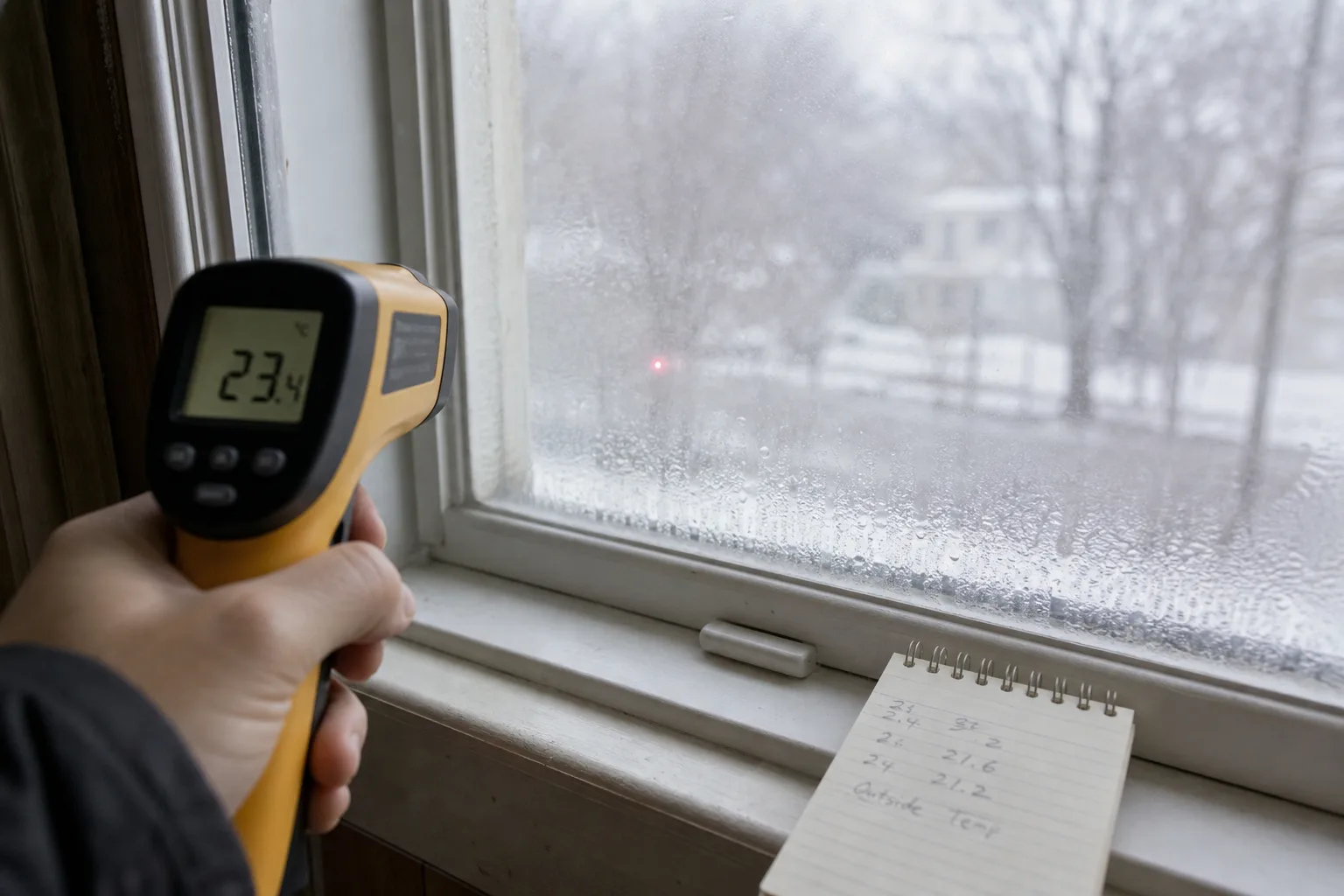
Glass at 20 degrees outside behaves very differently depending on what's in the unit. A single pane with a storm window over it might sit in the high 40s on the inside face. A decent double-glazed unit with a low-E coating in the same wall will sit closer to room temperature, often within ten or twelve degrees of it. That difference is the entire story, and you can collect it yourself with an infrared thermometer that costs less than a tank of gas.
Do it on a cold morning, before the sun hits the east side. Point it at the center of the glass, then at the frame, then at the wall next to the window. Write down all three for every window in the house. Take a photo of your thermostat's setpoint while you're at it, and note which rooms have doors that get closed and which have space heaters in them.
Why the surfaces matter: your body loses heat to cold surfaces by radiation regardless of what the air temperature is. A room at 70 with a wall of 45-degree glass feels like a room at 65. Most households solve that by turning the thermostat up two or three degrees, closing off the room, or plugging in a space heater. All three cost money, and none of them show up in a window quote. When the glass surface temperature comes up, the correction goes away, and the setpoint usually drifts back down without anyone deciding to do it.
That is the honest mechanism behind most reported savings. Not the U-factor arithmetic. The behavior change it permits.
What improves a lot, a little, and not at all
Having specified and walked a lot of these jobs, the pattern is consistent enough to put in a table.
| Outcome | How much double glazing moves it |
|---|---|
| Cold spots near windows, radiant discomfort | Large and immediate. Most noticeable in rooms people avoid in January. |
| Condensation on the interior glass and sill | Large. Warmer inner surface means the dew point is rarely reached, so the sill stops staying wet. |
| Drafts | Large, but credit goes mostly to the new frame and the sealing of the rough opening, not the second pane. |
| Street and traffic noise | Moderate. Depends on glass thickness, an unequal-thickness package, and the air gap. A standard replacement unit is not a sound job. |
| Summer heat gain on west and south glass | Moderate to large, but only if you specify the solar heat gain coefficient deliberately by elevation. |
| Total annual heating and cooling dollars | Real but usually modest, and easily swamped by attic insulation and air sealing done for a fraction of the price. |
| Fading of floors and furniture | Partial. Low-E coatings cut some ultraviolet, they do not eliminate it. |
The consequences people rarely trace back are in the middle of that list. Sills that stop staying wet stop growing mold and stop rotting, which ends a paint-and-patch cycle that was quietly costing a weekend every few years. Blinds that no longer need to stay shut against a cold pane change how much lighting gets used in the afternoon. Furniture gets moved back against outside walls. A bedroom that was unusable from December through February becomes a bedroom again, which is worth more per square foot than any fuel calculation.
The Department of Energy oversees efficiency standards and labeling for residential windows, and the performance numbers on the sticker are the ones to argue about with your contractor. Ask for the U-factor and the solar heat gain coefficient on the specific unit being quoted, not the product line.
Repair, insert, or full frame: three different jobs
People say "double glazing" and mean one of three transactions with very different price tags and very different failure modes.
Keep the sash, add a storm
On an old house with sound wood sashes, a tight, well-fitted exterior or interior storm window gets you a meaningful share of the surface-temperature gain for a small fraction of the cost. It also keeps the original glass and the original profiles, which matters if you're in a historic district where the review board has opinions. The drawback is honest: two things to clean, and storms that get left in the garage stop working.
Insert (pocket) replacement
The new unit drops into the existing frame. Faster, cheaper, no exterior trim disturbed, and no siding to repair. You lose an inch or so of glass area on each dimension, which you will notice on small windows and not on large ones. The critical limitation: if the existing frame is rotted or the original opening was never air-sealed, an insert seals the new unit into a bad frame and leaves the actual leak in place. That's the job that gets called back in year two.
Full-frame replacement
Everything comes out down to the rough opening. This is the only version that lets the crew see the sill pan, flash it properly, and foam the gap around the new unit. It is also the only version where the draft problem is genuinely addressed rather than covered. It costs more and it involves exterior and interior trim work. If your measurements showed the coldest reading at the frame or the wall beside the window rather than at the center of the glass, this is the conversation you should be having.
The glass package, decided elevation by elevation
Two panes of clear glass with air between them is not what anyone should be buying now. The specification that matters is the coating and the fill, and the right answer changes by which way the window faces.
- Low-E coating: a thin metallic layer that reflects long-wave heat back toward its source. Different formulations favor keeping heat in versus keeping solar gain out. Ask which one is being quoted.
- Argon or krypton fill: a measurable improvement over air, modest in absolute terms, cheap as an upgrade. Worth taking.
- Triple glazing: better numbers, heavier sash, higher cost per opening. In most of the country the money does better spent on full-frame installation of good double units than on triple units dropped into inserts.
- Solar heat gain: on south-facing glass in a cold climate, some winter gain is an asset. On west-facing glass in a hot climate it is the reason the living room is unbearable at five in the afternoon. One SHGC number for the whole house is a compromise nobody asked for.
Go around the house with a compass app and write the direction next to each opening on your list. It takes fifteen minutes and it turns a generic quote into a specified one.
What to have on the table before the first visit
Bring a list of every opening with its rough dimensions, its orientation, its current glass surface temperature on a cold morning, whether it opens and whether anyone actually opens it, and a photo of any condensation staining on the sill. Note which bedrooms need an egress-sized opening. Check whether an HOA or historic review controls exterior appearance, because that decision belongs at the start and not after the deposit. Add your last twelve months of utility bills, not to prove a payback but to establish the baseline you'll compare against honestly.
A contractor handed that folder can quote the job you actually have. Without it, you get a price for a product, and the product was never the part that decided how the house feels in February.