Legal Affairs — Field report TQL-LAW-556
Comparing Fee Agreements After a Truck Crash? Decide What the Percentage Is Measured Against
A contingency percentage means nothing until you know what it multiplies, who else gets paid out of it, and which costs sit outside the fee entirely.
Two firms quote you the same number. One says a third, the other says a third. Six months later those two agreements can produce settlement statements that differ by five figures on an identical recovery, and nothing in the quoted number told you that would happen. The percentage is the smallest part of the arithmetic. What it gets multiplied by, what gets subtracted before or after it, and who else has a claim on the same pot are the parts that decide what reaches you.
This matters more in commercial vehicle cases than almost anywhere else in personal injury, because the costs of building one are high, the opposing side is an organization with a defense budget, and the firms that handle them tend to be larger operations with multiple lawyers, staff, investigators and outside experts on the file. More moving parts means more places for money to leave.
Work out what the percentage multiplies before you argue about the percentage
A contingency fee is calculated against a recovery. The question is which recovery. In a gross-fee agreement, the fee comes off the total settlement before case costs are repaid. In a net-fee agreement, costs come out first and the fee applies to what remains. On a case with modest expenses the gap is small. On a case that required an accident reconstruction, a download of the truck's engine control module, a trucking safety expert and three out-of-state depositions, the gap is not small at all.
Then ask whether the percentage moves. Many agreements are tiered: one rate if the matter resolves before a lawsuit is filed, a higher rate after filing, a higher one still if the case is tried or appealed. That structure is normal and often reasonable. What you want is the trigger written plainly. "After suit is filed" and "after the case is set for trial" are different events, sometimes a year apart.
Ask the question in this form: on a hypothetical $300,000 recovery with $40,000 in costs, settled four months after filing, what is your fee, what are my costs, and what is my check? Any firm that handles these regularly can answer it on the spot. The answer is also a fair test of how clearly they explain things generally.
Treat case costs as a separate ledger with its own rules
Fees pay the lawyer. Costs pay everyone else, and in a trucking case the list runs long: crash reconstruction, electronic data retrieval from the tractor, driver qualification and hours-of-service record review, medical record retrieval and narrative reports, treating physician depositions, videographers, court reporters, filing fees, mediation. The Federal Motor Carrier Safety Administration is the agency responsible for the safety rules those records are measured against, and proving a violation usually means paying someone to analyze documents a defense firm would rather hand over slowly.
Three things to get in writing. First, who advances the costs and when. Most firms front them. Second, whether you owe repayment if the case loses or ends without a recovery. Many agreements waive that; some do not, and the difference belongs in the conversation, not in a surprise later. Third, whether the firm charges interest on advanced costs, and whether in-house items like mileage, copying, or an internal investigator's time are billed as costs on top of the fee.
Ask for a monthly or quarterly cost statement as a condition of signing. A firm running a real case file produces them without difficulty, and reading them keeps you from meeting the number for the first time on the settlement statement.
In a larger firm, ask who does the work and who else gets paid
You will often meet an intake coordinator first, then a signing attorney, then at some point a different lawyer who actually takes the depositions. That division of labor is how a firm absorbs the cost of a case that may run two years, and it is usually a strength. But you are entitled to know the structure before you commit. Ask who your day-to-day contact is, which attorney will appear at a mediation, who makes the decision to reject an offer, and what happens if that person leaves.
Then ask about fee splitting. If a local attorney refers your matter to a specialist truck accident lawyer at another firm, the two may share the fee, and the agreement should say so and say that the split does not increase your total. Written client consent to the arrangement is standard practice. The thing to confirm is that the division is between them rather than added to you.
One more question that sorts quickly: how many commercial vehicle cases does this office have open right now, and does it have staff who deal only with carriers and their insurers? You are not looking for a big number. You are looking for an answer given without hesitation.
Gather these six things before the first conversation
The quote you receive tracks the information you bring. Walk in with the crash report number and the investigating agency, the name of the carrier printed on the tractor and trailer and the USDOT number if you photographed it, your own auto policy including medical payments and underinsured motorist limits, the names of every provider you have seen with dates, any health insurance or government benefit plan that paid a bill (those plans assert liens, and liens come out of your share), and a plain written timeline of days missed from work.
The lien list matters more than people expect. A health plan's repayment claim is settled out of the recovery, and whether your lawyer negotiates it down, charges separately for doing so, or treats it as part of the base fee changes what you keep. Ask directly how lien resolution is handled and whether it is included.
Put the two agreements side by side on one page
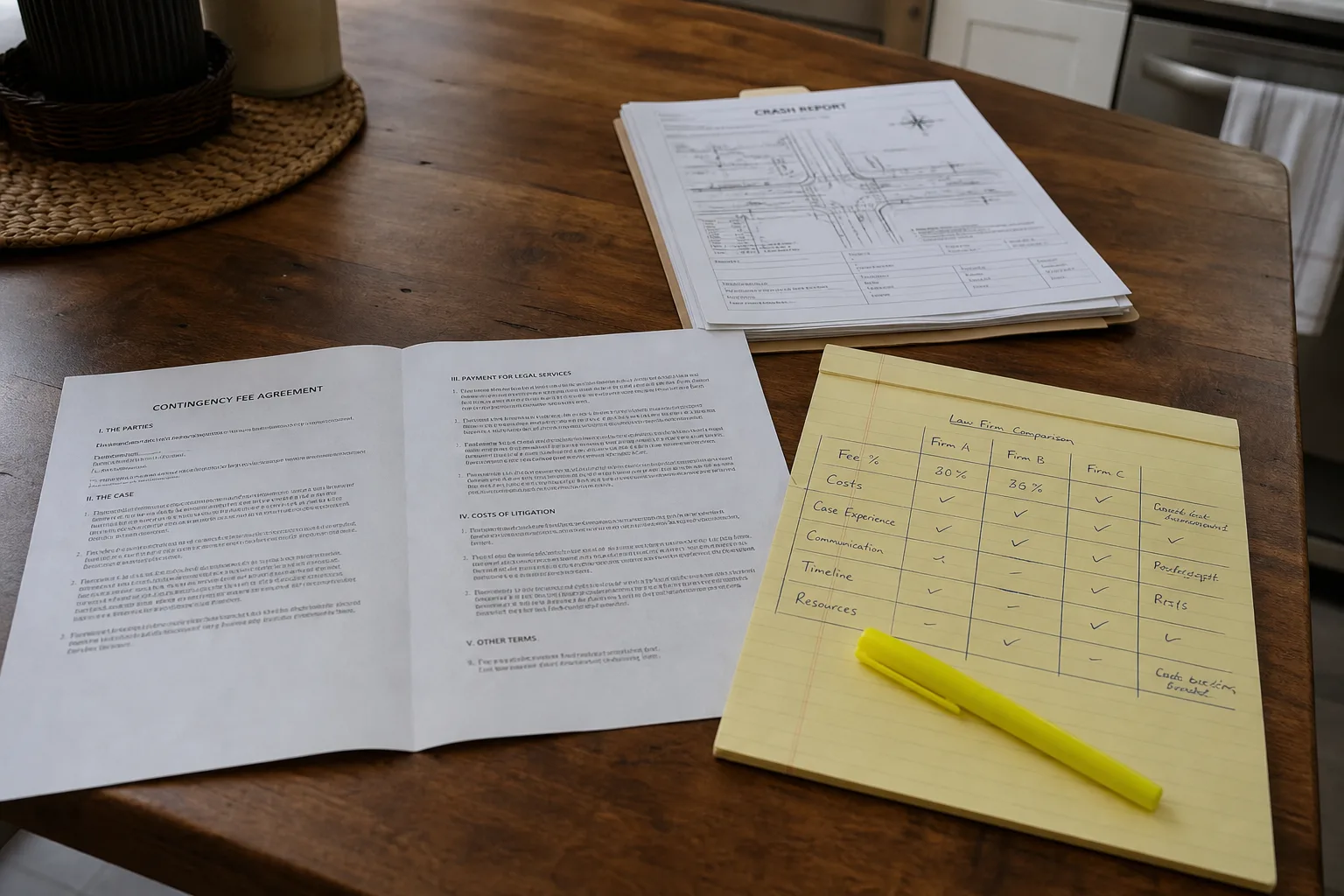
Build a short table yourself: fee percentage at each stage, gross or net, who advances costs, repayment if the case loses, interest on costs, lien negotiation included or not, named attorney, fee split disclosed. Fill it in from each firm's actual written agreement rather than from what was said in the meeting. The page will show you, in about ten minutes, which offer is genuinely better and which only sounded better.
A firm that answers all of it in writing, on request, before you sign, has told you something useful about how it will communicate for the next two years. That is worth as much as the number.