Education — Field report TQL-EDU-226
Comparing Training Programs? The Placement Partner Decides More Than the Tuition Line
Tuition is the number people compare. The site that supplies your clinical or externship hours is the one that decides how long the whole thing actually takes.
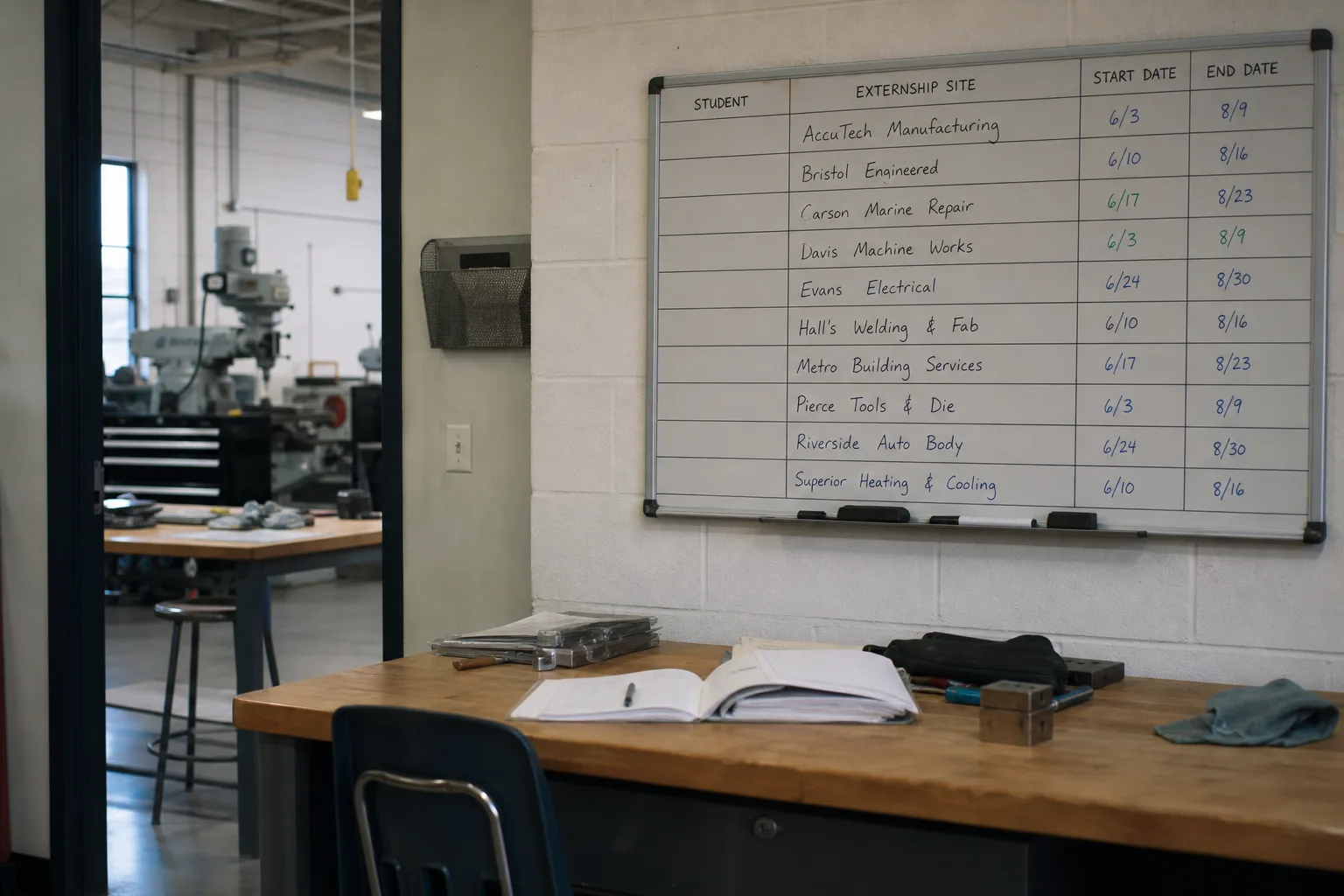
Two programs advertise the same credential. One costs a few thousand dollars more. Almost everyone picks by that gap, and almost everyone is comparing the wrong line. The number that ends up governing what the route costs you is not tuition. It's how many months pass between your last classroom day and the day a licensing board, a registrar, or a hiring manager accepts that you're done. That gap is controlled by a party most applicants never speak to before they enroll: the employer, clinic, shop, or agency that hosts your required hours.
Schools sell the classroom. The classroom is the part they fully control. The placement is the part they negotiate, and negotiation is where good programs and barely adequate ones separate.
Find out who actually holds the seats
Most hands-on credentials require supervised hours somewhere real. Clinical rotations, externships, preceptorships, on-the-job training under a journey-level worker. Programs handle this in one of three ways, and they rarely volunteer which one applies.
- The school holds contracted seats. There is a written agreement with named sites, a set number of slots per cohort, and a coordinator whose job is filling them. You get assigned.
- The school maintains a list. You call the sites yourself. The list may be four years old. Some sites on it stopped taking students during a staffing crunch and never told anyone.
- You're on your own. The catalog says students are "responsible for securing" their hours. That sentence is doing an enormous amount of work.
Ask which one it is in those terms, and ask for the count: how many students in the last graduating cohort, how many contracted seats, how many students had to find their own. A program running the first model will answer in about ten seconds because someone tracks it. A program running the third will reframe the question.
The U.S. Department of Labor oversees registered apprenticeship, and one of the structural reasons that route behaves differently is that the employer is a party to the arrangement from day one rather than a favor you go looking for at the end. You don't have to choose apprenticeship to borrow the standard. You just have to ask whether the employer side of your route is contracted or hypothetical.
Price the waiting, because nobody else will
Here is the arithmetic almost no admissions conversation walks through. Suppose your route finishes coursework in the spring, and placement takes four months longer than the brochure implies. What does that cost?
Start with wages you don't earn at the credentialed rate. That's the biggest number and the easiest to skip, because it never appears on a statement. Then add the parts that do show up:
- Loan interest that keeps accruing, and in some cases a grace period that expires while you're still waiting.
- Continued enrollment fees, if the school requires you to stay registered to keep the placement coordinator's attention.
- Background checks, drug screens, immunization records, and liability coverage that expire on a clock and get repurchased.
- Exam eligibility windows. Some boards require you to test within a set period after completing training. Miss it and you retake something.
- The current job you kept or quit. Quitting early to be available for a rotation that hasn't been scheduled is a common and expensive mistake.
Run those against the tuition difference between the two programs you're comparing. In a lot of cases the cheaper program with vague placement is more expensive by the second month of waiting.
Talk to the site, not just the school
You can verify most of this in an afternoon. Get two or three site names from the school's list. Call them. Ask the person who supervises students, not the front desk:
- Do you currently take students from this program, and how many per year?
- What's the wait from request to start?
- Do you ever hire out of the students you host?
- What makes a student easy for you to say yes to?
That last question is the one that pays. Sites have preferences: a specific software they want you to have touched, a shift pattern, a certification they'd rather you already hold. Hearing it before you enroll lets you arrive as the applicant they take first. It also tells you whether the school prepares people to that standard or hands the site a stranger.
If the site says they've hired several graduates from your program, you've found something better than a job placement statistic. You've found an employer who already trusts the training.
Look at the route three years out
The credential is not the finish line, it's the start of a maintenance schedule. Continuing education hours, renewal fees, and in some fields supervised practice that continues past licensure. Ask what renewal costs and who typically pays it. In fields where employers routinely cover continuing education and exam fees, the employer is again the overlooked party, and picking a route with strong employer relationships means walking into a job where those recurring costs land on someone else's budget.
Programs that are genuinely good at this will tell you which local employers reimburse, because their graduates report back. That flow of information is itself the signal. A school connected enough to know what regional employers pay for is a school whose placement calls get returned.
The comparison that matters isn't two tuition figures side by side. It's the full path from your first payment to your first credentialed paycheck, with the host site drawn in as the third party it always was. Ask about it before you sign, and the route you pick will be the one that finishes on schedule.