House & Home — Field report TQL-HOM-375
Dry to the Touch in Three Days? Why a Frozen Pipe Needs a Meter
Surfaces dry fast because air moves across them. Assemblies dry slowly, from the inside out, and the difference is a number nobody measured.
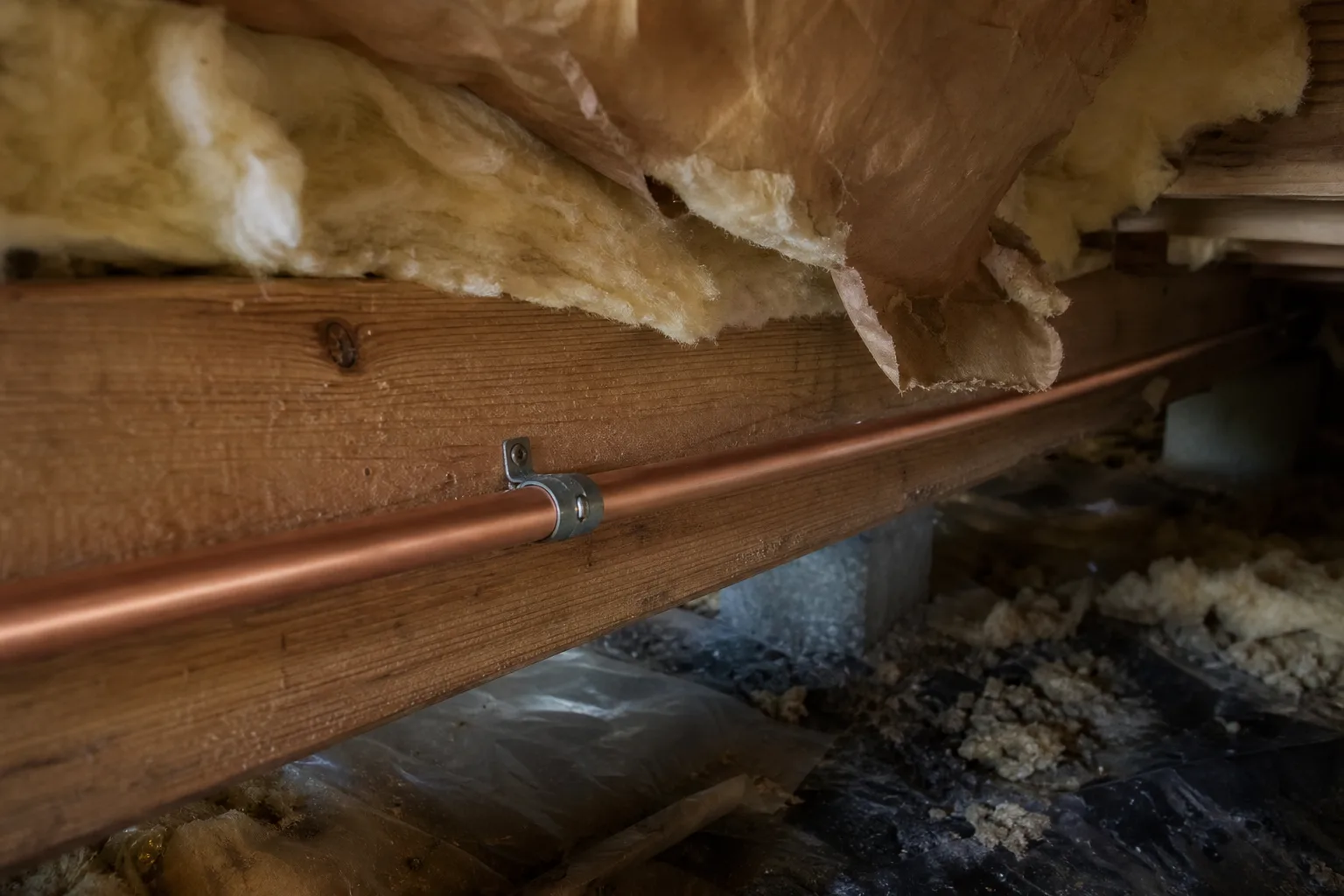
Picture the ceiling of a first floor hallway three days after a supply line let go upstairs, with two fans still humming, the drywall patched and repainted and everything completely dry to the touch. That is where a great many frozen pipe repairs stop, and it is also the point at which the expensive version of the same problem begins. Surfaces dry quickly because air moves across them. Assemblies dry slowly, from the inside outward, and the difference between a building that is dry and a building that looks dry is a number that nobody in that hallway has measured.
What a Burst Line Does Between the Ceiling and the Floor
A supply line under pressure does not leak, it delivers, and a half inch line that opens at a split seam moves a remarkable volume of water in the hour before somebody finds the shutoff. Most of that water never appears in the room where the pipe is. It runs along the top plate, drops into the stud bays, saturates the bottom of the insulation, soaks into the sole plate and the subfloor, and spreads sideways under flooring to places the ceiling stain never suggested. By the time it shows up as a wet patch on a ceiling below, the assembly holding it has been wet for a while and across a wider area than anyone would guess from the visible mark.
Why Air Movement Finishes the Surface Long Before the Cavity
Drying is evaporation, and evaporation happens at surfaces, which is why fans and dehumidifiers work and why they work unevenly. Painted drywall gives up its moisture to moving air within a day or two, and the paint film itself slows the passage of vapor from behind. So the face of a wall can read as finished while the back of the same sheet is still holding water.
Framing lumber is slower still. Dimensional lumber holds moisture deep in the grain and releases it over weeks rather than days, and a stud that measures acceptably on its face can be considerably wetter an inch in. This is why restoration work is supposed to include drilling holes, lifting a base trim, pulling a section of insulation or setting up injection drying rather than simply pointing equipment at a room. Air blown across a closed cavity dries the paint on the outside of the problem and very little else.
The Reading That Should Have Been Taken Before the Fans Left
A moisture meter puts a number on all of this, and the number matters less on its own than in comparison. A pin meter reads the resistance between two probes driven into the material, giving a moisture content percentage for wood, while a pinless meter reads dielectric properties through a surface without leaving holes. Neither gives a verdict by itself. What gives a verdict is a dry standard, a reading taken from the same material in an unaffected part of the house, so that a stud in the wet wall can be compared against a stud that was never involved.
Indoor moisture problems are the reason the Environmental Protection Agency keeps guidance on mold in buildings at all, and that guidance exists precisely because the interval between a wet assembly and a visible one is long enough for people to consider a job finished. What a homeowner should ask for is simple and rarely refused: the daily readings, the locations they were taken from, the dry standard they were compared against, and a final set showing the wet materials matching the unaffected ones. A restoration contractor doing this properly already keeps that log, since it is how they know when to stop paying for equipment rental.
What Fast Drying Costs Eighteen Months Later
A cavity that was closed up while still wet does not announce itself in the spring. It shows up later as a musty smell in one room that comes and goes with humidity. As a nail head telegraphing through paint where a stud moved. As a section of baseboard that no longer sits flat, or staining that reappears in the same place after two coats of primer. By then the repair is a second demolition of work that was already paid for once, and the claim on it is far harder, because a carrier who paid to dry a house in January is entitled to ask why it was signed off as dry.
Why the Number Beats the Fan Count
Speed is not the enemy here, and there is nothing wrong with a contractor who dries a house quickly. What matters is what closes the job. Equipment coming out on day three because the schedule says so is a different decision from equipment coming out on day three because the readings match the dry standard, even though the two look identical from the hallway.
That hallway ceiling, patched and repainted and cool to the touch, is genuinely finished if somebody wrote down what the framing behind it was reading that morning. If nobody did, it is a repair with an open question inside it, and the question will be answered eventually by weather rather than by choice. Frozen pipe season produces a great many of these, and the households that come through without a second round are rarely the ones with the most fans in the room. They are the ones who asked what the meter said before anybody loaded the truck.