House & Home — Field report TQL-HOM-635
Landscaping a Sloped Yard? The Water Path Decides What's Standing in Three Years
Most of the garden problems people blame on plants, patios or pests are water problems, and the rules that govern the fix change from one city to the next.
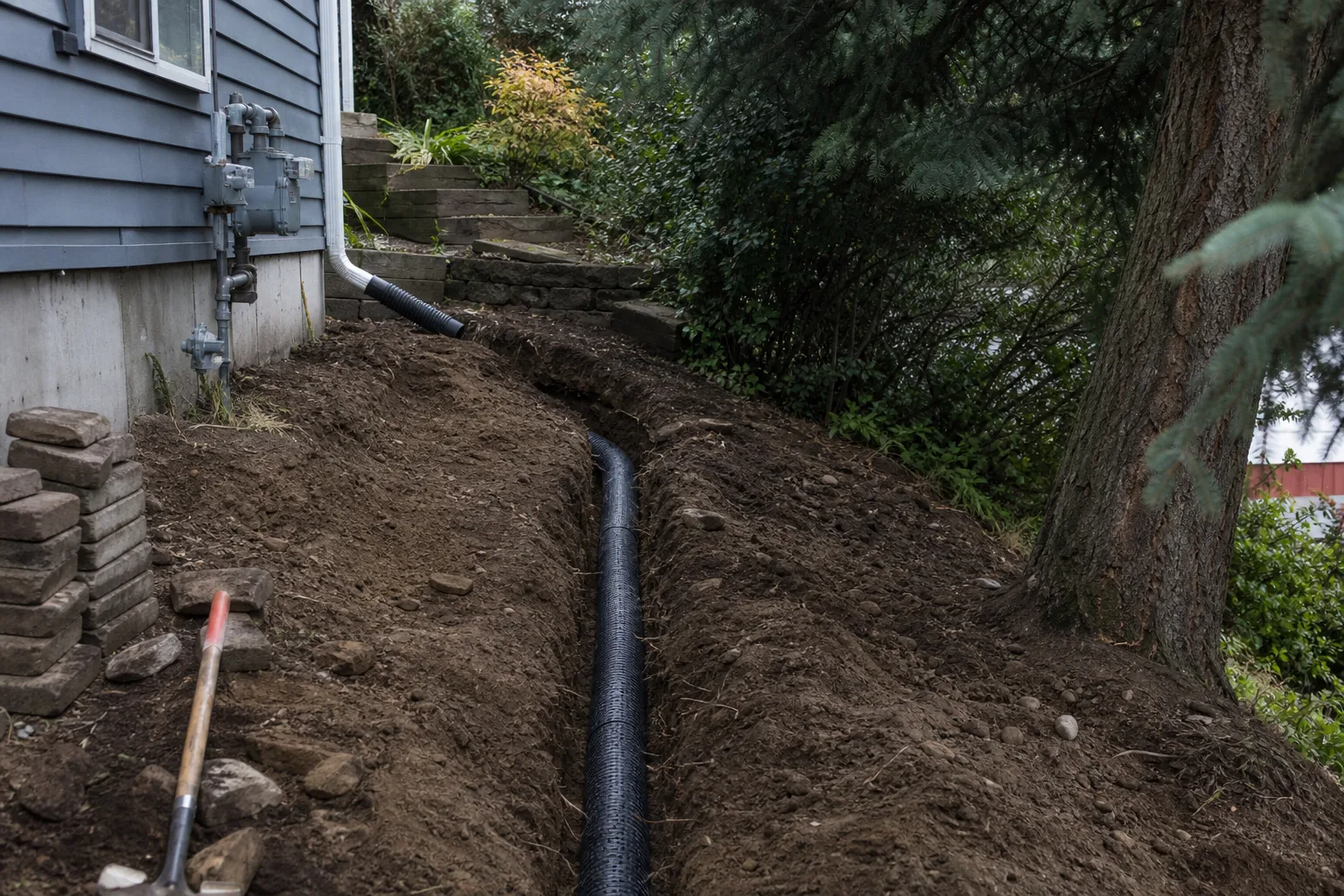
The bill for bad drainage almost never arrives labeled as drainage. It arrives as a replacement shrub, a re-leveled paver patio, a fence post that snapped at grade, a mosquito problem in July, a sump pump running in a month with no rain. Homeowners pay each of those separately, a few hundred dollars at a time, and rarely connect them. Three years in, the sum of those small invoices often exceeds what a single grading and conveyance job would have cost before the first plant went in the ground.
That is the practical argument for handling water first. Not because drainage is more interesting than planting, but because it is the only part of a yard that is expensive to retrofit. You can move a plant. You can restain a deck. You cannot easily change the slope under a 400 square foot patio you already paid for.
The consequences people bill to something else
Start with plants, because they are the most common casualty and the most misread. A shrub sitting in soil that stays saturated for days does not look drowned. It looks like it needs water. The leaves yellow, the growth stalls, and the owner responds by irrigating more, which finishes the job. Replacing five shrubs a year for three years is a real number, and it repeats until the water path changes.
Then hardscape. Pavers and flagstone move when the base under them cycles between wet and dry, or wet and frozen. A patio that was flat in year one and has a lip at the door threshold in year three is usually telling you where water sits. Re-setting a section is labor, and labor on a small repair job carries a minimum charge that makes it disproportionately expensive.
Then the things that look unrelated. Carpenter ants and termites are drawn to wet wood, so a downspout dumping beside a deck ledger becomes a pest control contract. Standing water for more than about a week becomes a mosquito nursery. Persistent moisture against a foundation becomes efflorescence inside, then a dehumidifier running continuously, then a line item on your electric bill you never itemize. Wood fence posts fail at the soil line, not in the middle, and they fail first on the low side of the yard.
None of these are dramatic. That is exactly why they get deferred, and deferral is where the money goes.
The same yard, different rules, different fix
Where you live changes the correct answer more than most people expect, and it changes the paperwork even more.
In much of the Pacific Northwest and the upper Midwest, the constraint is volume over a long wet season and limits on how much of your lot you may cover with hard surface. Add a patio, a driveway extension and a shed, and you can trip a local impervious surface threshold that requires you to keep the runoff on site: a dry well, an infiltration trench, a rain garden sized to your soil. In parts of the Southwest, on-site retention is the default expectation and the sizing is driven by short, violent storms rather than steady drizzle. In Florida and along the Gulf, the water table can sit close enough to the surface that infiltration is not a realistic strategy at all, so the design shifts to surface conveyance and elevation. On expansive clay soils in Texas and Oklahoma, the entire point of the drainage plan is to keep moisture content around the foundation as steady as possible, which means the sin is not just wet soil but soil that swings from soaked to bone dry.
The legal layer varies too. States divide roughly between the common enemy rule, which gives an owner wide latitude to shed water off their land, and the civil law rule, which holds you liable for changing the natural flow onto a neighbor. Many places apply a reasonableness test somewhere in between. Practically, this determines whether your solution can end at the property line or has to end at a street inlet, a curb drain, or an approved on-site facility. The Environmental Protection Agency oversees the stormwater permitting framework that municipalities operate under, which is why the rule you actually live with is written by your city or county rather than by anyone federal. Two towns fifteen minutes apart can reach different conclusions about the same dry well.
Trees are part of the water budget, not just the view
A mature conifer moves a large volume of water out of the soil during the growing season and intercepts a meaningful share of rainfall before it ever reaches the ground. Take it down and the yard behind it gets wetter, sometimes noticeably so in the first full wet season. People who remove a tree to make room for a patio, then find the patio base staying soft, are usually looking at that shift and blaming the installer.
The rules around trees are among the most local rules in landscaping. Many cities in the West protect trees above a certain trunk diameter, designate certain species as exceptional, and require a permit, an arborist report, or replacement planting before removal. That is why homeowners researching tree removal in seattle often find the ordinance question settled before the price question, and why a bid that includes permitting and a certified arborist's assessment is not comparable to one that does not.
Two follow-on costs are worth planning for. Root systems decay over several years and leave voids, so soil above them settles. If you set hardscape over a removal area too soon, you inherit that settlement. And the stump grinding decision matters: grindings left in place decompose, hold water differently than native soil, and are a poor base for anything structural.
Sequencing that keeps money from being spent twice
The order that holds up over time is straightforward. Establish where water arrives, where it currently goes, and where it is permitted to go. Fix the roof-to-ground path and the grade away from the house. Install any subsurface conveyance or retention while the yard is already open and a machine is already on site. Then set hardscape. Then plant, choosing species that match the moisture conditions you have created rather than the ones you wish you had.
The cost argument for that order is mobilization. Excavation equipment, spoil hauling and site access are a large share of a drainage job, and you pay for them once if the work is bundled and twice if it is not. Trenching a line under an existing patio means demolition, disposal and rebuild on top of the trenching itself.
Ask for the water plan in writing before you approve the planting plan: where each downspout terminates, what the finished slope is in the first ten feet from the foundation, what the receiving point is, and which permit or approval covers it. A contractor who can answer those four questions cleanly is quoting a yard that still works in year five.
Decoration is the part you see and the part that is cheap to change later. Water movement is the part you do not see and the part that sets the maintenance bill for as long as you own the place. Spend on it in the right order and the garden you designed is the garden you still have.