Corporate — Field report TQL-BUS-233
Hiring Someone to Write the Speech? What the Scope Has to Settle Before the First Draft
A speech contract that names deliverables but not access, approvals, or ownership will cost you again in eighteen months. Here is what to settle before anyone starts drafting.
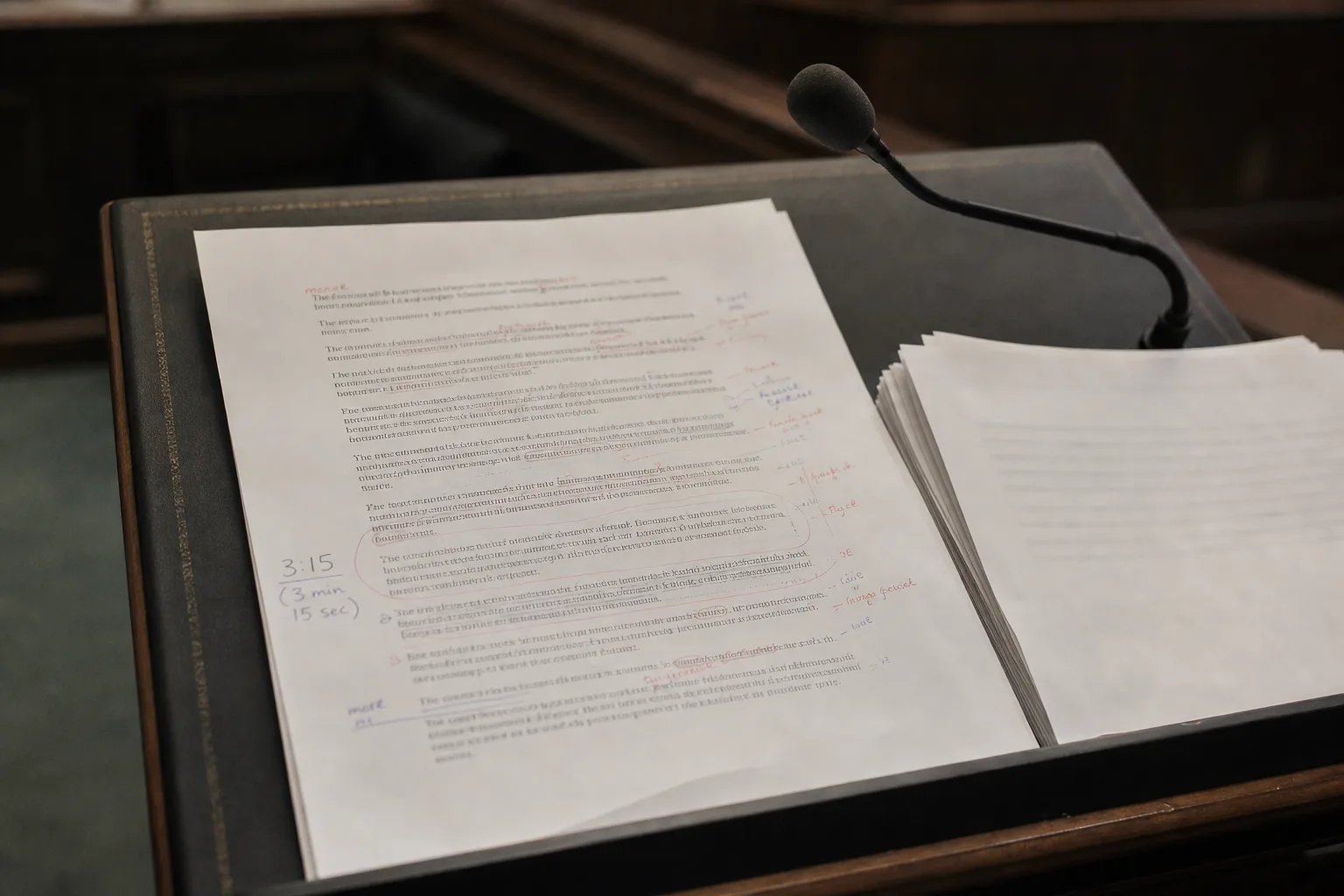
The invoice for a written speech is usually the smallest number in the whole exercise. The expensive part is the twelve hours of executive time, the three rounds of internal review, the rehearsal that gets scheduled at 7 a.m. because nobody blocked the calendar earlier, and the version-control mess that follows when four people are editing the same file. All of that is decided by the scope of work, and most scopes of work are two paragraphs long.
A barely adequate scope names a deliverable and a fee. A good one names the deliverable, the fee, the access required to produce it, who is allowed to say yes, and what happens to the text after the event. Those last three are where the money leaks, and they leak slowly enough that nobody connects the leak to the contract.
Name the deliverable in units the writer can actually count
"A twenty-minute keynote" is not a deliverable. It is a duration. Two writers will read it two different ways and both will be reasonable.
Write it down in countable units: target word count or spoken minutes at a stated pace, number of drafts included, number of revision rounds after each draft, and what a revision round means. A round is not one person's comment arriving on a Thursday. A round is one consolidated set of edits from one named person, delivered once. If your organization cannot consolidate, say so in the scope and price it accordingly, because the writer will be absorbing three review cycles at the price of one and will either eat the loss or quietly stop taking your calls.
Include the ancillary items explicitly if you want them: speaker notes, a shortened five-minute version for a press availability, a set of pull quotes for the communications team, a Q and A prep sheet with likely hostile questions. Each of those is real work. Each of them will be requested at some point during the week of the event. Deciding now whether they are in scope costs you one sentence. Deciding during the week of the event costs you goodwill and a change order.
The person who has to say it out loud is a party to this deal
Here is the party nearly every scope of work leaves out. The buyer is often a chief of staff, a communications director, or an event lead. The writer is the vendor. And the speaker, the one human being who will stand at a podium and put their name on every sentence, appears nowhere in the agreement except as a subject.
That omission is the single most reliable predictor of a bad outcome. A speech written from a briefing document and approved by a committee will be technically competent and sound like nobody. The speaker will feel it in rehearsal, panic on Tuesday, and rewrite it themselves on Wednesday night. You will have paid for a draft that functioned as an expensive outline.
So put the speaker in the scope. Specifically:
- A named block of speaker time. Two conversations minimum: one early interview of forty-five to sixty minutes, and one read-through after the second draft. Put the durations in the document and get them on the calendar before the contract is signed.
- Voice material. Recordings of the speaker talking unscripted, not their last three approved speeches. Approved speeches are a record of what the review committee permitted, not of how the person actually speaks.
- A stated position on stories. Whether the speaker is willing to use personal anecdote, and what is off limits. A writer who learns on draft three that the family material is forbidden has lost a week.
- Who reads the draft aloud, and when. Text that scans fine on a page can be unsayable. The rehearsal read is a deliverable step, not a courtesy.
Good agencies that place speech writers will insist on this access before quoting, and that insistence is a quality signal rather than an inconvenience. A writer who is content to work entirely from a brief is telling you what they intend to produce.
Say who can approve, and when approval closes
Scope creep in written work almost never arrives as a request for more pages. It arrives as an additional reviewer.
Name the approver. One person, by title, with a named backup. Everyone else contributes comments to that person and does not communicate with the writer directly. Then set a content freeze: a date after which changes are limited to factual corrections and legal edits. Put the date in the contract, not in an email.
Also decide what happens if the event moves or is canceled. A kill fee tied to the stage of work (say, a percentage on signature, more after first draft, full fee after content freeze) settles in advance a conversation that is unpleasant to have under pressure. Postponement is the more common case and deserves its own line: is the fee re-earned if the speech has to be substantially rewritten for a different room three months later?
Decide who owns the words, because you will want them again
This is the clause that pays you back years out. Work made by an independent contractor does not automatically belong to the buyer, and the U.S. Copyright Office is the federal body responsible for registration and for the rules that govern authorship claims. If you want unrestricted rights to reuse, adapt, and republish the text, the scope has to say so in plain terms.
Then think about the tail. Three years from now you will want the passage about why the company entered that market, or the framing the board responded to, and it will be somewhere in an email thread with a subject line nobody remembers. A scope that requires the writer to hand back a clean final file, an annotated source list, and a plain-text archive copy turns a one-off purchase into a reusable asset. That is the difference between paying for a speech and building a house style you can draw on.
Confidentiality belongs in the same section. Whether the writer may list you as a client, and in what terms, is easier to agree now than to argue about after they post the case study.
Price the access, not just the pages
Once the scope names speaker time, rehearsal, revision limits and ownership, the quote you receive means something. Two bids on a vague brief are not comparable at any price. Two bids on a specific one are, and the cheaper bid stops looking cheap the moment you notice it excludes the read-through.
Budget the internal hours too. Executive interview time, reviewer time, rehearsal time: that is the real cost of the speech, and it is largely fixed. What the scope controls is how much of it gets spent twice.
Draft the scope, send it to the speaker before you send it to the writer, and see whether they recognize the process they are being signed up for. If they do, you have already bought the better outcome.