House & Home — Field report TQL-HOM-402
Four Years of Entries, One House: Which Upkeep Jobs Were Worth Paying Somebody For
The owner started keeping a log because of an argument about the gutters. Four years later it held about ninety entries and a clear pattern.
The owner of a fifty year old single story house started keeping a log because of an argument about the gutters. Four years later it held around ninety entries, each carrying the date, the task, whether it was done in house or hired out, what it cost, and one line on how it went. The pattern that came out of it had almost nothing to do with difficulty, which is what everybody assumes the question turns on. It had to do with three other things entirely, and none of them are obvious until a few years of entries are sitting next to each other.
Year One, When Almost Nothing Was Hired Out
The first year ran on the reasonable theory that labor is the expensive part, so nearly everything was self performed: gutters, filters, caulking, a fence repair, painting the shed, servicing the mower, clearing the dryer vent, replacing a wax ring on a toilet. Most of it worked exactly as intended and cost a fraction of what a crew would have charged, which is the outcome that keeps people doing their own maintenance and is worth saying before anything else. Two jobs did not work, and both failures turned out to be more instructive than the eighty that did.
The exterior caulking around the windows on the sun facing wall was done with the wrong product, an interior grade acrylic that looked entirely correct on the day and cracked out within eighteen months. The mistake was not a question of skill, since applying caulk is not difficult. It was not knowing that the product mattered, which is the sort of thing a person learns by having chosen wrong once and rarely any other way.
The Mower Service, and the First Entry That Said Not Worth It
The second failure was subtler because nothing went wrong. The mower service was performed correctly and took four hours across two evenings, including a trip out for parts, and the shop turned out to charge less than the owner had assumed and would have finished it inside a day. That became the first entry in the log where the note simply read that this was not worth doing, and it opened up a category the owner had not been tracking at all: jobs that are perfectly within reach and still cost more in hours than they save in dollars.
Year Two, and the Service Call That Changed the Rule
The second year the heating and cooling service, the chimney inspection and the tree work over the roof were all hired out, while everything routine stayed in house. The heating and cooling visit produced the entry that reshaped the whole approach, because the technician found a cracked condensate drain pan and a capacitor reading well out of tolerance, neither of which the owner would have thought to look at and both of which were inexpensive to correct at that stage.
That is the first real category, and it is the one most households cut first when money is tight. These are jobs where the value being bought is the inspection rather than the labor. Servicing a furnace is not hard work. Knowing what a marginal reading means, having seen a thousand of them, is not something a homeowner acquires by doing their own annual service, and it is the thing that catches problems while they are still cheap to fix rather than after they have taken something else with them.
Year Three, and the Ladder
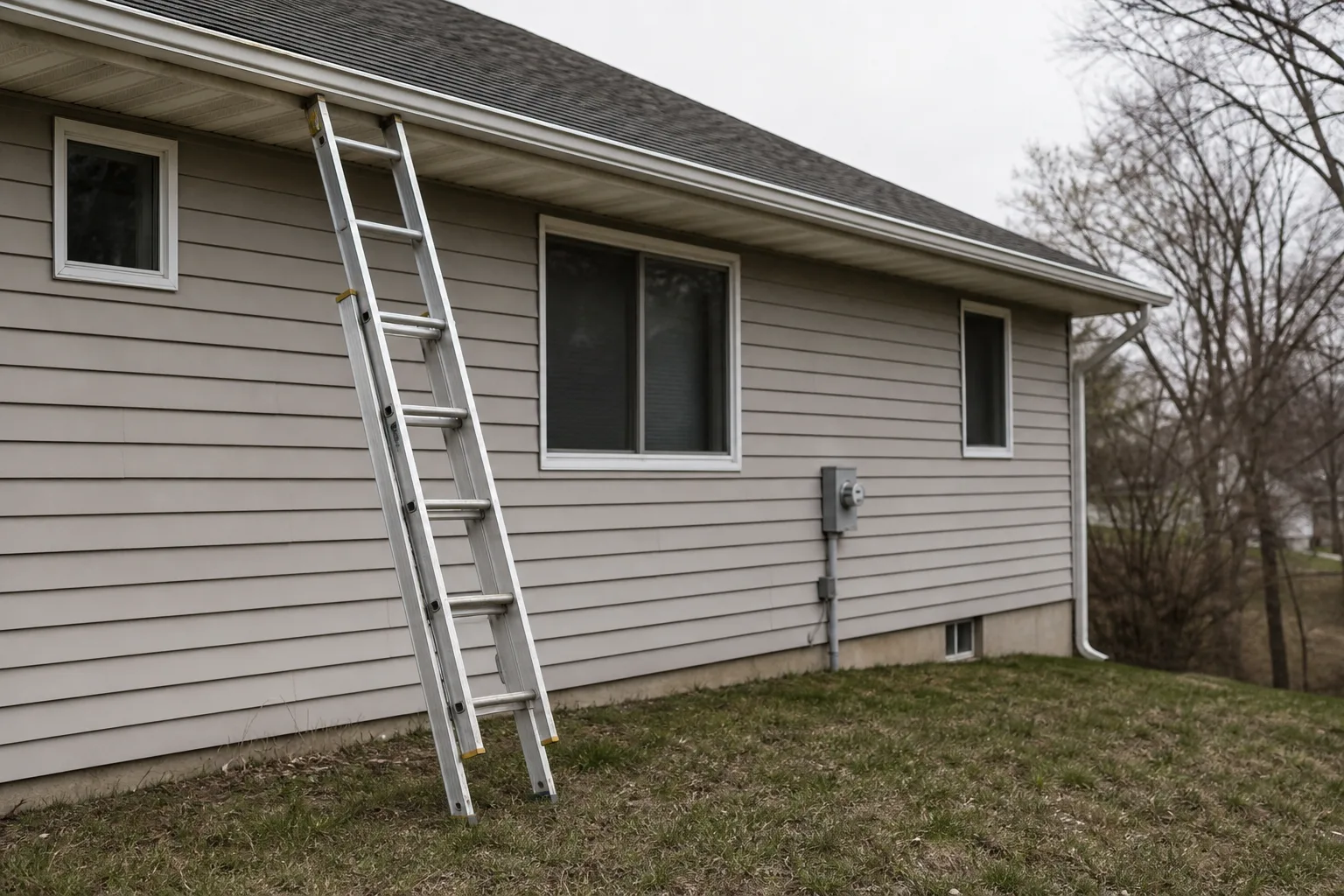
Year three included a fall, not a serious one, and serious enough to reset the arithmetic permanently. The owner had been clearing the gutters at the back of the house, which sits above a sloped yard, so the ladder foot stands on ground that is not level and the drop is longer than at the front. Nothing was broken. The log entry for that day is longer than any other entry in four years.
From then on the rule was that anything requiring a ladder over ten feet, or footing that is not flat, gets hired out regardless of how simple the task itself is. The front gutters, reachable from a short ladder on a flat driveway, stayed in house. The back gutters went to a crew. That is the second category: jobs where the failure mode is the person rather than the house, which covers roof work, tall ladders, steep pitches, anything inside an electrical panel and anything involving gas. Unlike most maintenance decisions, this one does not get cheaper with experience.
Year Four, When the Log Was Long Enough to Sort
By the fourth year the entries could be grouped, and three categories accounted for nearly every job worth paying for. Buying an inspection, meaning the annual heating and cooling service, the chimney, a sewer line camera before a suspected problem and a roof look after hail. Buying safety, on the terms set the previous year. And buying speed on something with a deadline attached, such as a failed water heater on a Friday or a leak that is actively running, where the hourly rate stops mattering because the alternative is damage accumulating by the hour.
The Column That Never Appears in a Ledger
The jobs that stayed in house shared a shape too: repeatable, low consequence if done imperfectly, needing no specialized tool and reachable without a ladder. Filters, front gutters, caulk on the low windows with the right product this time, detector batteries, the dryer vent, a few gallons drained off the water heater, the coils on the outdoor condenser. Across four years the self performed work produced two mistakes, both from not knowing a material or a specification rather than from lacking skill, and one of them cost more to redo than hiring it would have cost in the first place.
There is a third column nobody puts in a ledger, and the owner mentions it without being asked. Doing the routine work yourself means walking the property regularly with a reason to look closely at it. The cracked condensate pan was found by a technician. A wasp nest starting in a soffit vent, a section of siding that had come loose and a hose bib dripping inside a wall were all found by an owner who happened to be up a ladder for something else entirely. Hiring everything out removes that habit of looking, and nothing in any quote prices it.
The current arrangement is nine tasks in house on a written seasonal schedule, four annual services hired out, and a standing rule about ladders, which comes to roughly fourteen hours a year spread thin and four appointments booked in the same week each January. What a log really does is convert a hundred separate judgment calls into a policy. Once you can see that everything you regretted doing yourself involved either a ladder or a product specification you did not know about, the rule writes itself, and the argument about the gutters does not need having again.